In brief
The 5% dividend treaty tier uses a 25% holding and a 12-month test. Article 11 has separate public-financing exemptions, and Article 28 refers refund claims to the source state’s filing deadline.
The Saudi–Italy Double Taxation Convention uses the date of the dividend decision for its lower dividend ceiling. A payer reviewing a distribution should check the shareholding history and the decision authorising the distribution, then compare the treaty ceiling with the applicable Saudi domestic withholding rate.
| Payment | Treaty provision | Source-tax ceiling |
|---|---|---|
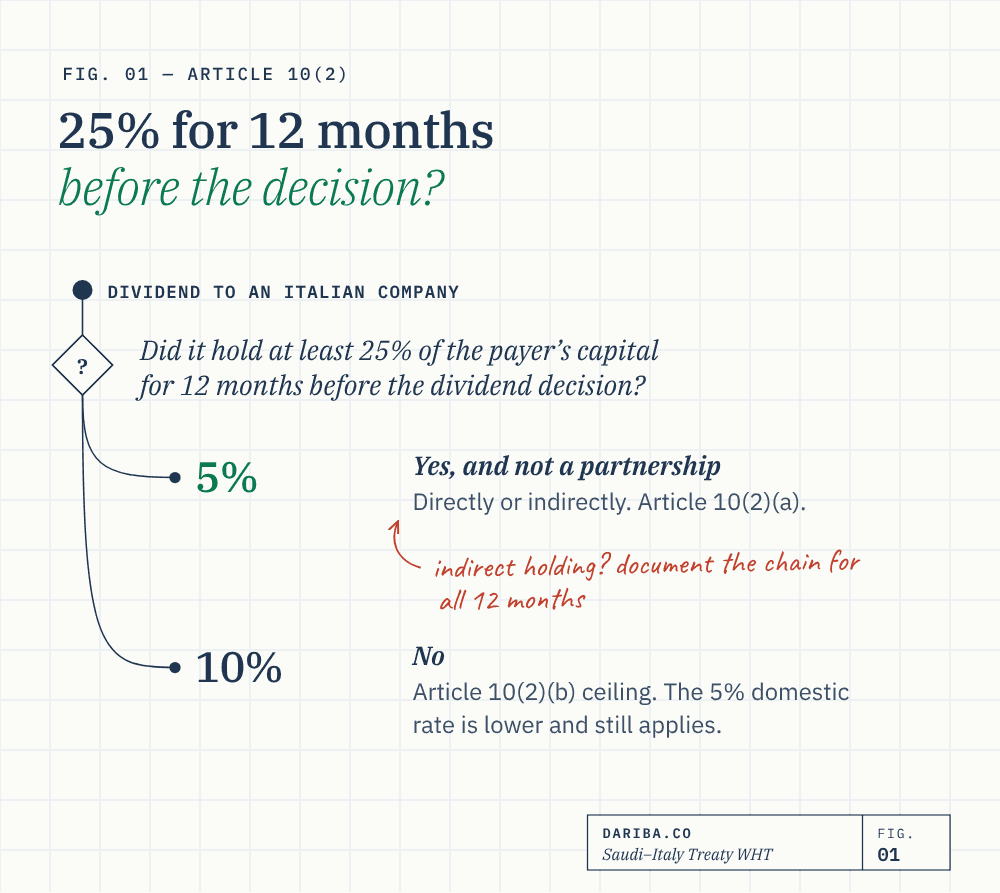
| Dividend to a qualifying company other than a partnership that held at least 25% of the payer’s capital, directly or indirectly, for at least 12 months before the dividend decision | Article 10(2)(a) | 5% of gross dividends |
| Other qualifying dividend | Article 10(2)(b) | 10% of gross dividends |
| Ordinary qualifying debt-claim income | Article 11(2) | 5% of gross income |
| Qualifying royalty | Article 12(2) | 10% of gross royalties |
The ordinary Saudi domestic dividend rate is 5%. A shareholder falling in the 10% treaty tier therefore still uses the lower domestic rate where it applies. For an indirect holding, document the ownership chain and how it changed throughout the 12 months. Article 10(4) separately addresses an effectively connected permanent establishment or fixed base.
Identify the relevant financing exemption
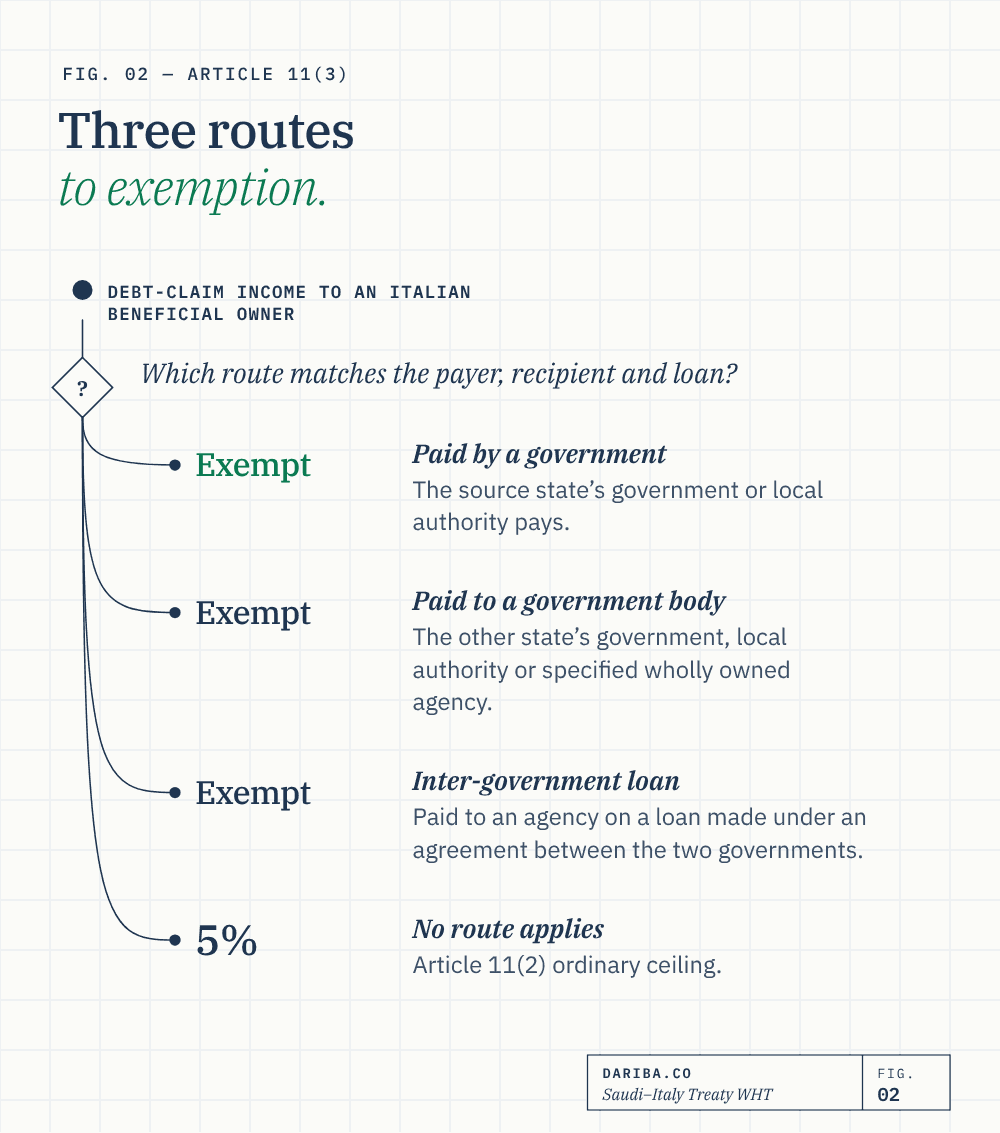
Article 11(3) has three routes. It covers income paid by the source state’s government or local authority, income paid to the other state’s government or local authority or the specified wholly owned agency or instrumentality, and income paid to an agency or instrumentality on a loan made under an agreement between the two governments. Identify the specific route and obtain the ownership or intergovernmental financing evidence it calls for. Article 11(5) expressly reaches paragraphs 1 to 3 when the debt is effectively connected to the stated permanent establishment or fixed base.
Additional Protocol paragraph 8 excludes late-payment penalties from the debt-income definition. Review the actual fee, loan and payment terms before classifying other financing charges. Article 12(3) includes specified intellectual property, know-how and equipment rights. Confirm the character and allocation of payments under bundled contracts before using the 10% ceiling.
File within the refunding state’s time limit
Article 28 provides for a refund where the Convention limits the source state’s collection right. It refers to the refunding state’s domestic deadline and requires an official certificate from the residence state attesting to the qualifying conditions. Additional Protocol paragraph 13 preserves other application practices agreed between the authorities. For Saudi payments, check the relevant route in section 4 of ZATCA’s Tax Circular on Implementation of Withholding Tax Under the Double Taxation Agreement.
The Convention entered into force on 1 December 2009, and Article 30 applies its original withholding rules to amounts paid from 1 January 2010. The OECD depositary’s 12 November 2026 status shows no Italian ratification deposit or entry-into-force date for the BEPS Multilateral Instrument. The dividend holding period comes from the bilateral Convention. Additional Protocol paragraph 15 preserves domestic anti-evasion and anti-avoidance laws.
Key takeaways
- Article 10(2)(a) combines a direct or indirect 25% holding with at least 12 months before the dividend decision.
- Ordinary qualifying debt income has a 5% ceiling, with specific exemptions in Article 11(3).
- Qualifying royalties have a 10% ceiling.
- Article 28 requires a refund claim within the source state’s time limit and an official certificate.
Sources
- Saudi–Italy Convention for the Avoidance of Double Taxation with Respect to Taxes on Income and on Capital and the Prevention of Tax Evasion, with Additional ProtocolArticles 10–12, 28 and 30 and Additional Protocol paragraphs 8, 13 and 15.
- Italian Official Gazette, Law No. 159 of 23 October 2009Ratification and execution of the Convention and Additional Protocol.
- OECD, Signatories and Parties to the BEPS Multilateral InstrumentThe 12 November 2026 status lists Italy as a signatory and shows no ratification deposit or entry-into-force date.
- ZATCA Tax Circular on Implementation of Withholding Tax Under the Double Taxation AgreementSection 4, Saudi relief-at-source and refund procedures.