In brief
Japan treaty construction and service PE thresholds exceed 183 days, while independent personal services have a different test. Matched agency/Option A/anti-fragmentation rules apply; Japan reserves against MLI 14 splitting.
The Saudi–Japan convention’s permanent-establishment tests are specific to this treaty and its matched MLI modifications. Construction and service presence use more than 183 days, while fixed-place, agency and insurance routes can require a different analysis. A short project is not automatically protected merely because it falls below one day threshold.
The original convention and integral Protocol were signed on 15 November 2010. Japan’s Ministry of Finance records entry into force on 1 September 2011. For the MLI changes discussed here, distinguish the withholding-event date of 1 January 2021, other taxable periods beginning on or after 1 November 2020, and the separate MAP case-presentation rule. The official synthesis assists reading; authentic instruments and the relevant period govern.
Begin with residence, the actual enterprise and fixed place
Article 4 addresses treaty residence, while Protocol paragraphs 3–4 preserve specified exempt public-purpose/pension bodies and the special dual-resident-entity situation where head/main office and effective management are in different states. Registration of a company or its shareholder’s nationality alone does not resolve every residence condition.
Article 5(1) uses the fixed-place business test; paragraph (2) lists examples including management premises, branches, offices, factories, workshops and natural-resource extraction places. The construction/service thresholds do not provide a general minimum duration for every other route.
Article 5(8) says control of one company by another does not, by itself, create either company’s PE. That rule is compatible with examining the actual premises, people, contracts and activities. A Saudi subsidiary’s mere existence is different from its actual role in conducting another enterprise’s business.
Apply the construction and service thresholds as written
| Route | Treaty threshold | Boundary |
|---|---|---|
| Building site, construction, assembly/installation project or connected supervision | More than 183 days | Apply the actual site/project/activity facts; the clause does not insert the service limb’s rolling-period wording |
| Services, including consultancy, through employees or other engaged personnel | More than 183 days in any twelve-month period | Same or connected project; relevant activity in the source state |
| Independent personal services under Article 14 | Its own fixed-base or at-least-183-day presence route | Different article, threshold wording and income attribution |
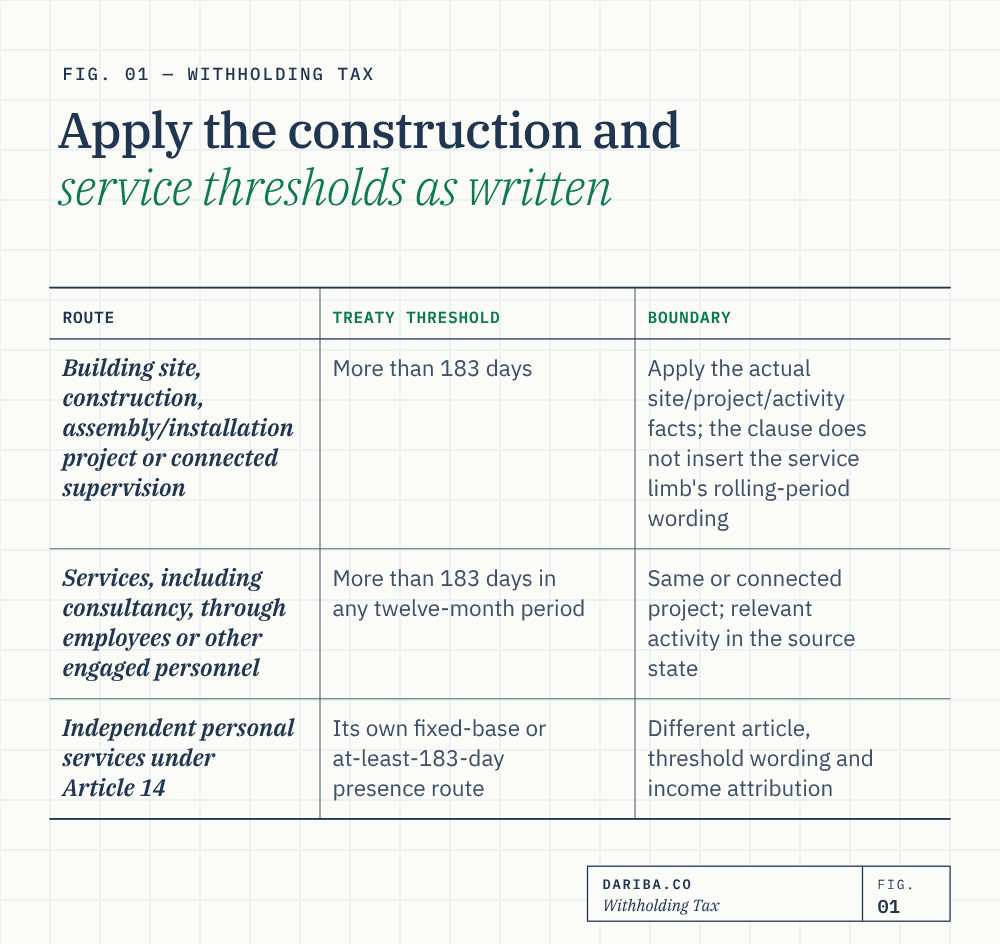
For Article 5(3), exactly 183 days does not exceed the numerical threshold. That conclusion does not establish the absence of a fixed-place, agency, insurance or other applicable route. Article 14’s amounting to or exceeding 183 days wording must not be replaced by Article 5’s strict “more than” test.
Dariba illustration — original assumptions: relevant service activity for the same or connected project totals 120 days and a further non-overlapping 64 days within one qualifying twelve-month period. The total is 184 days, above 183. A total of 120 plus 63 is 183 and does not exceed that Article 5(3)(b) threshold. These assumed activity periods are not a universal rule to add every employee’s overlapping person-days, or proof that unrelated projects must be combined.
Preserve the actual project connections, travel/activity evidence, contracts and rolling-period analysis. A calendar-year reset or a new invoice number is not a substitute for the treaty’s twelve-month and same/connected-project conditions.
Do not import the MLI contract-splitting article
Japan’s notified MLI position reserves against the entirety of MLI Article 14. The Saudi position’s absence of a reservation is insufficient to make that optional provision apply bilaterally. The official Japan–Saudi application summary and synthesis therefore do not add that contract-splitting rule to this treaty.
This does not create a safe harbour for artificial fragmentation. The original service-project connection language, other applicable PE routes and the matched principal-purpose test still require examination. It means that a review must identify its actual legal basis rather than automatically borrow the MLI aggregation formula used for another treaty.
Dariba analysis: connected companies carrying out successive work are a reason to review the facts and applicable provisions. They are not, by themselves, proof that every company day is added under an MLI article Japan reserved against. Keep the underlying activity periods, entity roles and reasons for the arrangement visible in the conclusion.
Apply Option A and the anti-fragmentation conditions
The matched MLI Article 13(2), Option A, replaces the original Article 5(4) activity exemptions. Storage, display, delivery, processing, purchasing/information and the other stated activities require the applicable preparatory-or-auxiliary character. The original wording should not be read as an unconditional warehouse exemption after the modification takes effect.
MLI Article 13(4) also addresses the same or closely related enterprise carrying on business at the same or another place in the same state. Its conditions concern an existing PE or a combined activity that is not preparatory/auxiliary, together with complementary functions forming part of a cohesive business operation.
The required connection matters. A sales operation and a supposedly auxiliary warehouse may need a combined review where the actual conditions are met; a list of all group premises does not automatically establish the result. Document what each location does and how the functions fit together.
Review the actual role in concluding contracts
Matched MLI Article 12 replaces the original Article 5(5)–(6) agency provisions. It covers the relevant habitual contract conclusion and habitual principal role leading to contracts routinely completed without material modification. The specified contract categories include enterprise-name contracts, qualifying property/right transactions and provision of the enterprise’s services.
An offshore signature does not automatically dispose of the principal-role question. Conversely, an employee arranging one meeting does not establish every habitual-role and contract condition. Examine negotiations, approvals, material modifications, customer communications and the actual function of the local person.
The independent-agent exception also retains actual independence and ordinary-course conditions. A person working exclusively or almost exclusively for closely related enterprises does not qualify as independent for those enterprises under the modified rule. A distributor or adviser label alone is insufficient.
Use the close-relationship definition without a percentage safe harbour
MLI Article 15 includes factual control and common control, plus the stated direct/indirect more-than-50% interest tests. For a company, preserve the actual voting/value or beneficial-equity wording rather than replace it with a different accounting-consolidation threshold.
Exactly 50% does not satisfy a strict more-than-50% limb simply by rounding, but another factual control basis may still apply. Likewise, Article 5(8)‘s control-alone rule does not remove the need to apply the modified agency or anti-fragmentation provisions when their additional conditions are met.
Keep the ownership chain, voting rights, agreements, governance and actual decision-making together. Different regimes’ definitions of “related” should not be assumed interchangeable.
Insurance and attribution retain their own rules
Original Article 5(7) deems an insurance enterprise to have a PE if it collects premiums in the other state or insures risks situated there. The reviewed clause does not include a general reinsurance carve-out. This is separate from testing whether a conventional office or dependent agent exists.
If a PE exists, Article 7 addresses attributable profits rather than automatically taxing every global or Saudi-related receipt as PE profit. Protocol paragraph 6 limits attributable service profits to the actual activities carried on by that PE in the source state. Other income articles remain relevant where they separately govern an item.
Protocol paragraph 7 also restricts specified internal royalties, commissions/service or management charges and debt-claim income to head/other offices, apart from actual-expense reimbursement and the stated banking exception. An internal invoice is not automatically a deductible third-party transaction. The Japan WHT guide connects these issues to payments and treaty ceilings.
Preserve benefit conditions and procedural deadlines
The matched principal-purpose test can affect treaty benefits even where the arithmetic of one PE threshold is clear. Retain the business arrangement and the actual purpose/facts; a standard “no PE” declaration is evidence to evaluate, not a universal entitlement certificate.
Article 25’s modified MAP entry route permits presentation to either competent authority, while retaining its three-year first-notification period. The published application rule gives that modification its separate 1 May 2020 condition and preserves the stated exception for cases already ineligible then. Domestic objection, filing, payment and information-request deadlines need their own review.
Dariba recommends a period-specific file covering treaty residence, premises, projects, activity days, local contract roles, agency independence, group functions, insurance risks and profit attribution. The conclusion should identify the route actually tested and unresolved facts. Neither remaining at or below 183 service days nor obtaining a local commercial registration settles every treaty and domestic obligation.
Key takeaways
- Construction and service PE thresholds are more than 183 days; the service limb uses the same/connected project within any twelve months.
- Exactly 183 days does not exceed Article 5’s threshold, but Article 14’s independent-personal-services test and other PE routes differ.
- Japan reserves against MLI 14 contract splitting; Saudi acceptance alone does not make it apply.
- Matched Option A and anti-fragmentation conditions qualify activity exemptions.
- Agency includes the habitual principal role in specified contracts; related-agent independence has separate conditions.
- Insurance and PE-profit attribution retain specific rules, including the Protocol’s actual-services and internal-charge limitations.
Sources
- Japan Ministry of Finance: authentic Saudi–Japan convention and integral ProtocolArticles 4–5,7,10–12,14,24–25,29; Protocol3–7,11–13; pp.4–16,20–30. Dividend holding conditions, debt/pension exemptions, equipment royalties, PE/attribution and English-prevails clause.
- Japan Ministry of Finance: MLI synthesis for the Saudi conventionReading aid, not a source of law. Intro/effect dates and visible MLI boxes on agency, OptionA/anti-fragmentation, close relationship, PPT, MAP and corresponding adjustment; authentic instruments prevail.
- Saudi–Japan exchange of diplomatic notes, 13 April 2013English originals within the official Japanese publication, pp.2–4: JBIC recognised under Protocol13(a)(v); amounts taxable from1April2012; agreement takes effect on the reply date.
- Japan Ministry of Finance: MLI reservations and notifications, 20 June 2023Japan’s updated list incorporates deposited and later notifications. Article 8 reservation; agency/OptionA notifications for Saudi Arabia; Article 14 reservation; MAP and corresponding-adjustment notifications.
- OECD depositary: Saudi MLI positionDeposited23January2020. Match Japan entries, agency5(5)/(6), OptionA5(4), PPT/MAP and corresponding-adjustment choices; a unilateral choice is insufficient.
- OECD: authentic English Multilateral InstrumentSelected Articles 6–8,12–17,35, with bilateral reservations/notifications and actual entry-into-effect conditions.
- OECD: current MLI signatories and partiesCurrent depositary status listing. Entry into force does not replace payment-event and taxable-period entry into effect.
- ZATCA: treaty withholding implementation circularSelected classification and procedure discussion, including business profits, debt claims, royalties and service income. Actual entitlement and current documents must be supported.
- Saudi Income Tax Law, current Arabic publicationArticles 5 and 68: domestic source/withholding framework, separately from treaty allocation.
- Saudi Income Tax Implementing Regulations, current Arabic publicationArticles 5 and 63: source, actual domestic category/rates and payment compliance. Lower domestic tax is not increased to a treaty ceiling.
- Japan Ministry of Finance: current bilateral treaty listCurrent list reviewed30October2026: original convention, entry into force1September2011, 2013notes and MLI links.
- Japan Ministry of Finance: matched Saudi MLI applicationSelected matched provisions and effect dates: WHT1January2021; other periods1November2020; separate MAP case-presentation condition1May2020. Read with latest notified positions.
General information based on official treaty, Protocol, exchange-of-notes, MLI and Saudi sources reviewed on 30 October 2026. Actual facts, residence, beneficial ownership where required, source, presence, period and benefit conditions determine treatment. The synthesis is a reading aid. Dariba illustrations are original assumptions; no claimant entitlement, project status, refund or procedural outcome is guaranteed.