In brief
The Japan convention uses conditional dividend, debt-claim and royalty rules. The Protocol and 2013 notes add material pension/institution and directional conditions; lower domestic tax and MLI benefit tests remain separate.
The Saudi–Japan tax convention provides conditional limits and exemptions for particular income. It does not replace Saudi domestic classification with one Japanese-country rate. Establish the recipient, residence, beneficial ownership where required, payment rights, Saudi presence and applicable period before applying a ceiling or claiming relief.
The convention and its integral Protocol were signed on 15 November 2010. Japan’s Ministry of Finance records entry into force on 1 September 2011; Article 29 makes the Saudi withholding provisions applicable to amounts paid from 1 January 2012. The Multilateral Instrument, or MLI, subsequently modifies selected provisions. The official synthesis is a reading aid; the authentic instruments govern, with English prevailing where the convention’s authentic texts diverge in interpretation.
Read the treaty ceiling alongside the domestic category
| Income | Ordinary treaty source-state limit | Additional analysis |
|---|---|---|
| Dividends | 5% qualifying corporate holding; 10% otherwise | Residence, beneficial ownership, holding size/period and effective connection |
| Income from debt-claims | 10% ordinarily | Specified government/financing and Japanese pension-fund routes can exempt source taxation |
| Equipment royalties | 5% | Actual industrial, commercial or scientific equipment use/right |
| Other defined royalties | 10% | Actual rights/know-how, beneficial ownership, source and connection |
| Enterprise business profits | Generally residence-state taxation without a Saudi PE | Income-specific articles, actual PE and benefit conditions remain material |
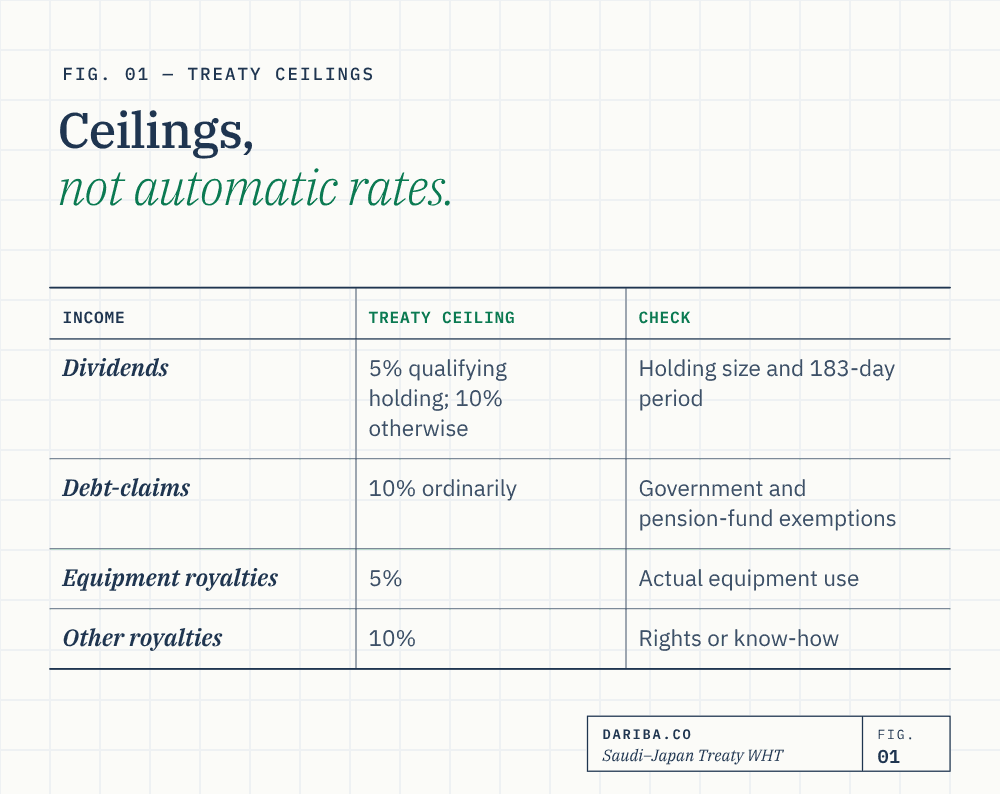
A treaty limit does not increase a lower domestic tax. Ordinary Saudi dividends and qualifying loan charges generally carry 5% domestic withholding under the applicable category. A 10% treaty ceiling does not turn those payments into a 10% Saudi charge. Domestic exceptions and the actual recipient/payment must still be reviewed. Use the domestic WHT guide before selecting treaty treatment.
Preserve the dividend holding period and payment direction
Article 10(2)(a)‘s 5% ceiling requires a corporate beneficial owner holding, directly or indirectly, at least 10% of the voting shares or total issued shares throughout the specified 183-day period ending when dividend entitlement is determined. Other qualifying cases have a 10% ceiling. A shareholding acquired just before payment should not be assumed to satisfy the period merely because it meets the percentage on payment day.
Japan reserves against MLI Article 8, so its generic dividend holding-period modification should not be substituted for this convention’s actual wording. The existing 183-day condition is not a universal 365-day test.
Protocol paragraph 11 adds particular conditions for dividends flowing from Japan to a Saudi resident: the qualifying holding concerns voting shares, and the Japanese payer must not be entitled to deduct dividends paid to beneficiaries in computing its Japanese taxable income. Do not silently transpose that directional restriction into every Saudi-to-Japan distribution, or overlook it in a reverse-flow investment.
Article 10(4) separately removes the ordinary dividend allocation where the holding is effectively connected with the relevant source-state PE or fixed base, sending the analysis to Article 7 or 14. Ownership, company-level profit taxation and shareholder withholding remain different questions.
Identify the actual debt-claim exemption route
Article 11 ordinarily caps qualifying debt-claim income at 10%. Paragraph (3) provides residence-state-only treatment for its specified government, subdivision/local-authority, central-bank or wholly government-owned institution cases, and for qualifying debt guaranteed, insured or indirectly financed by those bodies. Beneficial ownership and the actual financing chain matter; an export-related label alone does not prove the exemption.
Protocol paragraph 13 defines the relevant central-bank/institution categories through named bodies and a route for further qualifying institutions agreed by diplomatic notes. The original Japanese list includes the Bank of Japan, Japan Finance Corporation, Japan International Cooperation Agency and Nippon Export and Investment Insurance. It is not safe to substitute a generic list of every company with some government ownership.
The 13 April 2013 exchange of notes recognises the Japan Bank for International Cooperation under Protocol paragraph 13(a)(v). The agreement applies to amounts taxable on or after 1 April 2012. This operative exchange was checked separately because the original Protocol list and the MLI synthesis alone do not show the complete institution position reviewed here.
Protocol paragraph 12 also provides residence-state-only treatment for Saudi-source debt-claim income beneficially owned by a pension fund established under Japanese law. That is a specific pension-fund route, not a general exemption for every investment connected with an employee retirement arrangement.
Article 11(4) defines the income, while paragraphs (5)–(7) preserve effective-connection, source and special-relationship excess rules. A higher related-party charge does not automatically receive protection for the whole amount merely because an ordinary arm’s-length amount would qualify.
Separate equipment use, intellectual property and services
Article 12(2) caps equipment royalties at 5% and other defined royalties at 10%. Its definition covers the specified intellectual-property rights, equipment and information about industrial, commercial or scientific experience. Review the actual rights granted; an invoice headed “licence”, “software”, “SaaS” or “technical support” is not a complete classification.
Dariba illustration — original assumptions: a Saudi payer owes SAR 100,000 of ordinary intellectual-property royalties, properly falling in the domestic 15% royalty category. Assume the Japanese recipient meets all treaty conditions, with no effective connection or excess-payment issue. Domestic withholding is SAR 15,000; the 10% treaty ceiling is SAR 10,000, a SAR 5,000 difference. The calculation assumes entitlement and does not itself approve relief at source or a refund.
If the actual payment instead falls in a domestic equipment-rent category taxed at 5%, a 5% equipment-royalty treaty limit would not by itself create another reduction. Establish both classifications rather than calculate 15% domestic tax for every equipment arrangement merely because the treaty calls it a royalty.
Article 12(4)–(6) separately addresses PE/fixed-base connection, source and excess due to a special relationship. A supply of independent expertise and a transfer of existing know-how may require different analysis. The treaty classification guide explains why those distinctions affect the route.
Test service income and presence before using business profits
Article 7 generally protects an enterprise’s profits from source-state tax without a PE, while preserving income dealt with separately elsewhere in the convention. Protocol paragraph 5 excludes an individual’s personal-service income dealt with by Articles 14 or 15 from Article 7 profits. A corporate consulting contract and an individual’s professional activity should not automatically receive the same threshold analysis.
Protocol paragraph 6 links service profits attributable to a PE to the actual service activities carried on by that PE in the source state. Paragraph 7 restricts specified internal head-office charges, apart from actual-expense reimbursement and the stated banking exception. A bookkeeping allocation is not automatically a deductible external fee or a treaty-protected payment.
Article 5(7) also contains a specific insurance PE rule for collecting premiums or insuring risks in the other state. The text does not state a general reinsurance exclusion. Do not promise zero WHT on insurance merely from an office-based “no Saudi PE” declaration. The Japan PE guide addresses the actual presence routes and MLI changes.
Apply the matched MLI and the correct relief procedure
For this treaty, the published MLI effect dates are 1 January 2021 for relevant withholding events and taxable periods beginning on or after 1 November 2020 for other taxes. The MAP modification has its separate 1 May 2020 case-presentation condition. Entry into force of the MLI is a different date from these entry-into-effect tests.
The matched principal-purpose test replaces the original Article 24 relief limitation. A benefit may be denied where obtaining it was one of the arrangement’s principal purposes under the stated test, unless the object-and-purpose qualification is established. Residence documentation alone does not settle that analysis or beneficial ownership.
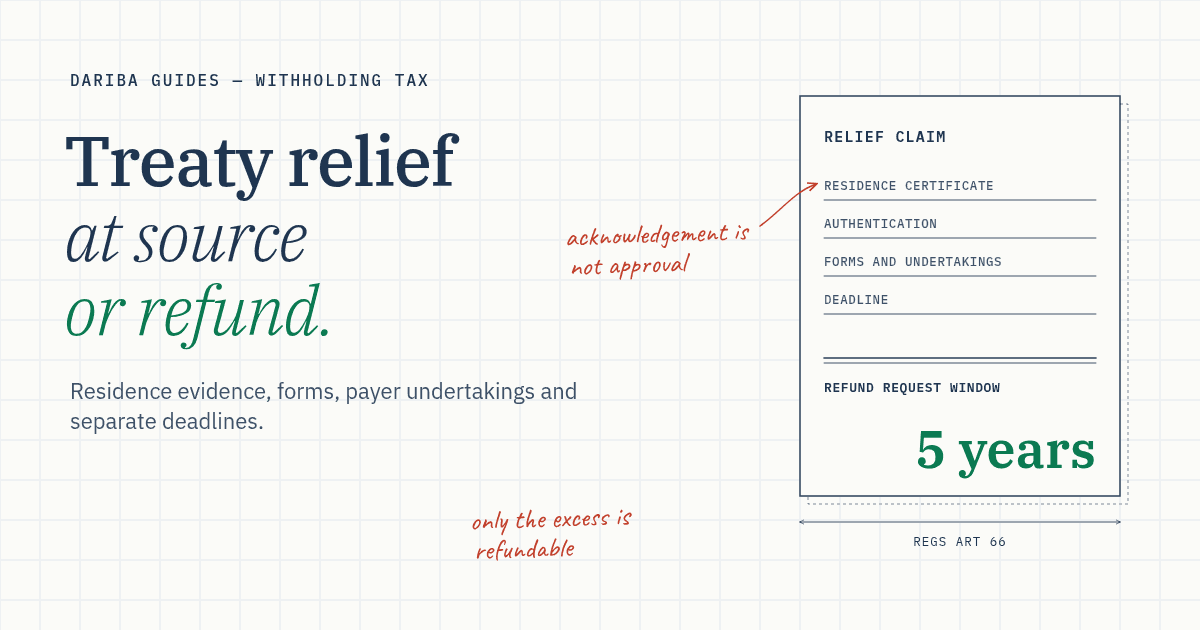
ZATCA’s treaty-implementation circular distinguishes substantive allocation from the procedure for relief at source or repayment. Retain the current required residence and beneficial-owner evidence, contract, payment classification, PE assessment and actual claim documents. Filing/payment obligations and potential exposure for an unsupported reduced rate remain separate from this guide’s arithmetic.
Article 25, as modified, permits a qualifying MAP case to be presented to either competent authority, with the retained three-year period from the first notification of the relevant action. MAP is not an automatic suspension of domestic deadlines or a guarantee of agreement. The relief guide and MAP guide explain the practical process and limits.
Key takeaways
- Treaty ceilings do not increase lower Saudi domestic tax.
- The lower dividend ceiling requires the specified 10% corporate holding for 183 days; Japan’s MLI Article 8 reservation preserves the actual treaty wording.
- Debt-claim exemptions include the defined government/financing and qualifying Japanese pension-fund routes.
- The 2013 exchange recognises JBIC under Protocol 13(a)(v), applicable to amounts taxable from 1 April 2012.
- Equipment royalties have a 5% ceiling; other defined royalties 10%, subject to actual entitlement and connection.
- Business profits, independent personal services and insurance PE provisions require different analysis.
Sources
- Japan Ministry of Finance: authentic Saudi–Japan convention and integral ProtocolArticles 4–5,7,10–12,14,24–25,29; Protocol3–7,11–13; pp.4–16,20–30. Dividend holding conditions, debt/pension exemptions, equipment royalties, PE/attribution and English-prevails clause.
- Japan Ministry of Finance: MLI synthesis for the Saudi conventionReading aid, not a source of law. Intro/effect dates and visible MLI boxes on agency, OptionA/anti-fragmentation, close relationship, PPT, MAP and corresponding adjustment; authentic instruments prevail.
- Saudi–Japan exchange of diplomatic notes, 13 April 2013English originals within the official Japanese publication, pp.2–4: JBIC recognised under Protocol13(a)(v); amounts taxable from1April2012; agreement takes effect on the reply date.
- Japan Ministry of Finance: MLI reservations and notifications, 20 June 2023Japan’s updated list incorporates deposited and later notifications. Article 8 reservation; agency/OptionA notifications for Saudi Arabia; Article 14 reservation; MAP and corresponding-adjustment notifications.
- OECD depositary: Saudi MLI positionDeposited23January2020. Match Japan entries, agency5(5)/(6), OptionA5(4), PPT/MAP and corresponding-adjustment choices; a unilateral choice is insufficient.
- OECD: authentic English Multilateral InstrumentSelected Articles 6–8,12–17,35, with bilateral reservations/notifications and actual entry-into-effect conditions.
- OECD: current MLI signatories and partiesCurrent depositary status listing. Entry into force does not replace payment-event and taxable-period entry into effect.
- ZATCA: treaty withholding implementation circularSelected classification and procedure discussion, including business profits, debt claims, royalties and service income. Actual entitlement and current documents must be supported.
- Saudi Income Tax Law, current Arabic publicationArticles 5 and 68: domestic source/withholding framework, separately from treaty allocation.
- Saudi Income Tax Implementing Regulations, current Arabic publicationArticles 5 and 63: source, actual domestic category/rates and payment compliance. Lower domestic tax is not increased to a treaty ceiling.
- Japan Ministry of Finance: current bilateral treaty listCurrent list reviewed30October2026: original convention, entry into force1September2011, 2013notes and MLI links.
- Japan Ministry of Finance: matched Saudi MLI applicationSelected matched provisions and effect dates: WHT1January2021; other periods1November2020; separate MAP case-presentation condition1May2020. Read with latest notified positions.
General information based on official treaty, Protocol, exchange-of-notes, MLI and Saudi sources reviewed on 30 October 2026. Actual facts, residence, beneficial ownership where required, source, presence, period and benefit conditions determine treatment. The synthesis is a reading aid. Dariba illustrations are original assumptions; no claimant entitlement, project status, refund or procedural outcome is guaranteed.