In brief
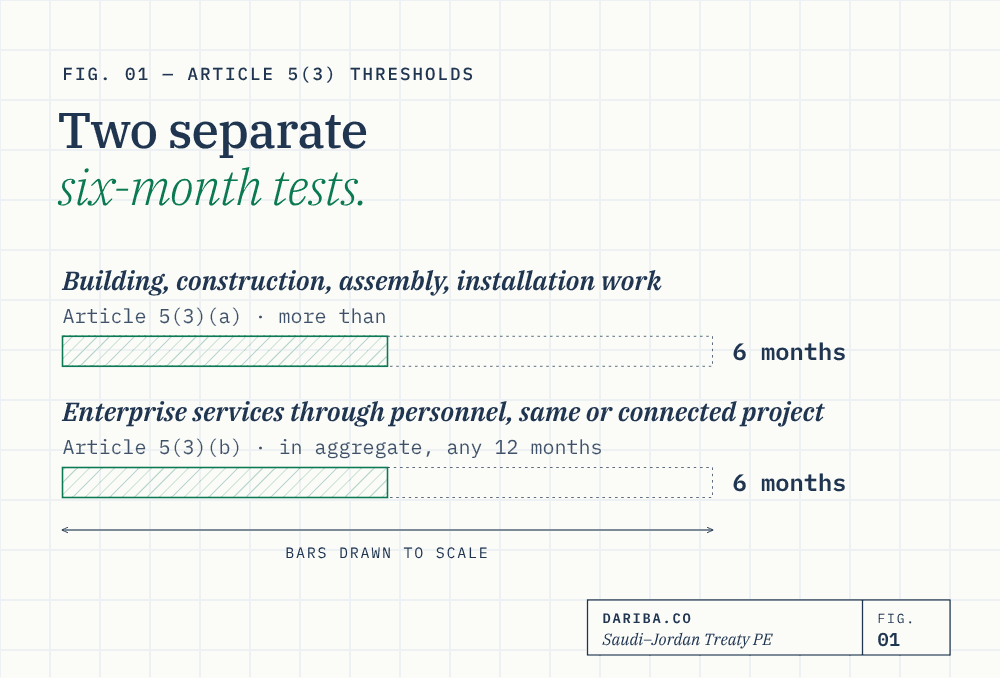
The Saudi–Jordan agreement uses separate six-month project and service tests. Article 7 covers specified similar local sales and activities, subject to the Protocol’s export provision.
A Jordanian supplier installing equipment in Saudi Arabia can face separate questions about its site, its service work and the profits on the exported equipment. Articles 5 and 7 of the Saudi–Jordan Double Taxation Agreement and its Protocol address those questions.
| Activity | Bilateral provision | Duration test |
|---|---|---|
| Building, construction, assembly, installation or related construction work | Article 5(3)(a) | More than six months |
| Enterprise services, including consultancy, through personnel on the same or a connected project | Article 5(3)(b) | More than six months in aggregate in any 12 months |
Keep a chronology of the site and service work. For applicable periods, check the Multilateral Instrument’s contract-splitting rule where closely related enterprises perform connected activities at the same project or site. Check permanent premises separately. For applicable periods, MLI Article 12 includes specified representatives who habitually play the principal role leading to contracts the enterprise routinely concludes without material changes. MLI Article 13 Option A requires the relevant activity to be preparatory or auxiliary. Under Protocol paragraph 2, the fixed-place list also covers the specified rig or vessel used for natural-resource exploration and extraction and a farm or plantation used for investment or business.
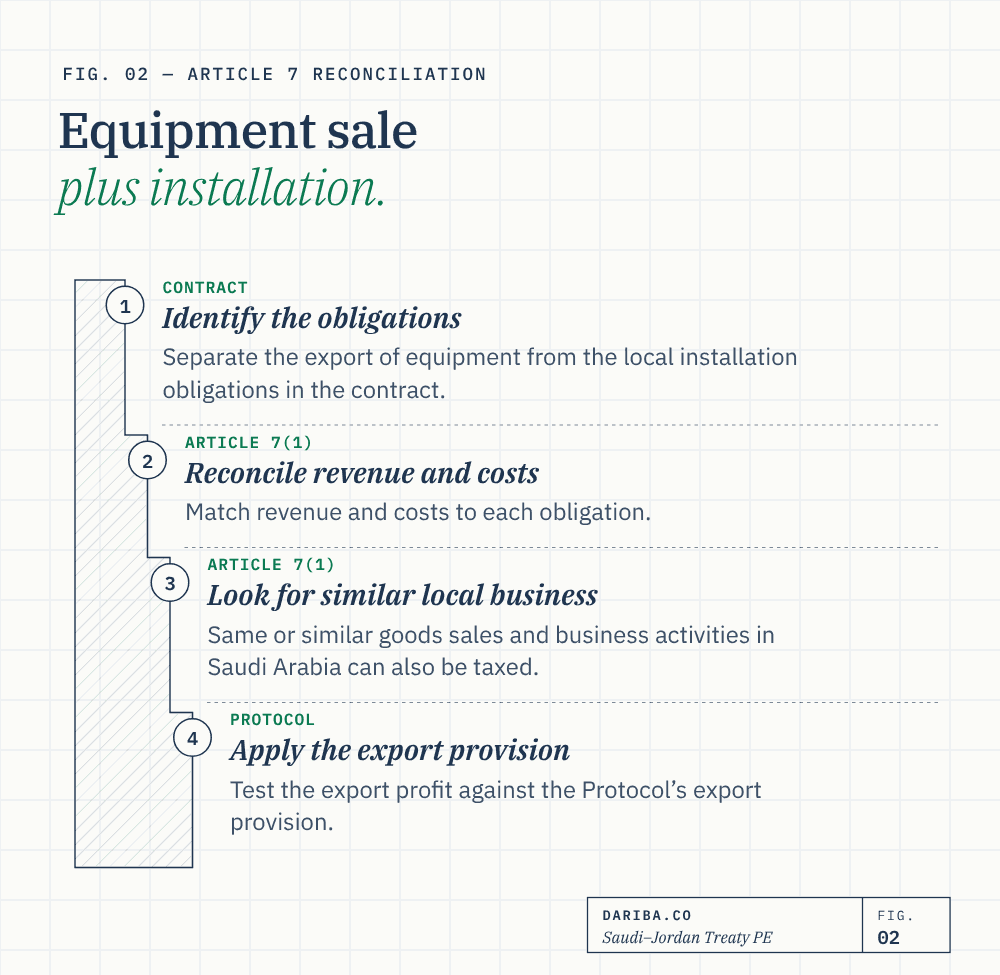
Reconcile local activity with export profit
Article 7(1) allows the source state to tax profit attributable to the permanent establishment and profit from same or similar goods sales and business activities in that state. Protocol paragraph 3 excludes covered merchandise export profits from taxation in the importing state. When the export contract includes activities performed through a local permanent establishment, the income from those activities may be taxed there.
For an equipment sale with local installation, identify the export and local obligations in the contract, reconcile the revenue and costs for each, and check for other similar local transactions. Article 7(2) uses the profits a separate enterprise could earn under comparable conditions. For an individual professional, review the distinct fixed-base and 183-day provisions in Article 14. See the Saudi–Jordan withholding guide for separately classified dividends, financing returns and royalties.
Key takeaways
- Article 5(3) has separate tests for listed projects and for services on the same or a connected project.
- Protocol paragraph 2 adds specified rigs, vessels, farms and plantations to the fixed-place examples.
- Read Article 7(1) alongside the export contract rule in Protocol paragraph 3.
Sources
- Saudi–Jordan Agreement for the Avoidance of Double Taxation and Prevention of Tax Evasion with Respect to Taxes on Income, with ProtocolArticles 5, 7 and 14 and Protocol paragraphs 2–3.
- Jordan’s Deposited MLI Reservations and NotificationsListed agreement 27 and Articles 12–14.
- Saudi Arabia’s Deposited MLI Reservations and NotificationsListed agreement 19 and Articles 12–14.
- ZATCA Circular 2104001, Force of Attraction Rule in the Context of Permanent EstablishmentPartial force of attraction and the similarity test.