In brief
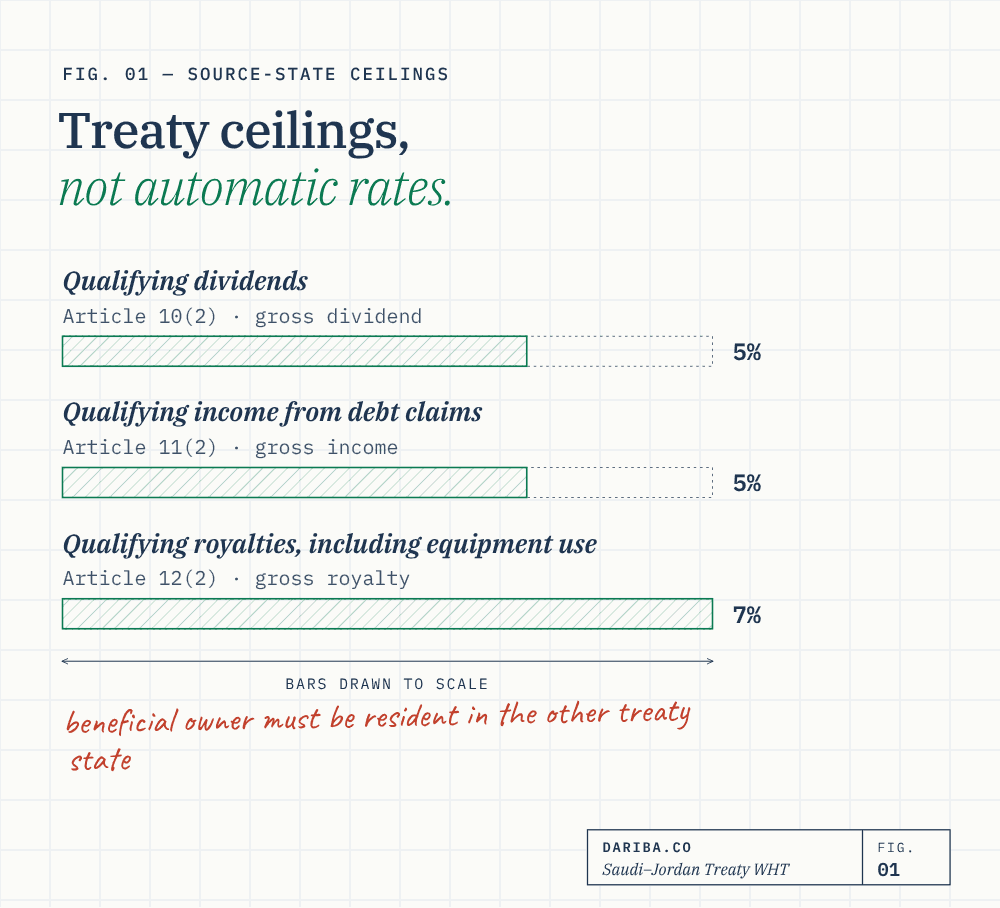
The treaty caps qualifying dividends and debt-claim income at 5% and royalties at 7%. The debt-income exemption depends on who earns and who pays the income.
For a Saudi company paying a Jordanian recipient, the contract and the recipient’s role determine which article to test. The Saudi–Jordan Double Taxation Agreement entered into force on 1 September 2017. Article 28 applies its original withholding provisions to amounts paid from 1 January 2018.
| Payment | Treaty provision | Source-state ceiling |
|---|---|---|
| Qualifying dividends | Article 10(2) | 5% of the gross dividend |
| Qualifying income from debt claims | Article 11(2) | 5% of the gross income |
| Qualifying royalties | Article 12(2) | 7% of the gross royalty |
Each ceiling requires a beneficial owner resident in the other treaty state. Apply the relevant domestic charge and document residence, beneficial ownership and treaty entitlement, including the Multilateral Instrument’s principal purpose test. An effectively connected shareholding, debt claim or royalty right can redirect the income to Article 7 or Article 14.
Check both parties to a government debt payment
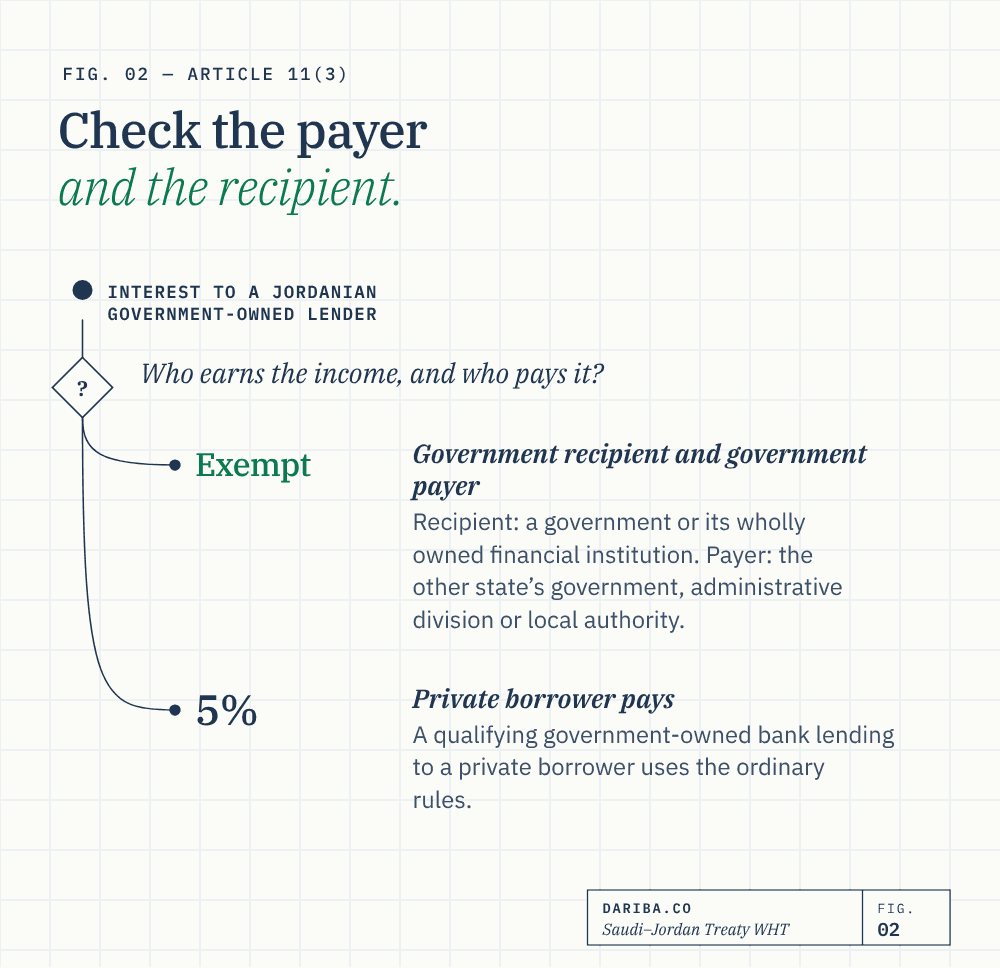
Article 11(3) exempts qualifying debt income belonging to a treaty state’s government or one of its wholly owned financial institutions. The payer must be the other state’s government, an administrative division or a local authority of that state. A qualifying government-owned bank receiving interest from a private borrower would still have to examine the ordinary rules. Article 11(4) excludes late-payment penalties from the treaty’s debt-income definition.
Read the royalty agreement and document the relief
Article 12(3) includes specified intellectual property, use of industrial, commercial or scientific equipment and certain know-how. For a contract that bundles equipment use and on-site work, identify what each payment buys and check the permanent establishment rules for the local activity. For related-party debt or royalty payments, Articles 11(7) and 12(6) limit the article’s treatment to the amount the parties would have agreed without their special relationship.
Keep the agreement, invoice, residence documentation and relevant ownership and payment records. Section 4 of ZATCA’s Tax Circular on Implementation of Withholding Tax Under the Double Taxation Agreement describes the Saudi relief-at-source and refund routes.
Key takeaways
- Articles 10(2), 11(2) and 12(2) set gross-payment ceilings of 5%, 5% and 7% respectively.
- Article 11(3) requires both a qualifying recipient and a qualifying government payer.
- Effectively connected payments can fall under Article 7 or Article 14.
Sources
- Saudi–Jordan Agreement for the Avoidance of Double Taxation and Prevention of Tax Evasion with Respect to Taxes on Income, with ProtocolArticles 4, 10–12, 14 and 28.
- ZATCA Treaty Register, Jordan ConventionSignature and entry into force.
- Jordan’s Deposited MLI Reservations and NotificationsListed agreement 27 and treaty-abuse provisions.
- Saudi Arabia’s Deposited MLI Reservations and NotificationsListed agreement 19 and treaty-abuse provisions.
- ZATCA Tax Circular on Implementation of Withholding Tax Under the Double Taxation AgreementSection 4 on relief at source and refund claims.