In brief
Apply the bilateral ceilings, Kazakhstan’s special debt-income base and the separate post-tax branch profit limit.
A Saudi lender receiving debt-claim income from Kazakhstan should read Article 11(2) of the Saudi–Kazakhstan Double Taxation Convention with its Protocol. The Protocol changes the calculation for debt income arising in Kazakhstan. Article 29 applies the original withholding provisions to amounts paid from 1 January 2017.
| Payment | Provision | Source-state ceiling |
|---|---|---|
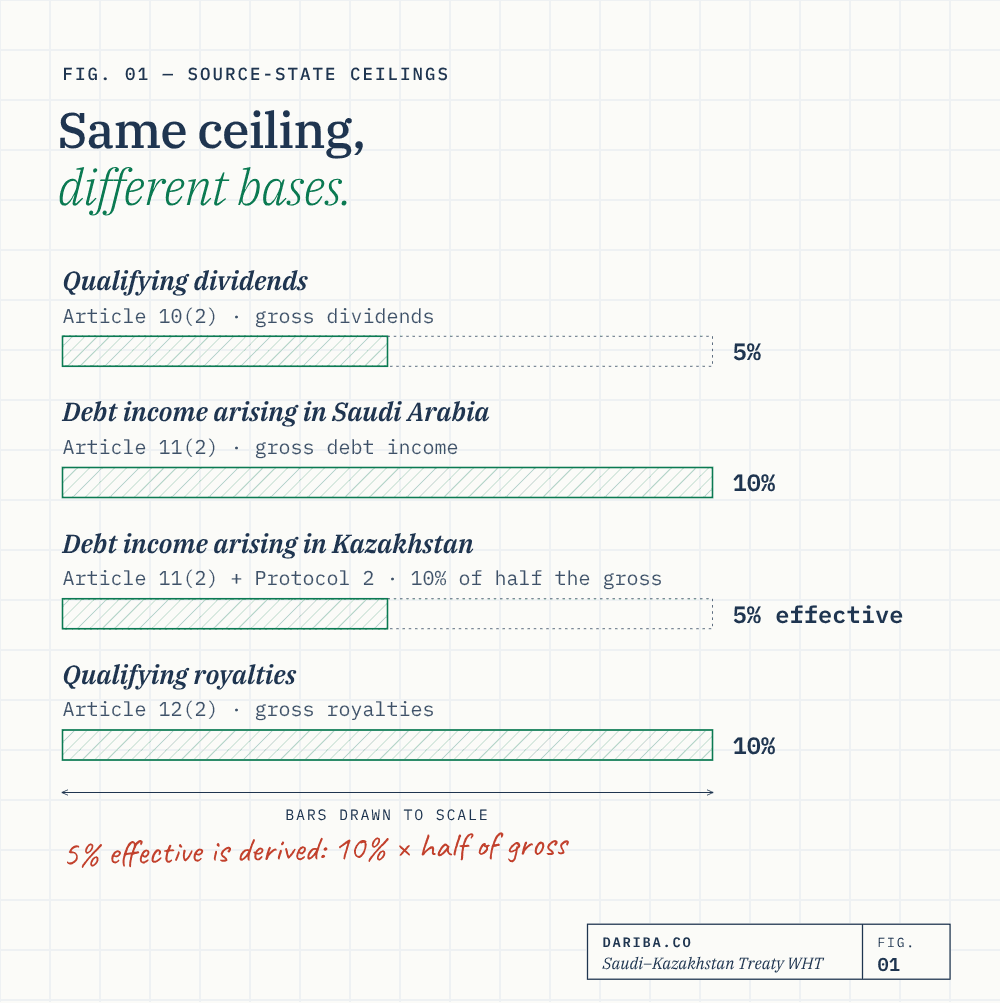
| Qualifying dividends | Article 10(2) | 5% of gross dividends |
| Qualifying debt income arising in Saudi Arabia | Article 11(2) | 10% of gross debt income |
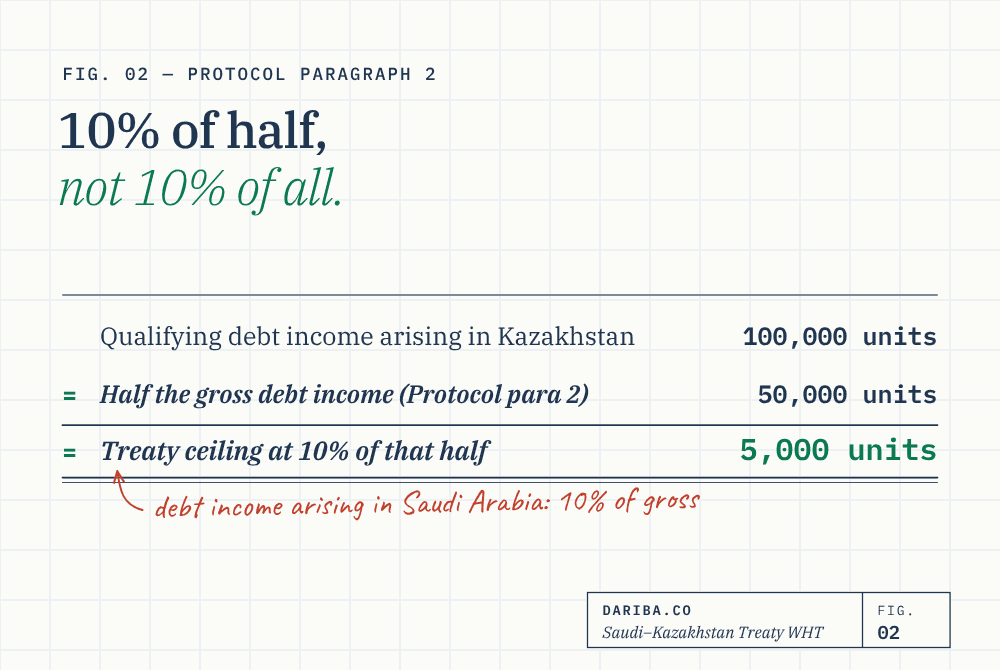
| Qualifying debt income arising in Kazakhstan | Article 11(2) and Protocol paragraph 2 | 10% of half the gross debt income |
| Qualifying royalties | Article 12(2) | 10% of gross royalties |
On 100,000 units of qualifying debt income arising in Kazakhstan, the treaty ceiling is 5,000 units. Determine the source under Article 11(5), including any establishment or fixed base that incurred and bears the debt expense. The Saudi domestic loan-charge rate can apply below the ordinary treaty ceiling on Saudi-source debt income.
Apply the branch tax ceiling to the remaining profit
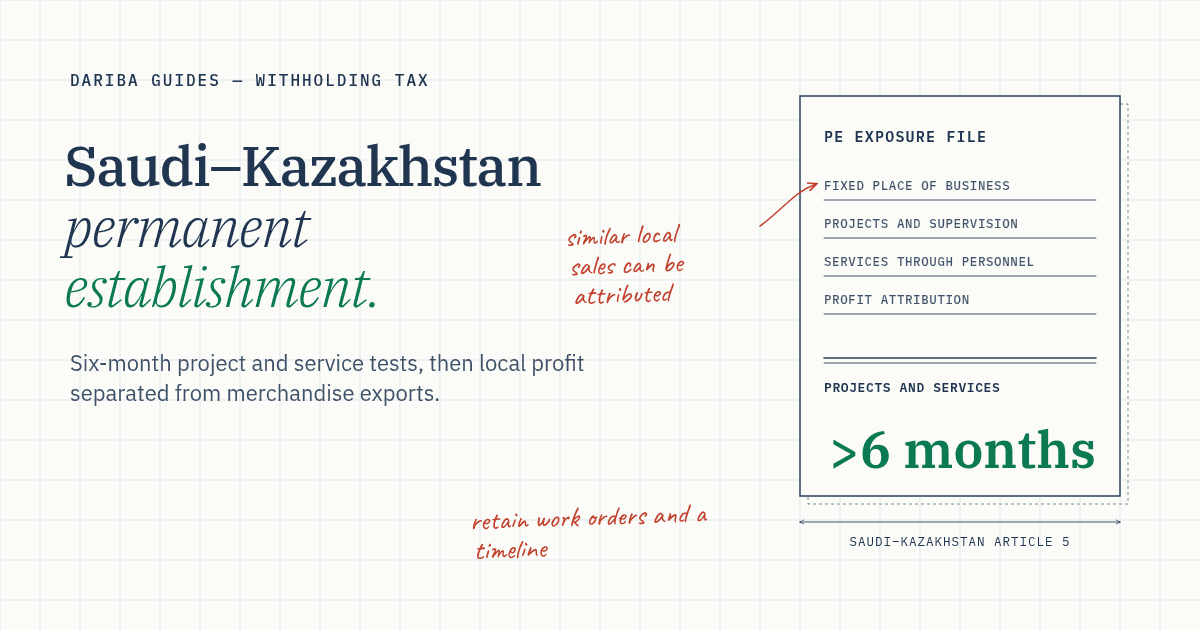
Protocol paragraph 1 permits the state where the permanent establishment is situated to tax the covered profit remaining after taxation under Article 7, subject to a 5% ceiling. Reconcile the attributable profit, the first tax and the remaining amount. The permanent establishment guide explains the Article 7 scope.
Article 26 exempts qualifying dividend, debt and royalty income derived by the Kazakh Government, including the National Bank of Kazakhstan, and wholly owned Kazakh State entities. It also addresses gains on disposal of the assets that generated the income. Verify the recipient’s legal status and the asset involved.
For current relief, check residence, beneficial ownership, effective connection and the Multilateral Instrument’s principal purpose test. Article 12(3) covers specified software rights, equipment use and know-how. Use the contract to identify the right granted and section 4 of ZATCA’s Tax Circular on Implementation of Withholding Tax Under the Double Taxation Agreement for the filing route.
Key takeaways
- The ordinary dividend, debt and royalty ceilings are 5%, 10% and 10%.
- Protocol paragraph 2 halves the treaty base for debt income arising in Kazakhstan.
- Protocol paragraph 1 sets a 5% ceiling on covered profit remaining after Article 7 taxation.
Sources
- Saudi–Kazakhstan Convention for the Avoidance of Double Taxation and Prevention of Tax Evasion with Respect to Taxes on Income, with ProtocolArticles 10–12 and 26 and original application provisions.
- Kazakhstan’s Deposited MLI Reservations and NotificationsListed agreement 38 and applicable agency, activity and abuse provisions.
- Saudi Arabia’s Deposited MLI Reservations and NotificationsRead alongside the other jurisdiction’s deposited positions.
- ZATCA Tax Circular on Implementation of Withholding Tax Under the Double Taxation AgreementSection 4 on relief at source and refunds.