In brief
The Saudi–Korea treaty caps qualifying dividends and royalties at 5% or 10% and qualifying debt income at 5%. Specified government-linked debt can qualify for exemption. The actual domestic charge, treaty classification and relief procedure each matter.
When a Saudi company pays a Korean counterparty, start with the contract and identify the income under Article 63 of the Saudi Income Tax Implementing Regulations. Then apply the corresponding provision of the Saudi–Korea income tax convention. An equipment lease, a licence to use a patent and a service performed with the supplier’s equipment can require three different analyses.
ZATCA’s Korea Convention entry records that the Convention entered into force on 1 December 2008. Under Article 28(2), its original withholding provisions applied to amounts payable from 1 January 2009. For current payments, also check the Multilateral Instrument (MLI) and the applicable Saudi procedure.
Compare the treaty ceilings with the domestic charge
| Payment to a qualifying Korean beneficial owner | Treaty provision | Maximum Saudi source tax under that provision |
|---|---|---|
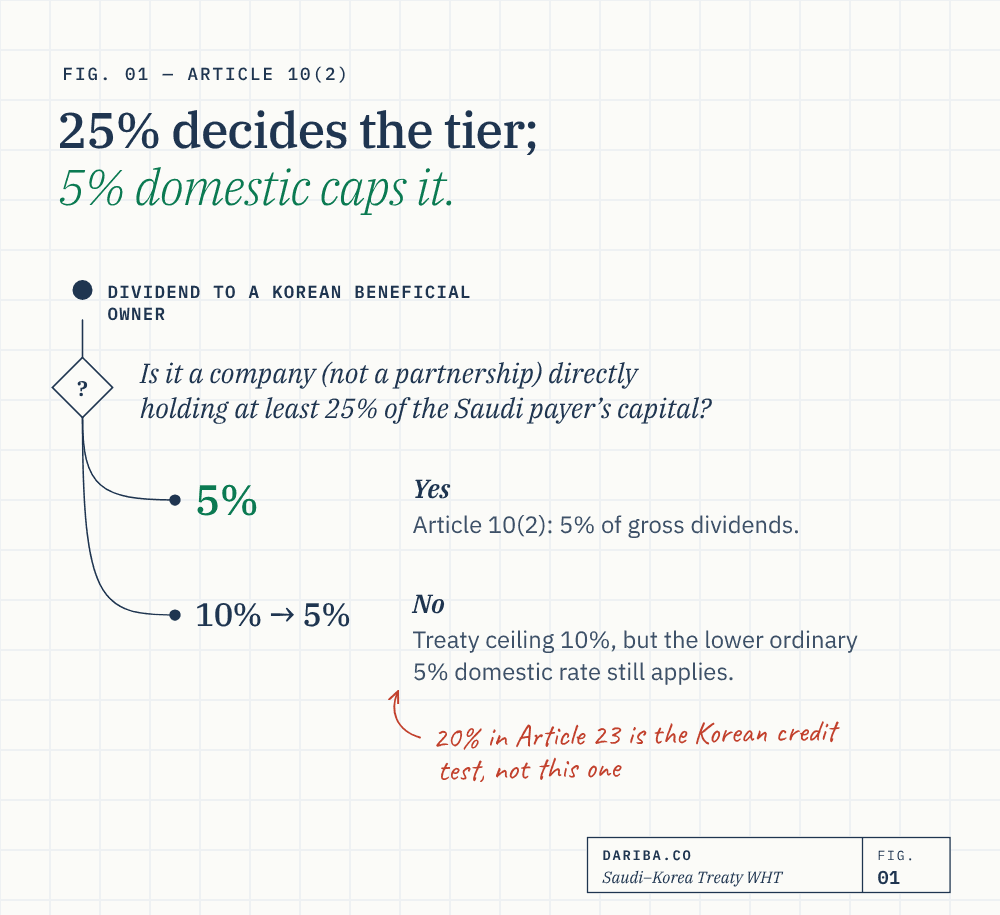
| Dividend to a company other than a partnership directly holding at least 25% of the Saudi payer’s capital | Article 10(2) | 5% of gross dividends |
| Other dividend | Article 10(2) | 10% of gross dividends |
| Ordinary debt-claim income | Article 11(2) | 5% of gross income |
| Debt-claim income meeting a government-related exemption | Article 11(3) | Exempt |
| Royalty for use of industrial, commercial or scientific equipment | Article 12(2)(a) | 5% of gross royalties |
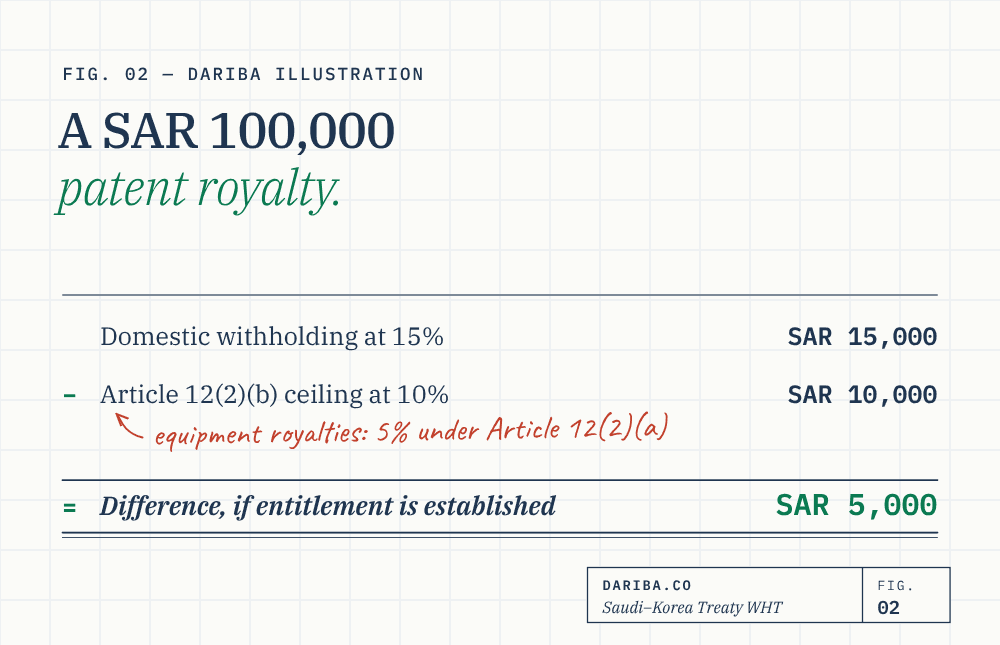
| Other royalty | Article 12(2)(b) | 10% of gross royalties |
Saudi Arabia’s ordinary domestic dividend rate is 5%. A Korean shareholder in the 10% treaty tier therefore still faces the lower ordinary domestic rate, assuming the payment is a dividend and no special rule applies. Article 23(1)(b)(ii) separately addresses the Korean tax credit for underlying Saudi tax and uses a 20% shareholding threshold. The 25% test belongs to the dividend ceiling.
Saudi Arabia reserved against MLI Article 8, so that provision supplies no 365-day holding period for the treaty’s 5% dividend ceiling. The principal purpose test under MLI Article 7 still matters. Record the commercial reasons for the arrangement and identify any financing or contractual obligations to pass the payment on to another party.
Identify the debt and any government support
Article 11(3) lists the other state’s government, including subdivisions and local authorities, and addresses its central bank and specified financial institutions. A separate limb covers income paid to a resident in relation to qualifying government-backed or financed debt. Where the clause calls for designation by mutual agreement, obtain evidence of the designation. Keep the executed financing documents and the guarantee or funding instrument that covers the relevant debt.
Article 11(4) excludes late-payment penalties from the treaty definition of income from debt-claims. Review late charges, guarantee fees and arrangement fees on their own terms. Paragraphs 5–7 address an effectively connected permanent establishment or fixed base, source and the excess attributable to a special relationship.
Read the rights granted under the contract
Article 12(3) covers specified intellectual property, know-how and equipment use. Identify what the customer may do with the equipment or intellectual property and how the supplier is paid. For a bundle with installation, support and licences, retain the statements of work, price breakdown and evidence of who controls the equipment. Apply paragraphs 4–6 to any effective connection, source question or related-party excess.
Dariba illustration. On a gross SAR 100,000 patent royalty subject to the ordinary 15% domestic royalty rate, domestic withholding would be SAR 15,000. If the Korean beneficial owner qualifies under Article 12(2)(b), the 10% ceiling is SAR 10,000. The SAR 5,000 difference depends on establishing entitlement and following the applicable relief procedure.
Document relief before filing
Section 4 of ZATCA’s Tax Circular on Implementation of Withholding Tax Under the Double Taxation Agreement explains the direct relief and refund routes. Retain the applicable forms and residence evidence, beneficial ownership and anti-abuse analysis, agreement, payment record and evidence of any tax withheld. Read Article 24 and the applicable MLI provisions separately if the matter requires competent-authority assistance. A dispute over the classification or recipient can affect both the amount withheld and the evidence the payer needs to retain.
Key takeaways
- The dividend ceiling is 5% for a qualifying company directly holding at least 25% of the payer’s capital, and 10% otherwise.
- Article 11 caps qualifying debt-claim income at 5% and separately exempts specified government-linked financing.
- Article 12 distinguishes equipment royalties at 5% from other royalties at 10%.
- A treaty ceiling can reduce the applicable domestic charge. A lower domestic rate still applies.
- Document beneficial ownership, effective connection and treaty anti-abuse before claiming relief.
Sources
- Saudi–Korea Convention for the Avoidance of Double Taxation and the Prevention of Tax Evasion with Respect to Taxes on Income and its ProtocolArticles 4, 10–12, 23–24 and 27–28. The signature clause gives the English text priority in case of divergent interpretation.
- ZATCA’s Korea Convention entrySigned on 24 March 2007. Entered into force on 1 December 2008.
- Saudi Arabia’s Deposited MLI Reservations and NotificationsCoverage list and Article 8 reservation.
- OECD Sixth Peer Review Report on Treaty Shopping, KoreaThe Saudi Arabia entry records implementation of the principal purpose test through the MLI.
- Saudi Income Tax Implementing RegulationsArticle 63 provides the Saudi domestic withholding categories and rates.
- ZATCA Tax Circular on Implementation of Withholding Tax Under the Double Taxation AgreementSection 4 describes the relief-at-source and refund procedures.