In brief
The treaty uses different thresholds for construction and enterprise services. The Protocol distinguishes export profits from profits attributable to local activities and limits the basis for specified project contracts.
A Korean supplier can export machinery to Saudi Arabia, send engineers to install it and supervise testing under one contract. The Saudi–Korea income tax convention asks two questions. Article 5 determines whether the Korean enterprise has a Saudi permanent establishment (PE). Article 7 and paragraph 4 of the Protocol determine which profits Saudi Arabia can tax through that PE.
Use the threshold for the activity performed
Under Article 5(3)(a), a building site, construction, assembly or installation project, or connected supervisory activities, comes within the project provision when it continues for more than six months. Under Article 5(3)(b), an enterprise furnishing services through personnel, including consultancy, meets the service threshold when activities for the same or a connected project aggregate more than 183 days within any 12 months in the other state.
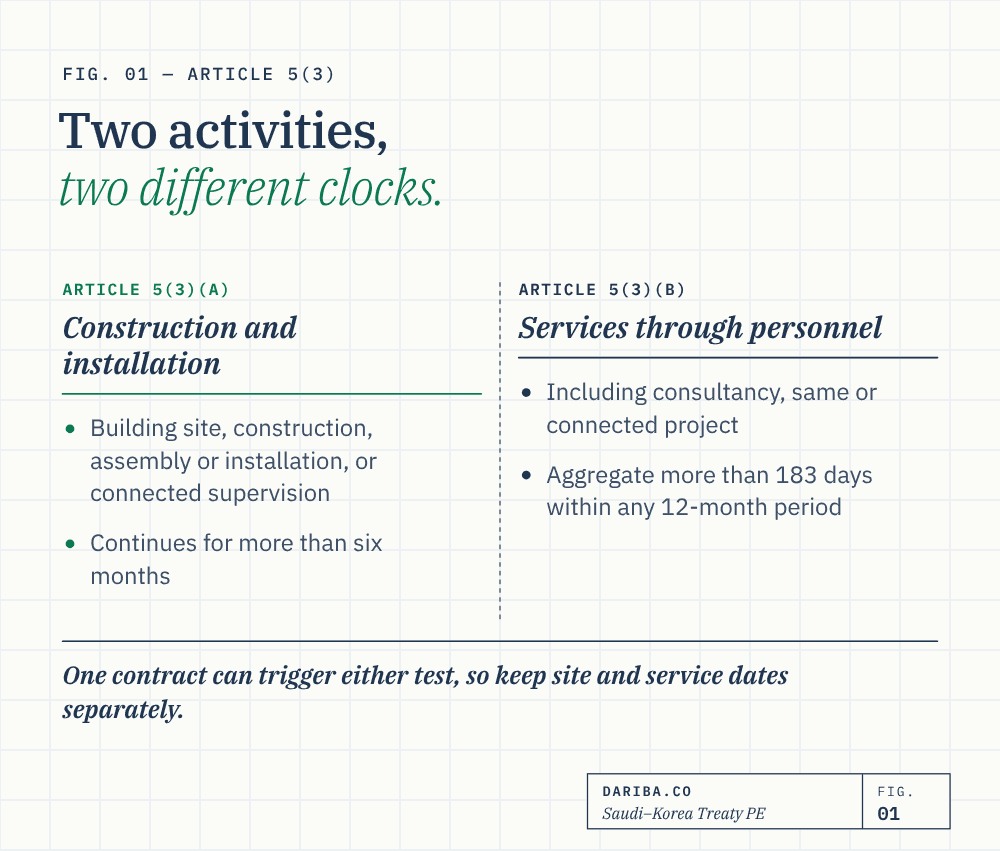
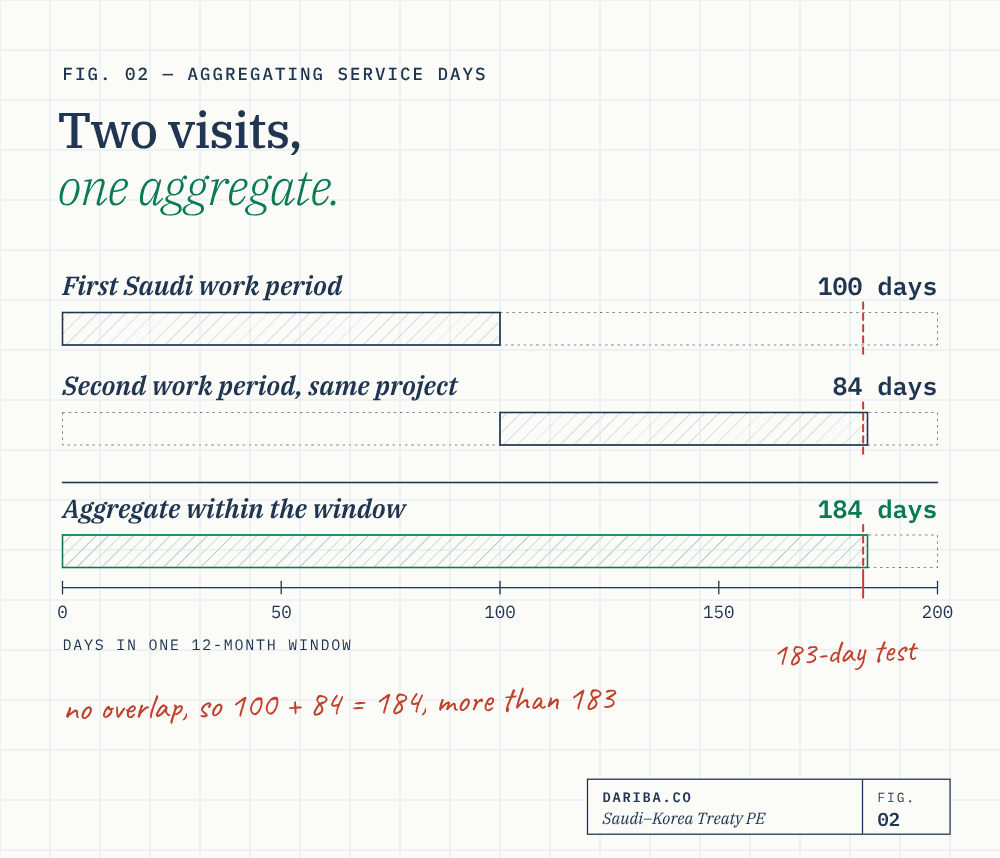
Keep a project chronology with site handover, start and completion dates, local service dates and a record of related work orders. For example, if the same consulting project has two non-overlapping Saudi work periods of 100 and 84 days within one 12-month window, their aggregate is 184 days. This Dariba illustration assumes both periods count. It does not address concurrent personnel, interruptions or when an activity began or ended.
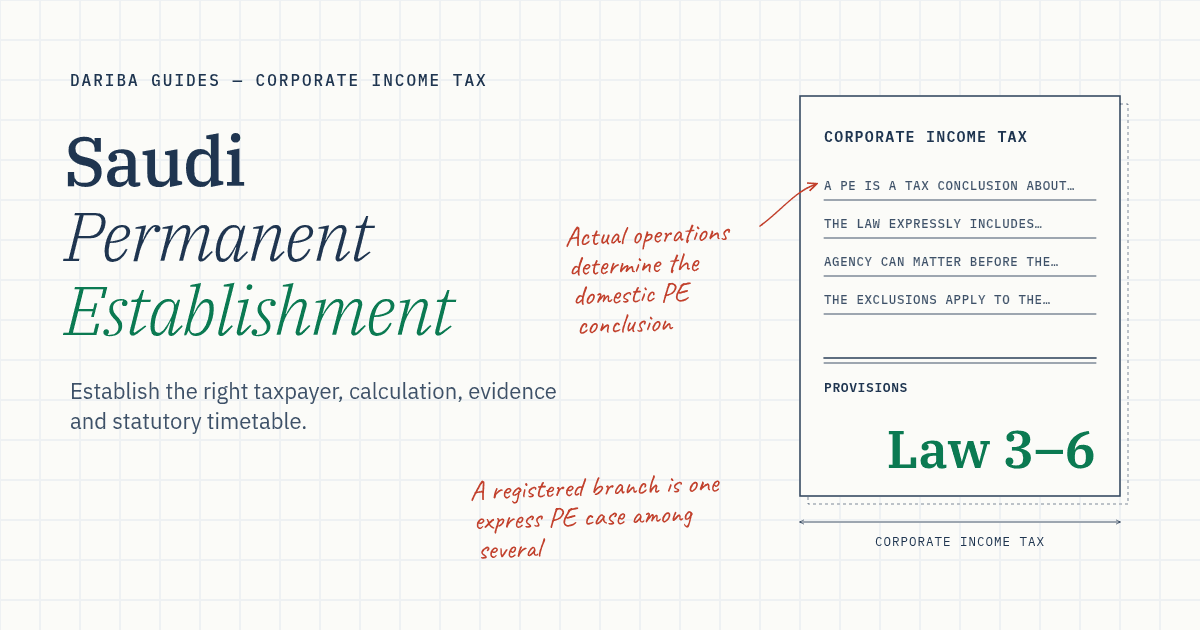
Article 5 also addresses a fixed place of business. Under the original agency wording in Article 5(5), examine both habitual contract authority and habitual stock maintenance with regular deliveries. Test whether an agent acts independently in its ordinary business under paragraph 6. Where the arrangement relies on agency or activity exceptions, compare the treaty wording with the matched MLI positions for the applicable period. The MLI principal purpose test also matters for structures designed around treaty relief.
Attribute profit to the Saudi work
Article 7(2) attributes profit on a separate-enterprise basis. Protocol paragraph 4(c) reserves the specified profits from merchandise exports from taxation in the importing state. Where an export contract includes local activities, Saudi Arabia can tax the profit attributable to a Saudi PE from those activities, excluding the part performed outside Saudi Arabia.
Protocol paragraph 4(d) addresses surveying, building, construction, installation and assembly contracts. Base the attribution on the work effectively performed by the PE in its state. The contract value can include equipment manufactured abroad, design work abroad and on-site work, so reconcile the scope and value of each component against delivery and cost records. Keep the basis for allocating shared project expenses and apply Article 7(3) to head-office charges.
Check which income article governs each payment
Protocol paragraph 4(a) includes enterprise services and tangible movable-property rental in its description of business profits. Article 7(6) preserves the treatment of income dealt with in another treaty article. Check Article 12 for equipment-use royalties, and then consider whether the underlying right or property is effectively connected with the PE under Article 12(4).
For an individual providing independent services, Article 14(1) has a regularly available fixed-base test and a separate presence test of at least 183 days in any 12-month period beginning or ending in the fiscal year concerned. The taxable income is limited to the income attributable to the fixed base or derived from activities performed in the other state under the relevant limb.
Protocol paragraph 4(b) preserves the stated operation of domestic laws taxing insurance profits from non-residents. Paragraph 5 preserves the separate air-transport agreement and provides for consultation where its application diverges from the Convention. Each clause requires its own analysis where the project includes those activities.
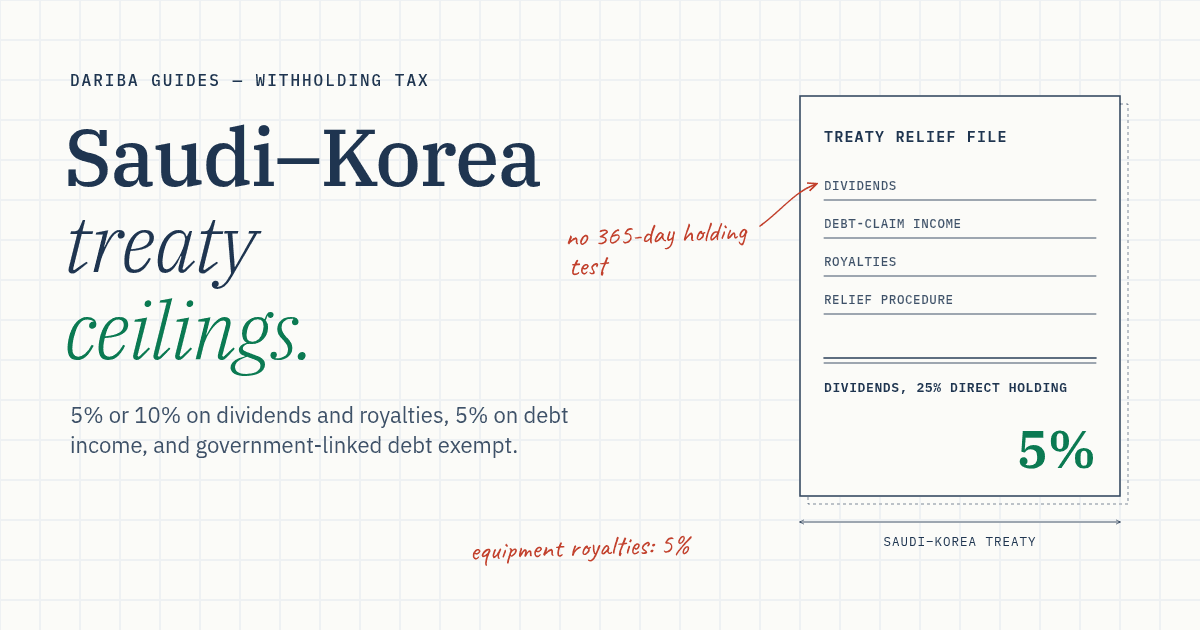
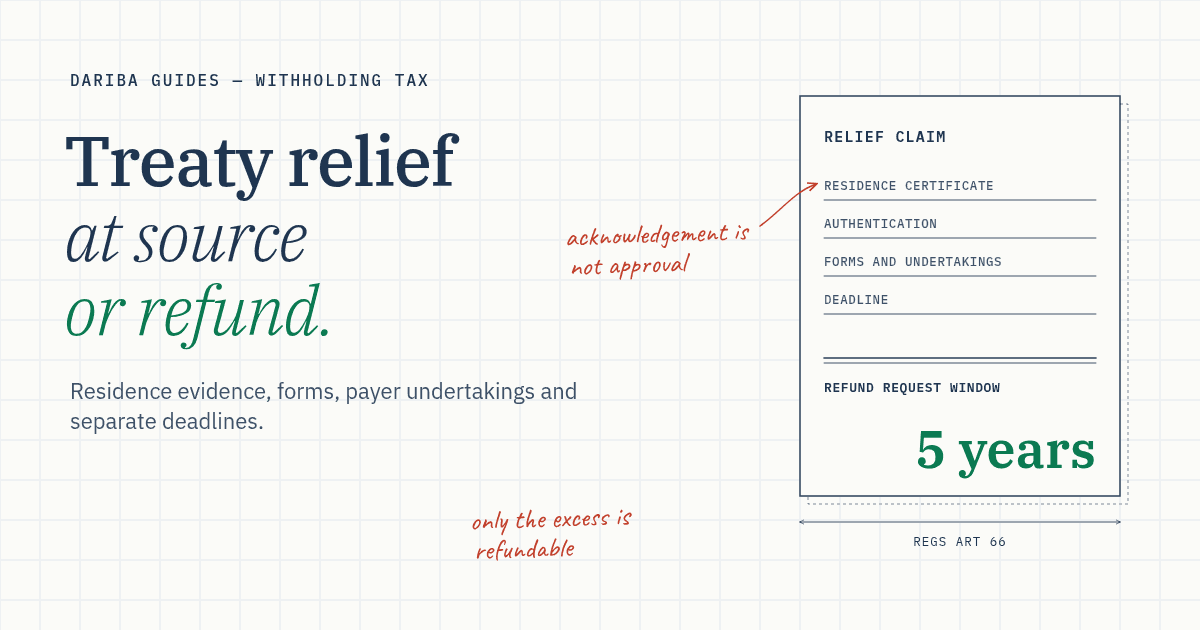
Use the Saudi–Korea withholding guide for the dividend, financing and royalty provisions. Record the treaty basis and local attribution before determining how the Saudi payer should handle withholding or treaty relief.
Key takeaways
- Article 5(3)(a) uses more than six months for specified sites, projects and related supervisory activities.
- Article 5(3)(b) aggregates more than 183 days within any 12 months for services on the same or a connected project.
- A fixed place or agency relationship requires a separate review.
- Protocol paragraph 4 distinguishes merchandise exports from local activity and limits attribution for specified project contracts.
- Individual independent services follow Article 14.
Sources
- Saudi–Korea Convention for the Avoidance of Double Taxation and the Prevention of Tax Evasion with Respect to Taxes on Income and its ProtocolArticles 5, 7, 12 and 14 and Protocol paragraphs 3–5. Paragraph 4(c) covers merchandise exports and associated local activities. Paragraph 4(d) addresses specified project contracts.
- Saudi Arabia’s Deposited MLI Reservations and NotificationsUse with Korea’s deposited position for provision-by-provision matching.
- OECD Sixth Peer Review Report on Treaty Shopping, KoreaThe Saudi Arabia entry records implementation of the principal purpose test through the MLI.