In brief
Apply the 2026 withholding provisions, including the residence-only debt-income rule and 7% royalty ceiling.
A Saudi payer should classify a payment to a Mauritanian resident before applying the Saudi–Mauritania Double Taxation Agreement. The Agreement entered into force on 1 January 2025. Article 30 applies its withholding provisions to amounts paid from 1 January 2026.
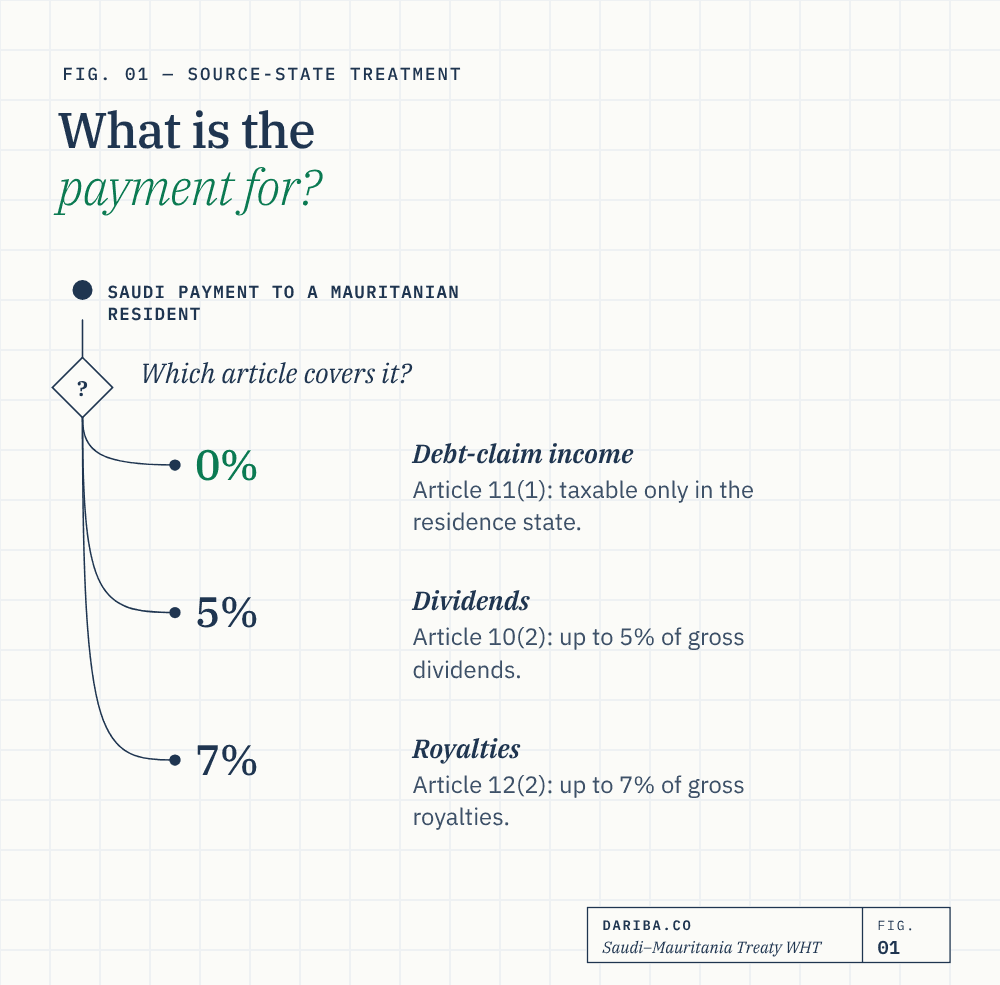
| Payment | Treaty provision | Source-state treatment |
|---|---|---|
| Qualifying dividends | Article 10(2) | Up to 5% of gross dividends |
| Qualifying debt-claim income | Article 11(1) | Taxable exclusively in the beneficial owner’s residence state |
| Qualifying royalties | Article 12(2) | Up to 7% of gross royalties |
Check the lender and the underlying debt
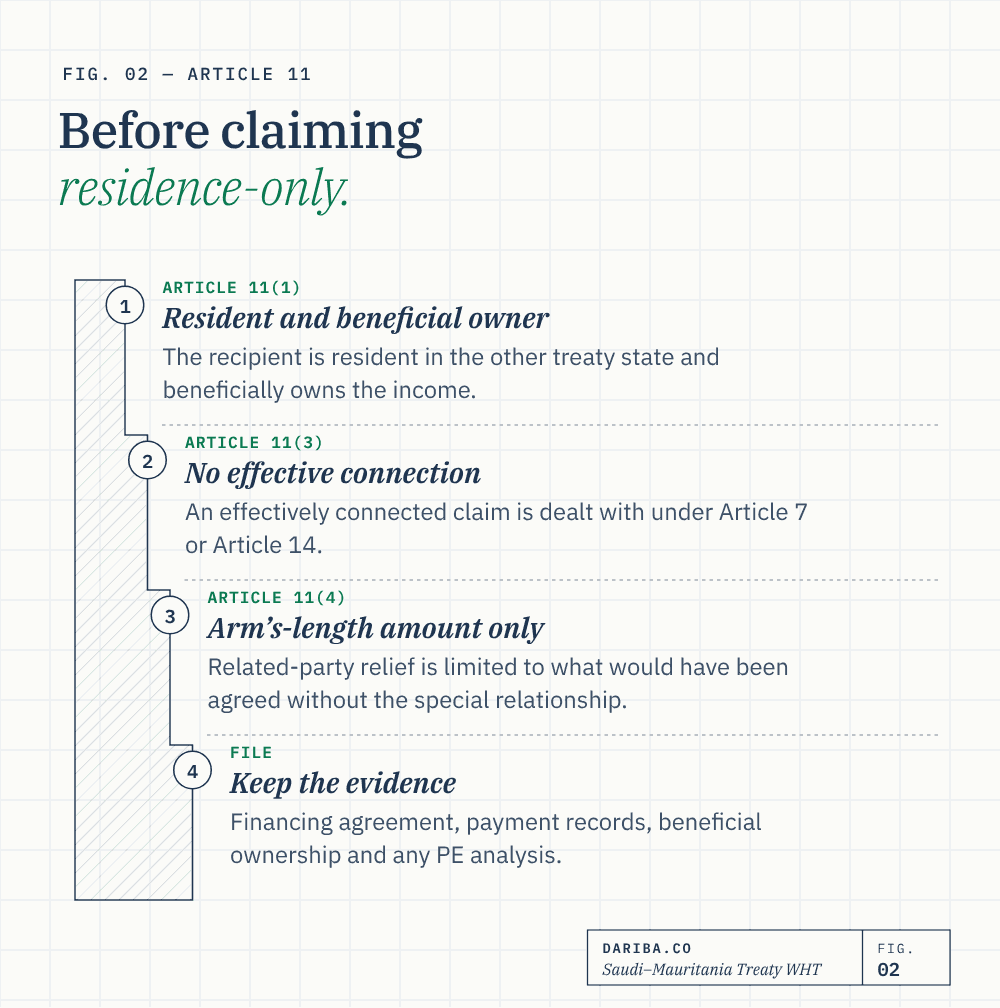
Article 11(1) requires the recipient to be a resident of the other treaty state and the beneficial owner of the income. Article 11(3) directs an effectively connected claim to Article 7 or Article 14. Article 11(4) limits the article’s relief on related-party payments to the amount that would have been agreed without the special relationship. Keep the financing agreement, payment records, beneficial ownership evidence and any local establishment analysis.
Review the separate government provision
Article 27 addresses qualifying Article 10 income earned by a treaty state’s government in the other state and gains from disposal of shares, bonds or rights. It expressly includes the named central banks and wholly state-owned bodies. Establish the claimant’s status and the income or asset covered by the article.
Article 29 preserves domestic anti-avoidance provisions. For an ordinary relief claim, retain the residence and income evidence and use section 4 of ZATCA’s Tax Circular on Implementation of Withholding Tax Under the Double Taxation Agreement for the Saudi filing route.
Key takeaways
- Article 11 generally assigns debt income exclusively to the beneficial owner’s residence state.
- The original provisions apply to amounts paid from 1 January 2026.
Sources
- Saudi–Mauritania Agreement for the Avoidance of Double Taxation and the Prevention of Tax Evasion with Respect to Taxes on Income and on CapitalArticles 10–12 and 27–30.
- ZATCA Treaty Register, Mauritania ConventionEntry into force.
- ZATCA Tax Circular on Implementation of Withholding Tax Under the Double Taxation AgreementSection 4 on relief at source and refunds.