In brief
The treaty applies separate six-month, 183-day and 30-day thresholds to specified activities. It also has special rules for insurers and hydrocarbon-related employment.
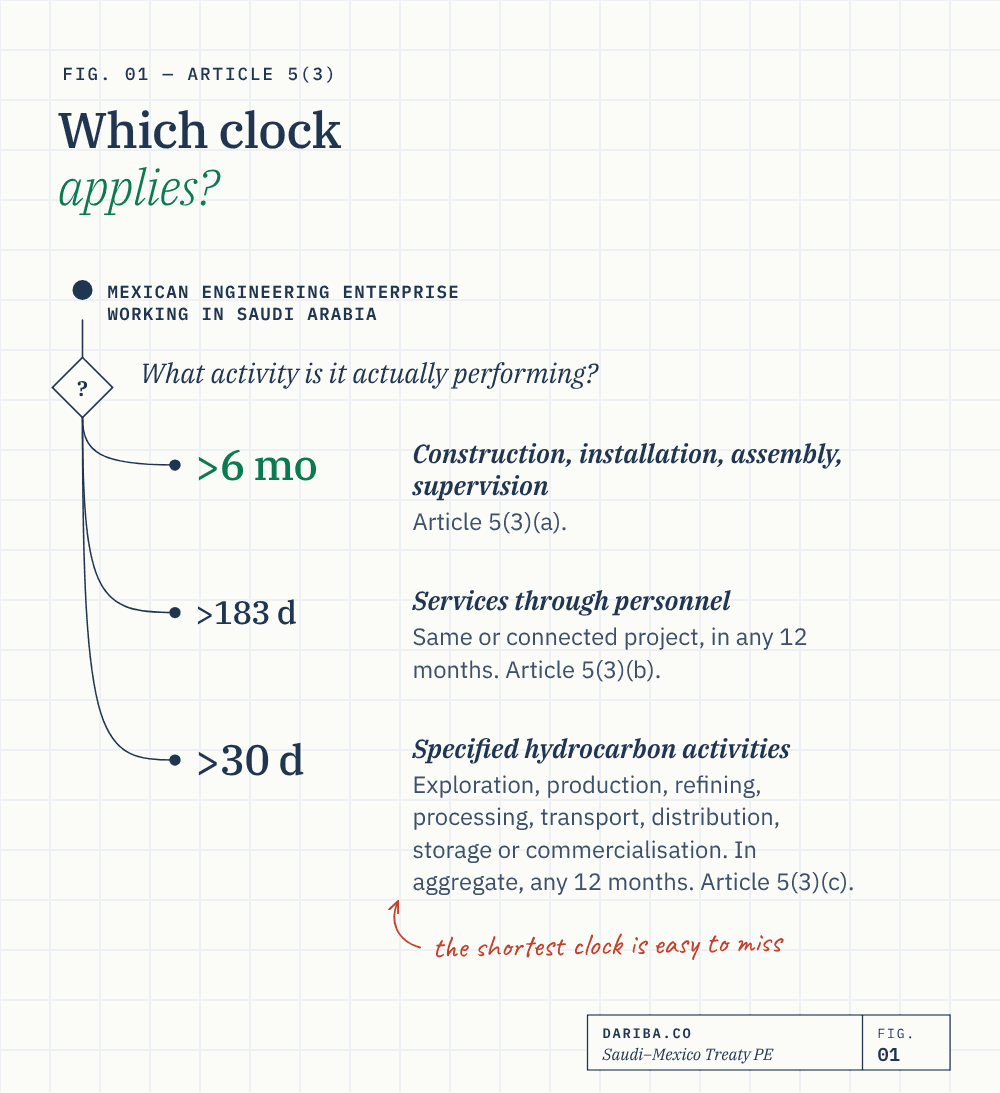
A Mexican engineering enterprise working in Saudi Arabia should identify the activity before choosing a time threshold. Article 5 of the Saudi–Mexico Double Taxation Agreement distinguishes construction, enterprise services and activities involving hydrocarbons.
| Activity | Treaty provision | Time threshold |
|---|---|---|
| Specified construction, installation, assembly or associated supervision | Article 5(3)(a) | More than six months |
| Services through personnel on the same or a connected project | Article 5(3)(b) | More than 183 days in any 12 months |
| Specified hydrocarbon activities | Article 5(3)(c) | More than 30 days in aggregate in any 12 months |
The hydrocarbon limb reaches activities consisting of or connected with the listed exploration, production, refining, processing, transport, distribution, storage or commercialisation. A 31-day assignment can satisfy that time limb if the activities fall within its scope. Map the work to the contract, field activity and project records.
Assess fixed places, agents and insurers
The time tests sit alongside the fixed-place and agency routes. For current cases, check the matched Multilateral Instrument provisions before relying on a local agent or activity exemption. Mexico reserved against MLI Article 14 on contract splitting. Article 5(6) of the bilateral Agreement separately deems an insurance enterprise to have a permanent establishment (PE) where it collects premiums in the other state or insures risks situated there. Test that clause against the actual underwriting and collection arrangements.
Separate enterprise profit from remuneration
Once the enterprise carries on business through a PE, Article 7(1) allows the source state to tax profits attributable to the PE and, within the limits of paragraphs (b) and (c), profits from local sales of goods of the same or a similar kind and from similar local business activities. ZATCA’s Circular 2104001, Force of Attraction Rule in the Context of Permanent Establishment, describes this as partial force of attraction. Protocol paragraph 3 specifically excludes covered merchandise export profits from taxation in the importing state. Income from other activities under the export contract conducted through a local PE may be taxed there. Reconcile the relevant profits to contract deliverables and expenses.
Protocol paragraph 7 separately addresses employment connected with specified hydrocarbon activities. Its 30-day exception also requires a non-resident employer. Another limb covers specified support vessels and aircraft. A conclusion about the enterprise’s PE leaves a separate question about where each employee’s pay can be taxed.
Keep site and travel records, local contracting authority and the allocation of contract revenue and costs. If the Saudi establishment remits profit to its head office, review the separate withholding analysis under Article 10(6).
Key takeaways
- Article 5(3)(a) uses more than six months for specified projects.
- Article 5(3)(b) aggregates more than 183 days within 12 months for the same or a connected service project.
- Article 5(3)(c) uses more than 30 days within 12 months for specified hydrocarbon activities.
- Protocol paragraph 7 separately addresses hydrocarbon-related employment.
Sources
- Saudi–Mexico Agreement for the Avoidance of Double Taxation and the Prevention of Tax Evasion with Respect to Taxes on Income, with ProtocolArticles 5, 7, 14 and 15 and Protocol paragraphs 3, 7 and 10.
- Mexico’s Deposited MLI Reservations and NotificationsListed agreement 49, Article 14 reservation and Article 35 election for Mexico’s own application.
- Saudi Arabia’s Deposited MLI Reservations and NotificationsListed agreement 27 and the relevant agency and activity notifications.
- ZATCA Circular 2104001, Force of Attraction Rule in the Context of Permanent EstablishmentPartial force of attraction and the similarity test.