In brief
The treaty caps qualifying dividends at 5% and royalties at 10%. Debt income has separate recipient tiers, and branch profit remittances have their own limit and tax base.
A Saudi payer should first identify what its Mexican counterparty earned. The Saudi–Mexico Double Taxation Agreement has different rules for a shareholder distribution, a financing return, a royalty and a branch remittance. The original Agreement entered into force on 1 March 2018 and Article 29 applies the original withholding provisions to amounts paid from 1 January 2019.
| Payment | Treaty provision | Source-tax ceiling |
|---|---|---|
| Qualifying dividend | Article 10(2) | 5% of gross dividends |
| Qualifying debt-claim income paid to a financial entity or pension fund | Article 11(2) | 5% of gross income |
| Other qualifying debt-claim income | Article 11(2) | 10% of gross income |
| Qualifying royalty | Article 12(2) | 10% of gross royalties |
Article 26 separately exempts specified Article 10 and 11 income derived by a qualifying government recipient, including the named central banks and wholly owned State entities. Verify the recipient’s legal status and the income covered by that article. The ordinary 5% Saudi domestic rate on loan charges remains relevant where the treaty ceiling is higher.
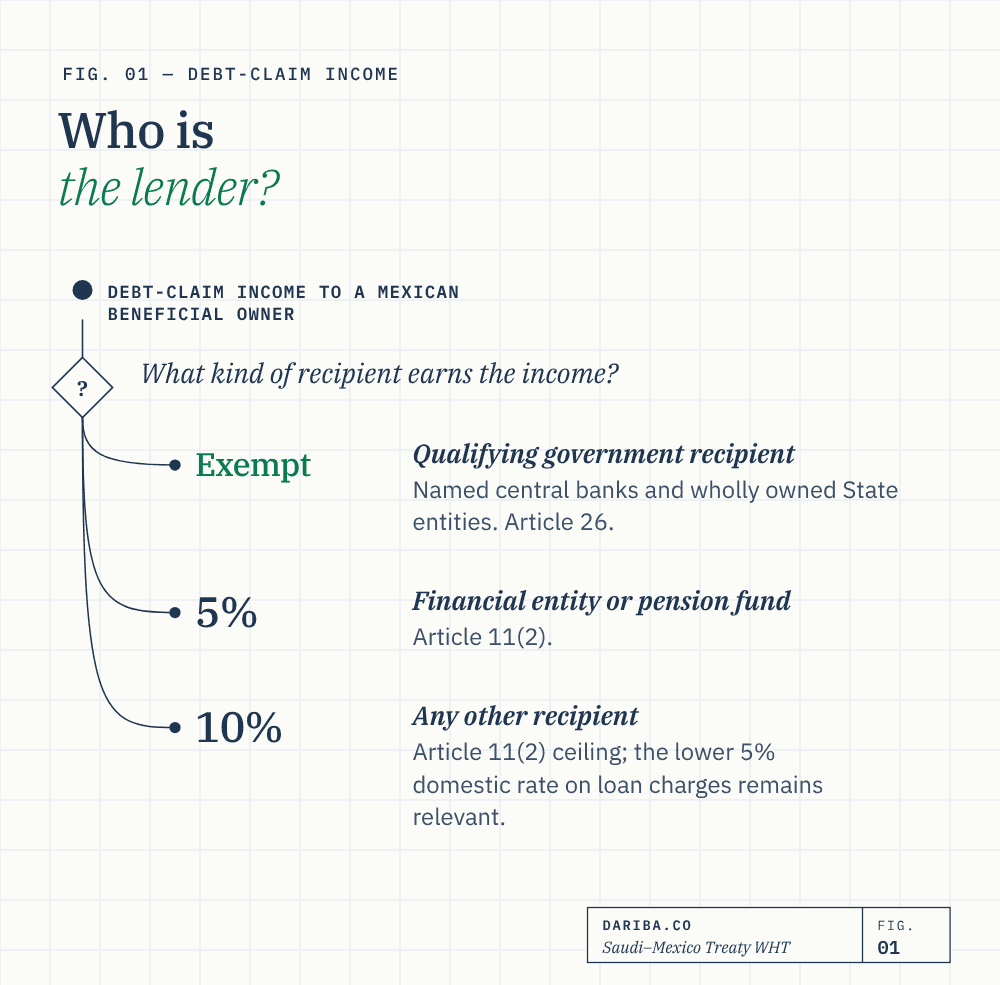
The Article 26 exemption also reaches qualifying dividend income. Check the status of the public recipient before applying the exemption to a distribution.
Calculate branch remittances on the treaty base
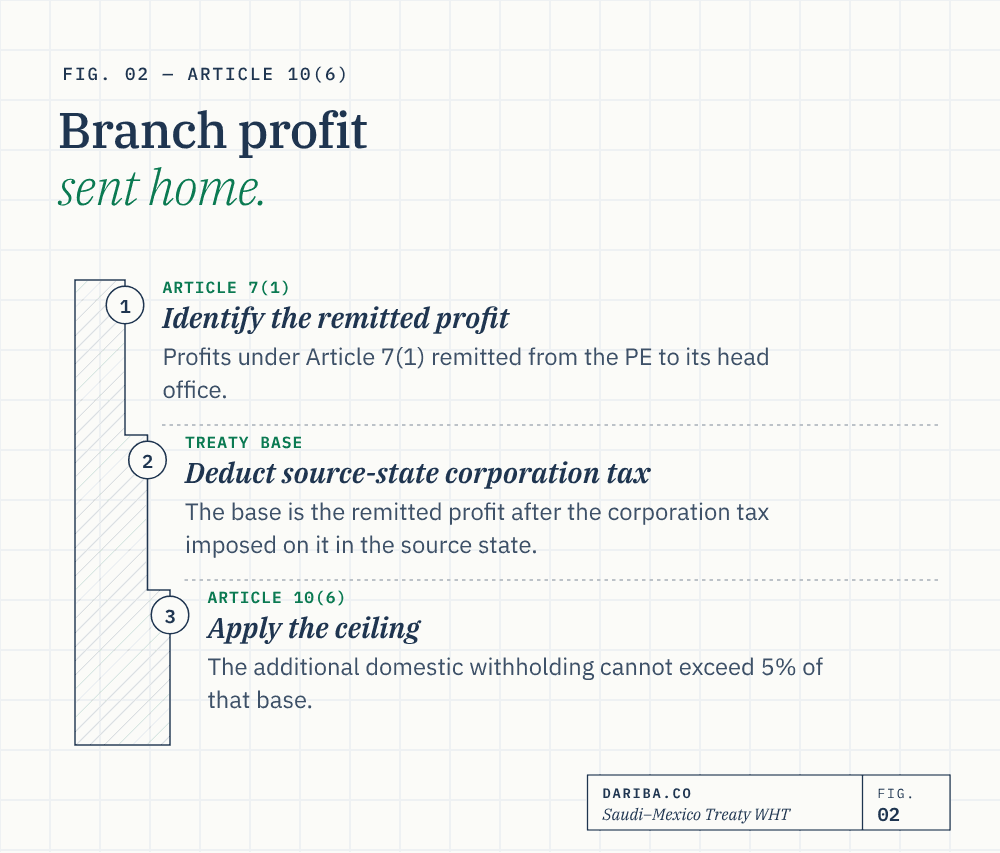
Article 10(6) allows the source state to apply an additional withholding charge under its domestic law when profits under Article 7(1) are remitted from a permanent establishment to its head office. The ceiling is 5% of the remitted profit after deducting the corporation tax imposed on that profit in the source state. If the local branch remits profit, reconcile the underlying profit, corporation tax and amount remitted before applying that limit.
Review contingent payments for rights
Article 12(3) defines qualifying rights and equipment use. Protocol paragraph 6 also includes proceeds from disposal of a listed right or property where payment depends on its productivity, use or disposition. Review the conditions attached to earn-outs and usage-based consideration. Apply the effective-connection and related-party excess clauses to the relevant payment.
Retain the evidence for treaty relief
Both states listed the Agreement for the Multilateral Instrument. Apply the principal purpose test to current arrangements and review the payment period and matched provisions. Retain the residence evidence, beneficial ownership and the commercial reasons for the transaction. Use section 4 of ZATCA’s Tax Circular on Implementation of Withholding Tax Under the Double Taxation Agreement to establish the filing route.
Key takeaways
- Article 11(2) distinguishes qualifying financial entities and pension funds from other recipients.
- Article 10(6) addresses branch profit remittances after corporation tax, subject to a domestic charge.
- Article 26 exempts specified government income under Articles 10 and 11.
- Protocol paragraph 6 treats certain contingent payments on transfers of rights as royalties.
Sources
- Saudi–Mexico Agreement for the Avoidance of Double Taxation and the Prevention of Tax Evasion with Respect to Taxes on Income, with ProtocolArticles 10–12, 26, 28 and 29 and Protocol paragraphs 5–6.
- Mexico’s Official Gazette, Promulgating Decree for the Saudi–Mexico Agreement and ProtocolOfficial Spanish publication of 26 February 2018.
- Mexico’s Deposited MLI Reservations and NotificationsListed agreement 49 and Article 7 positions.
- Saudi Arabia’s Deposited MLI Reservations and NotificationsListed agreement 27 and the Saudi position under Article 7.
- ZATCA Tax Circular on Implementation of Withholding Tax Under the Double Taxation AgreementSection 4 on relief at source and refunds.