In brief
Article 5 has separate six-month project and service tests. The Protocol distinguishes merchandise export profit from profit on other activities carried out through a local permanent establishment.
A Polish company may sell a production line to a Saudi customer and send staff to assemble it, provide training or supervise operations. Article 5 of the Saudi–Poland Double Taxation Convention determines whether the work creates a permanent establishment (PE). Article 7 and Protocol paragraph 3 determine how the export and local work enter the profit analysis.
Check the project and service periods
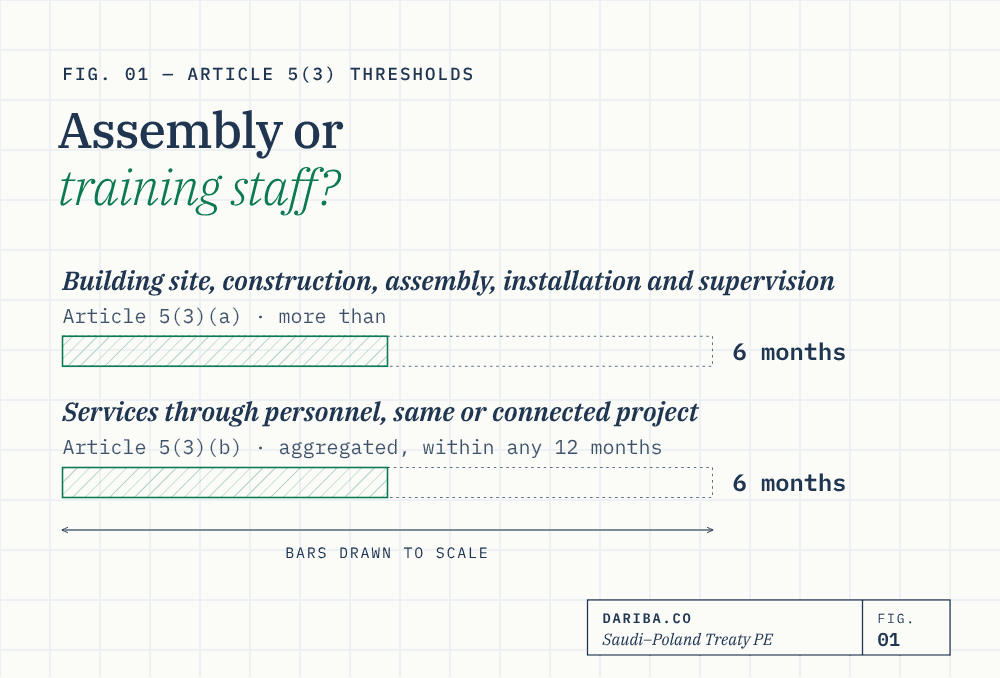
Article 5(3)(a) covers a building site, construction, assembly, installation and related supervision continuing for more than six months. Article 5(3)(b) covers services through employees or other personnel, including consultancy, aggregating more than six months within any 12 months for the same or a connected project. Build a chronology from the work orders, site records and staff activity. Separate contracting documents can still cover connected work.
Examine the warehouse and the agent’s actual role
Articles 5(4)(a) and (b) cover facilities or stock used solely for storage or display. Review dispatch and sales activity where the business also fulfils customer orders from Saudi stock. Article 5(5)(b) separately covers an agent without the specified contracting authority who habitually maintains local stock and regularly delivers it for the enterprise. Article 5(5)(a) addresses habitual exercise of contract authority. Apply the independent-agent rule in paragraph 6 to the actual business relationship.
Attribute profit from the work carried out in Saudi Arabia
Article 7 attributes profit using the separate-enterprise standard. Protocol paragraph 3(a) excludes the stated merchandise export profit from tax in the importing state. If the export contract also includes other activities carried out through a Saudi PE, Saudi Arabia may tax profits derived from those activities. Keep contract pricing, cost records and acceptance evidence that distinguish the merchandise sale and the work of the local PE. Paragraph 3(b) separately preserves application of domestic tax law to insurance activities.
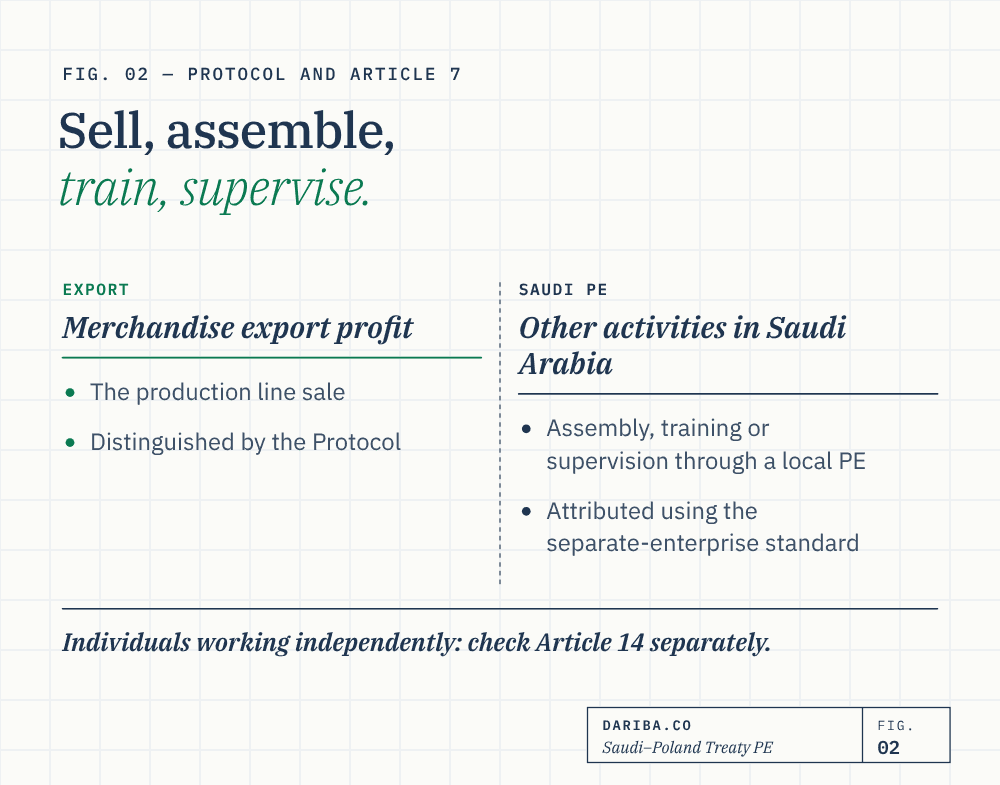
For independent work by an individual, check Article 14 separately. The enterprise’s PE analysis and the nature of each payment inform the Saudi withholding analysis and the tax position of the people performing the work.
Key takeaways
- Article 5(3)(a) uses more than six months for specified construction and similar projects.
- Article 5(3)(b) aggregates more than six months within any 12 months for the same or a connected service project.
- The storage or display clauses in Article 5(4)(a) and (b) should be read separately from agency deliveries under Article 5(5)(b).
- Protocol paragraph 3(a) distinguishes merchandise export profit from other work carried out through a local establishment.
Sources
- Saudi–Poland Convention for the Avoidance of Double Taxation and the Prevention of Tax Evasion with Respect to Taxes on Income, with ProtocolArticles 5, 7 and 14 and Protocol paragraph 3.
- Polish Ministry of Finance, Synthesised Text of the MLI and the Saudi–Poland ConventionArticle 5 and the matched anti-abuse changes.