In brief
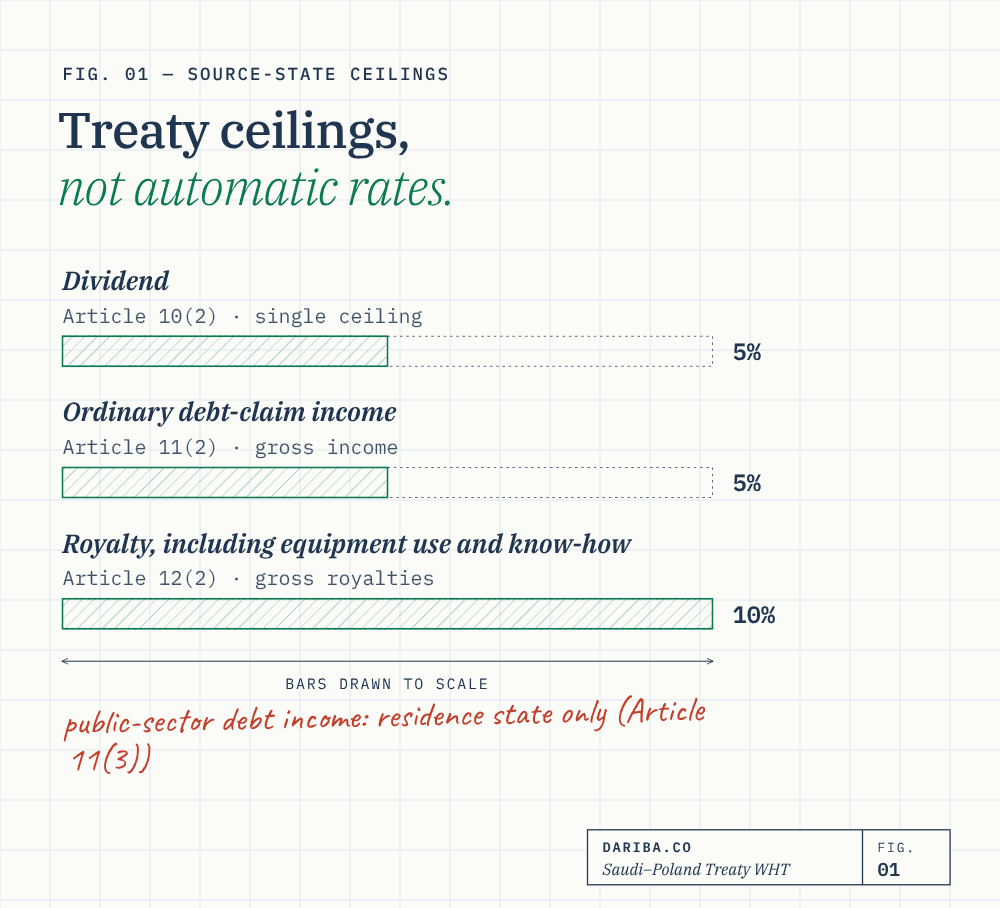
The Saudi–Poland treaty caps qualifying dividends and ordinary debt income at 5% and royalties at 10%. Article 11(3) gives specified public-sector debt income exclusive residence-state taxation.
A Saudi company paying a Polish resident should identify the contract rights or investment generating the payment before applying the Saudi–Poland Double Taxation Convention. The original treaty entered into force on 1 June 2012. Its withholding provisions applied from 1 January 2013. Poland’s Ministry of Finance identifies 1 January 2021 as the general MLI application date for withholding events in both states.
| Payment to a qualifying Polish beneficial owner | Treaty provision | Source-tax ceiling or allocation |
|---|---|---|
| Dividend | Article 10(2) | 5% of gross dividends |
| Ordinary debt-claim income | Article 11(2) | 5% of gross income |
| Qualifying public-sector debt-claim income | Article 11(3) | Taxable only in the beneficial owner’s state |
| Royalty | Article 12(2) | 10% of gross royalties |
Identify the dividend recipient and debt exemption
Article 10(2) gives a single 5% ceiling where the beneficial owner is resident in the other state. Check the recipient’s residence and beneficial ownership and whether Article 10(4) redirects an effectively connected holding to the business-profits or fixed-base rules. The ordinary Saudi domestic dividend rate is also 5%.
Article 11(3) covers payments by the specified government or public authority, payments to the other state’s government or specified authority, and payments to its central bank or specified owned or controlled corporate body. Verify the public body’s identity and ownership or control, the actual debtor and the recipient’s beneficial ownership. Late-payment penalties fall outside the debt-claim definition in Article 11(4). Review any fee or charge separately, together with the effective-connection, source and related-party excess rules.
Classify the royalty and support the relief claim
Article 12(3) covers specified intellectual property, know-how and use of industrial, commercial or scientific equipment. Identify the rights granted under a licence or equipment contract. Reconcile the price allocation where the contract includes both services and rights. Article 12(4) addresses effective connection, and paragraphs 5 and 6 cover source and excess caused by a special relationship.
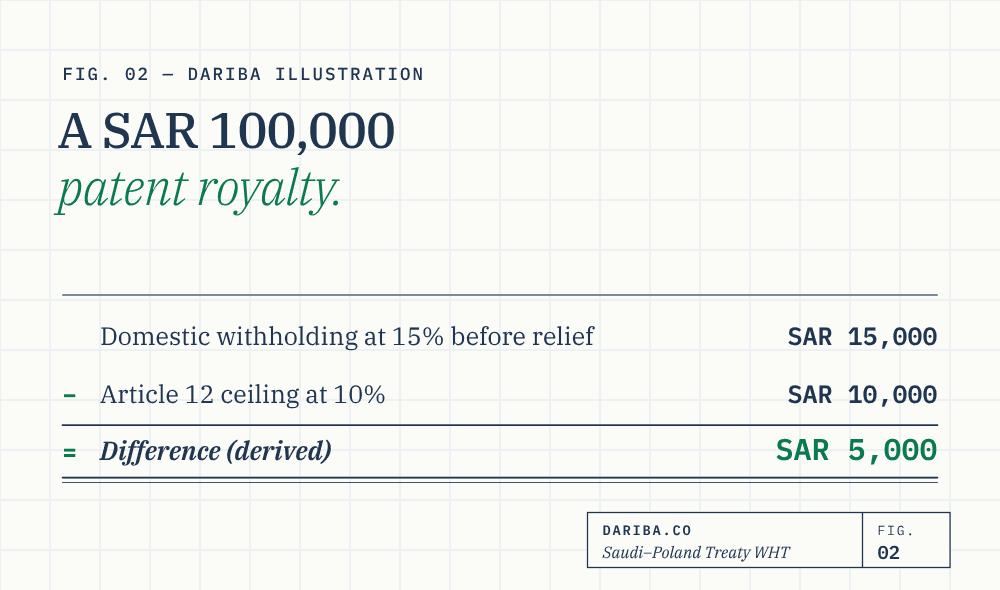
Dariba illustration. A SAR 100,000 patent royalty subject to Saudi domestic withholding at 15% would produce SAR 15,000 before relief. A qualifying Article 12 ceiling of 10% would limit it to SAR 10,000. If a lower domestic charge applies to the payment, that lower amount remains relevant.
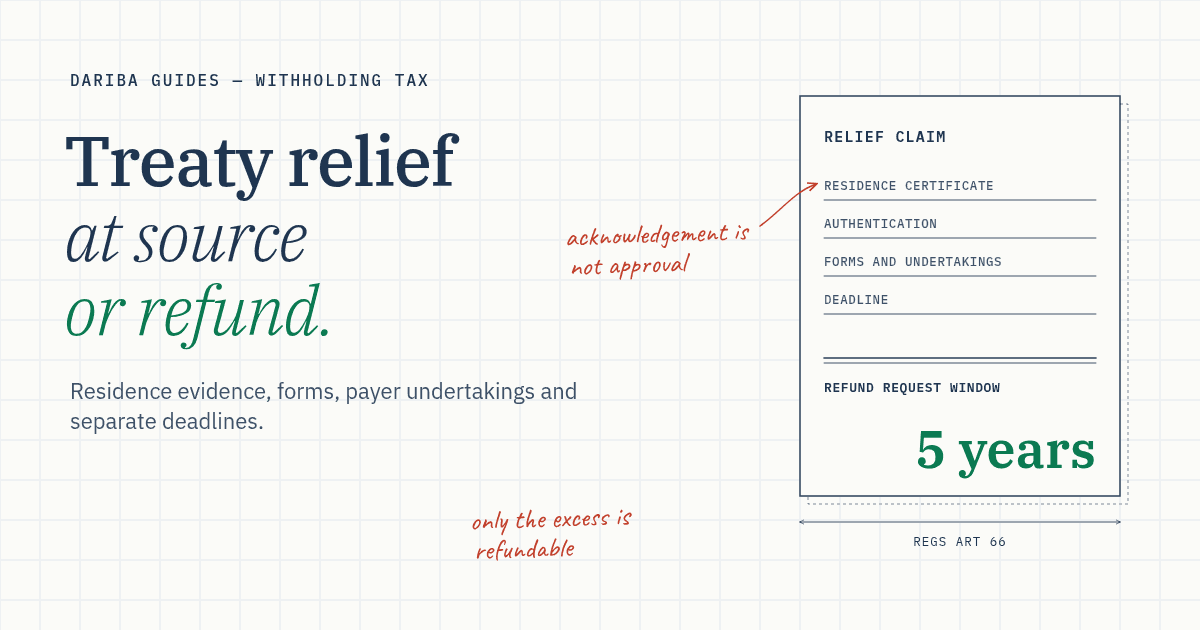
MLI Article 7(1) replaces the original Article 27 rule with the principal purpose test. Retain the commercial rationale for the arrangements, the residency and beneficial ownership evidence, the contract and the withholding calculation. Follow section 4 of ZATCA’s Tax Circular on Implementation of Withholding Tax Under the Double Taxation Agreement for the applicable relief-at-source or refund route.
Key takeaways
- The 5% dividend ceiling in Article 10(2) requires qualifying residence and beneficial ownership.
- Article 11(3) addresses specified government, central-bank and public-body debt payments.
- Article 12 includes equipment use among the rights that can generate royalties.
- MLI Article 7(1) replaces the original Article 27 anti-abuse rule.
Sources
- Saudi–Poland Convention for the Avoidance of Double Taxation and the Prevention of Tax Evasion with Respect to Taxes on Income, with ProtocolArticles 10–12 and 27–28.
- Polish Ministry of Finance, Synthesised Text of the MLI and the Saudi–Poland ConventionWithholding application date and the replacement of Article 27 by MLI Article 7(1).
- ZATCA, Poland ConventionEntry into force on 1 June 2012.
- ZATCA Tax Circular on Implementation of Withholding Tax Under the Double Taxation AgreementSection 4, relief at source and refunds.