In brief
Article 5 applies separate six-month tests to projects and enterprise services. Protocol paragraph 4 distinguishes merchandise export profit from other activities carried out through a local establishment.
A Portuguese equipment supplier can sell machinery to a Saudi customer and agree to install it, supervise commissioning or train staff. Article 5 of the Saudi–Portugal Double Taxation Convention determines whether the activities create a Saudi permanent establishment (PE). Article 7 and Protocol paragraph 4 govern the associated profit calculation.
Measure the local project and services
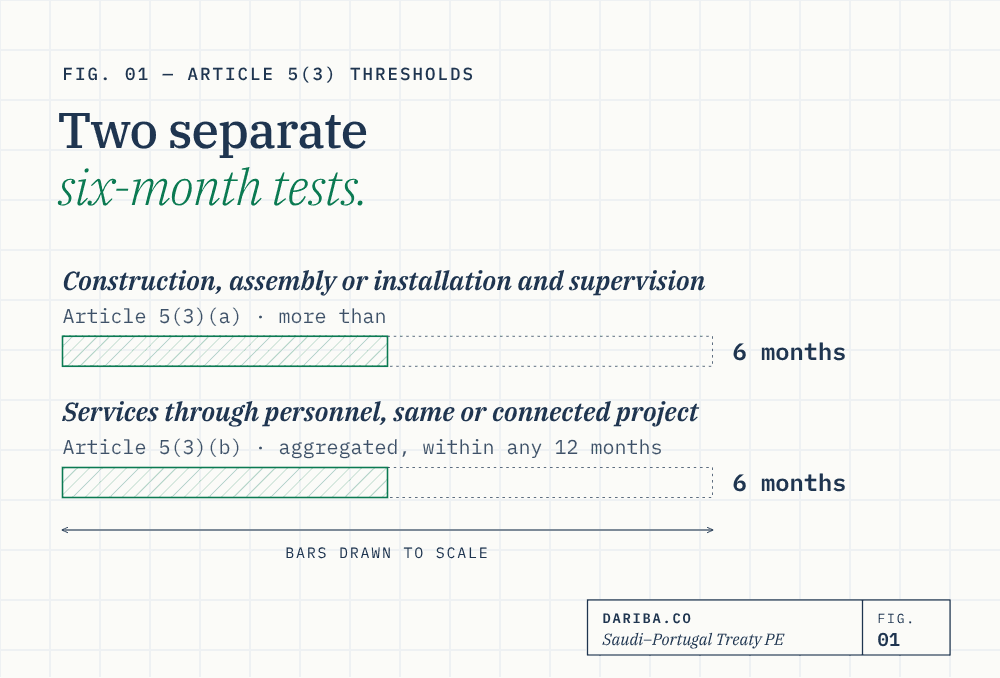
Article 5(3)(a) applies to specified construction, assembly or installation projects and related supervision continuing for more than six months. Article 5(3)(b) aggregates more than six months within any 12 months for services furnished through personnel on the same or a connected project. Record when work began and ended, which team performed it and whether multiple work orders cover connected activity.
Review the fixed place and the agency relationship
Check the enterprise’s premises under Article 5(1) and any claimed activity exemption in paragraph 4. The original agency provision in Article 5(5) addresses habitual exercise of contract authority and specified local stock and regular delivery arrangements. Paragraph 6 concerns agents acting independently in the ordinary course of business. Portugal reserved against MLI Article 12 and Article 14 in full. Review any separate matched MLI activity-exemption provisions when relying on a warehouse or other limited activity.
Allocate the export profit and the local work
Protocol paragraph 4(b) excludes the stated merchandise export profits from tax in the importing state. Other activities under the same export contract can generate profits taxable under Article 7 where the work is carried on through a local PE. Use delivery, installation and acceptance records to establish the actual work. Reconcile the contract price and costs with the functions and risks of the Saudi establishment.
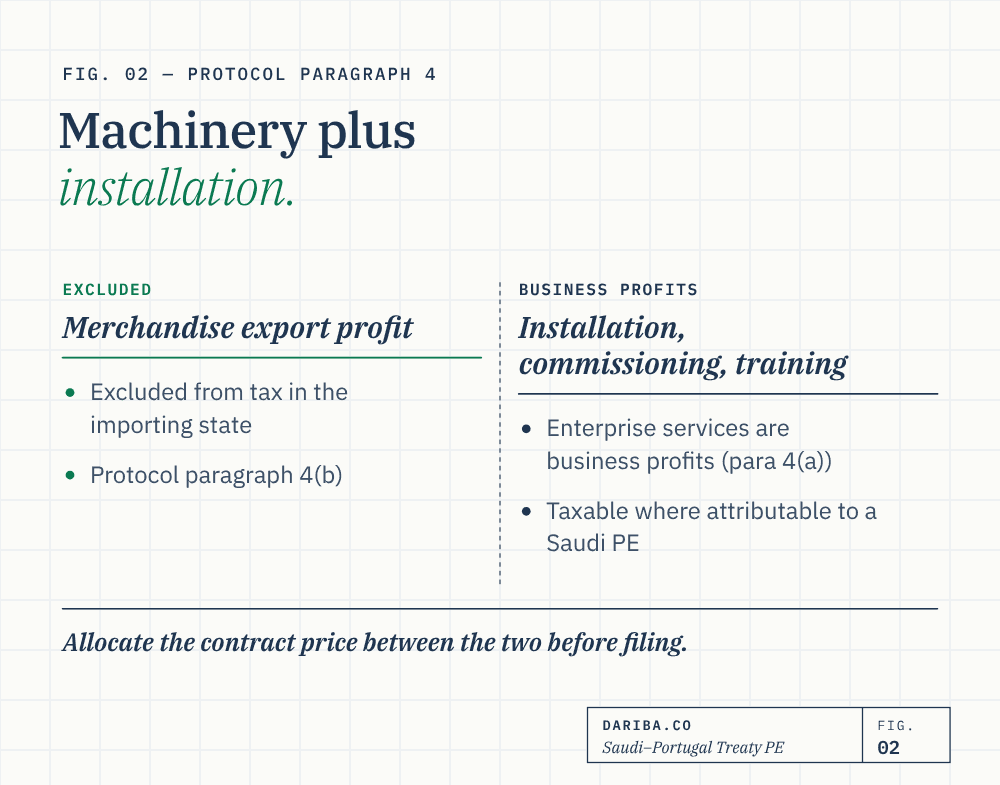
Protocol paragraph 4(a) includes enterprise services in business profits. Review Article 14 separately for independent services performed by individuals, and Article 12 for any equipment-use or intellectual property rights. The income classification and effective connection inform the withholding analysis.
Key takeaways
- Article 5(3)(a) uses more than six months for specified projects and supervision.
- Article 5(3)(b) aggregates more than six months within any 12 months for the same or connected service projects.
- Portugal reserved against MLI Articles 12 and 14, so those provisions do not supply additional agency or contract-splitting rules.
- Protocol paragraph 4(b) separates merchandise export profit and profits on other activities through a local establishment.
Sources
- Saudi–Portugal Convention for the Avoidance of Double Taxation and the Prevention of Tax Evasion with Respect to Taxes on Income, with ProtocolArticles 5, 7, 12 and 14 and Protocol paragraph 4.
- Portugal’s Deposited MLI Reservations and NotificationsReservations under Articles 12(4) and 14(3)(a).
- Portugal’s Assembly Resolution No. 127/2016, Saudi–Portugal Convention and ProtocolAuthenticated treaty and Protocol.