In brief
The treaty provides 5% and 10% dividend tiers, a 10% ordinary debt-income ceiling and an 8% royalty ceiling. Specified public-sector debt income can be taxed only in the recipient’s state.
A Saudi company paying a Portuguese resident should compare the relevant domestic withholding category with the Saudi–Portugal Double Taxation Convention. For a dividend, the owner and direct capital holding matter. For debt income, the treaty distinguishes the ordinary ceiling from a separate rule for specified public-sector recipients.
| Payment to a qualifying Portuguese beneficial owner | Treaty provision | Source-tax ceiling or allocation |
|---|---|---|
| Dividend to a company other than a partnership with a direct holding of at least 10%, or to a specified public recipient | Article 10(2)(a) | 5% of gross dividends |
| Other qualifying dividend | Article 10(2)(b) | 10% of gross dividends |
| Ordinary debt-claim income | Article 11(2) | 10% of gross income |
| Debt income paid to and beneficially owned by a qualifying public recipient | Article 11(3) | Taxable only in the recipient’s state |
| Qualifying royalty | Article 12(2) | 8% of gross royalties |
Check the public recipient rules in the direction of the payment
For Saudi-source income, the Portuguese-side lists in Articles 10(2)(a)(ii) and 11(3)(b) include the Portuguese State, specified subdivisions or local authorities, and the Central Bank of Portugal. The lists for Saudi recipients address different entities. Verify the applicable recipient category and beneficial ownership before claiming relief.
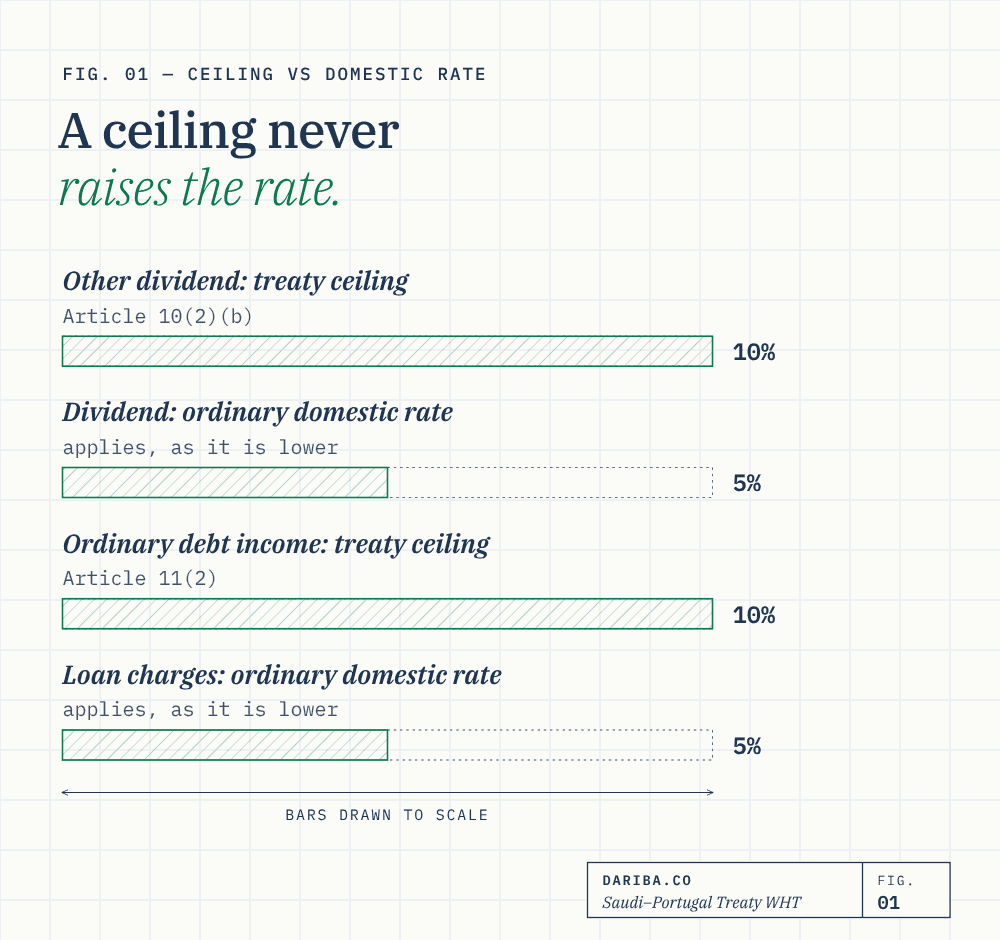
The ordinary Saudi domestic rates on dividends and loan charges are 5%. The 10% treaty ceilings do not raise those rates. Article 11(4) excludes late-payment penalties from its debt-income definition. Apply paragraphs 5–7 to effective connection, source and excess caused by a special relationship. Paragraph 5 expressly refers to paragraphs 1 and 2, so check the precise conditions of paragraph 3 for public debt connected to a Saudi establishment.
Classify the rights and support the claim
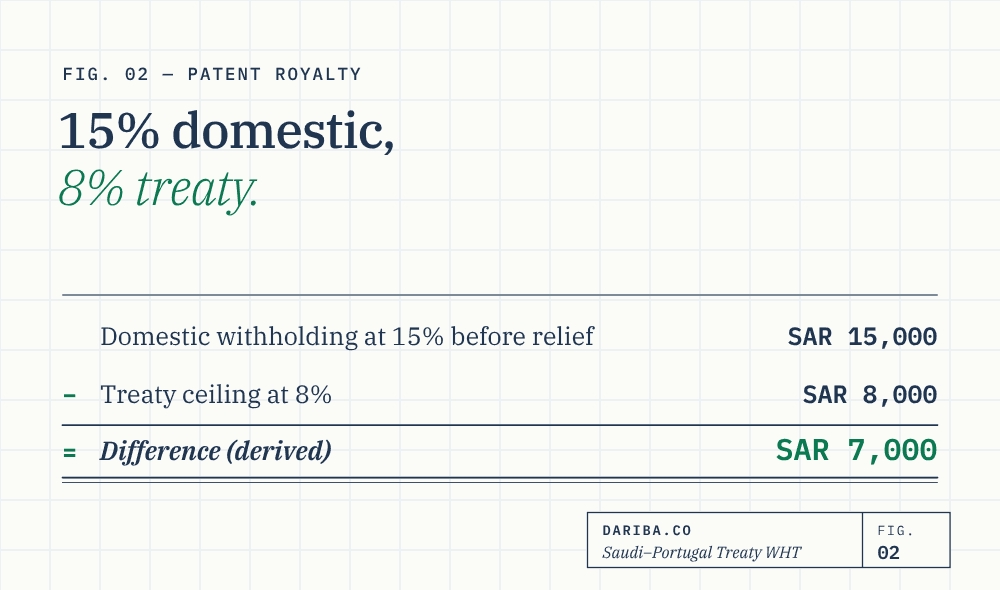
Article 12(3) includes specified intellectual property, know-how and equipment-use rights. Separate those rights from work performed under the same contract and review any effectively connected establishment. Dariba illustration. An assumed SAR 100,000 patent royalty subject to domestic withholding of 15% gives SAR 15,000 before relief. If the treaty’s 8% ceiling applies, it gives SAR 8,000.
The original Convention entered into force on 1 September 2016. Article 28 applies its original withholding provisions from 1 January 2017. For current claims, apply the principal purpose test under the Multilateral Instrument and review the Convention’s beneficial-ownership requirements. Use section 4 of ZATCA’s Tax Circular on Implementation of Withholding Tax Under the Double Taxation Agreement for the applicable filing and evidence.
Key takeaways
- Article 10(2)(a) uses a qualifying direct 10% capital holding or a separately listed public recipient.
- Article 11(3) addresses specified government and central-bank debt income.
- A 10% debt ceiling cannot raise a lower applicable Saudi domestic rate.
- Article 12 applies an 8% ceiling to qualifying royalties.
Sources
- Saudi–Portugal Convention for the Avoidance of Double Taxation and the Prevention of Tax Evasion with Respect to Taxes on Income, with ProtocolArticles 10–12, 27–28 and Protocol paragraph 6.
- Portugal’s Assembly Resolution No. 127/2016, Saudi–Portugal Convention and ProtocolAuthenticated texts of the Convention and Protocol.
- OECD Sixth Peer Review Report on Treaty Shopping, Saudi ArabiaPortugal row records the principal purpose test through the MLI.
- ZATCA Tax Circular on Implementation of Withholding Tax Under the Double Taxation AgreementSection 4, relief at source and refunds.