In brief
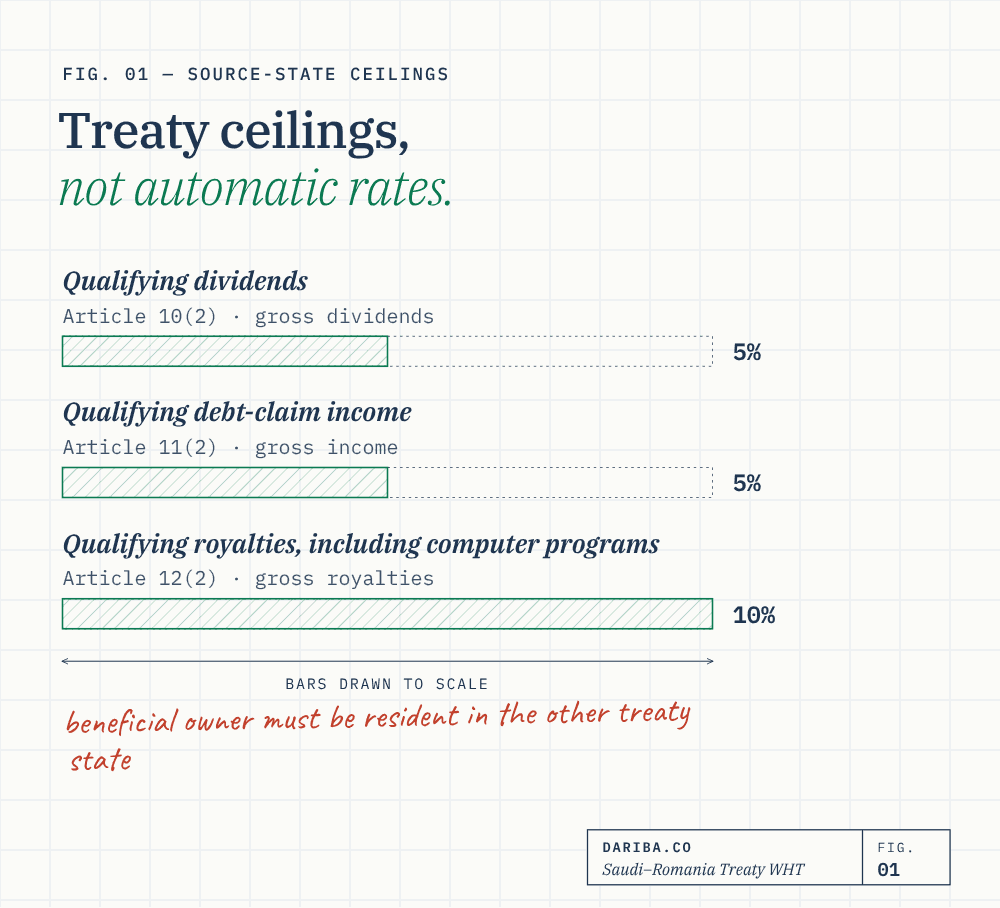
Qualifying dividends and debt income carry 5% ceilings, and qualifying royalties carry a 10% ceiling. Government and export-finance exemptions have their own conditions.
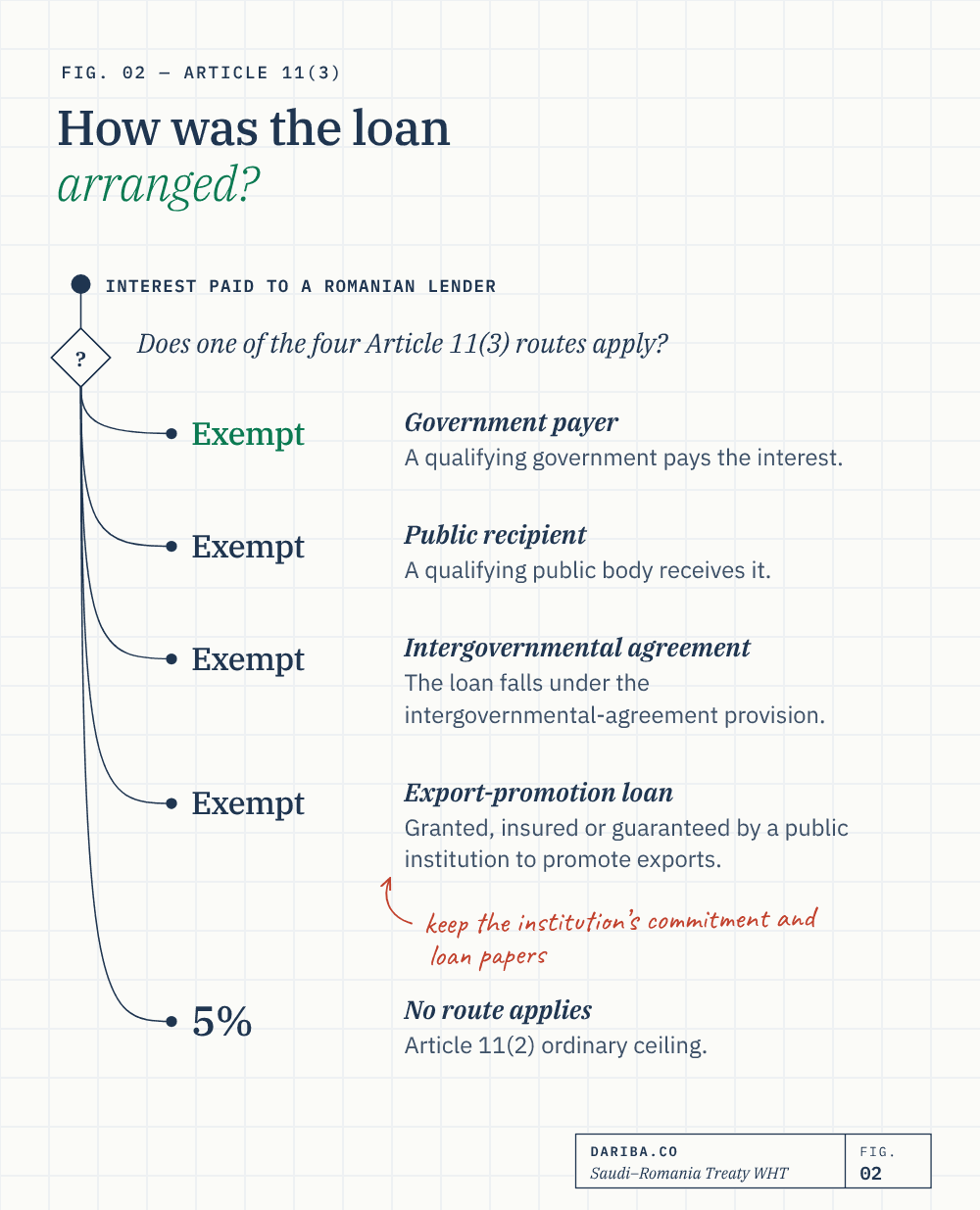
A Saudi borrower paying a Romanian lender should check how the loan was arranged and whether a public institution granted, insured or guaranteed it to promote exports. The Saudi–Romania Double Taxation Convention applies ordinary withholding ceilings and gives qualifying government and export financing separate treatment.
| Payment | Treaty provision | Source-state ceiling |
|---|---|---|
| Qualifying dividends | Article 10(2) | 5% of gross dividends |
| Qualifying debt-claim income | Article 11(2) | 5% of gross income |
| Qualifying royalties | Article 12(2) | 10% of gross royalties |
The ceilings require a beneficial owner resident in the other treaty state. Article 10(3) separately exempts qualifying dividends paid to the other state’s government, listed subdivisions or authorities and specified wholly owned agencies or institutions.
Identify the applicable debt exemption
Article 11(3) provides four alternative routes. They cover a qualifying government payer, a qualifying public recipient, a loan to which the intergovernmental-agreement provision applies, and a loan granted, insured or guaranteed by a public institution to promote exports. For the last route, retain the institution’s commitment, the loan documentation and evidence that the arrangement serves the export purpose. An export contract can help establish the purpose of the financing.
Check effective connection and filing dates
Article 12(3) includes specified copyrights, including computer programs, as well as equipment rights and know-how. Read the contract to identify the right granted. Where the relevant shareholding, debt claim or royalty right is effectively connected with a local permanent establishment or fixed base, check Article 7 or 14. The permanent establishment guide explains the activity tests.
Romania’s tax administration dates the Multilateral Instrument’s withholding changes from 1 January 2024 in both states. Those changes include the principal purpose test. Keep evidence of residence, beneficial ownership, the relevant exemption and the commercial reasons for the arrangement. Section 4 of ZATCA’s Tax Circular on Implementation of Withholding Tax Under the Double Taxation Agreement describes the Saudi filing routes.
Key takeaways
- Articles 10–12 set gross-payment ceilings of 5%, 5% and 10% respectively.
- Article 11(3) provides alternative qualifying routes for exempt debt-claim income.
- A public institution can qualify under the export-finance route by granting, insuring or guaranteeing a loan to promote exports.
Sources
- Saudi–Romania Convention for the Avoidance of Double Taxation and the Prevention of Tax Evasion with Respect to Taxes on IncomeZATCA’s English treaty text, Articles 10–12.
- Romanian Tax Administration’s Synthesised Text of the Saudi–Romania Convention and the Multilateral InstrumentApplication dates and replacement of Article 27 by the principal purpose test.
- ZATCA Tax Circular on Implementation of Withholding Tax Under the Double Taxation AgreementSection 4 on relief at source and refund claims.