In brief
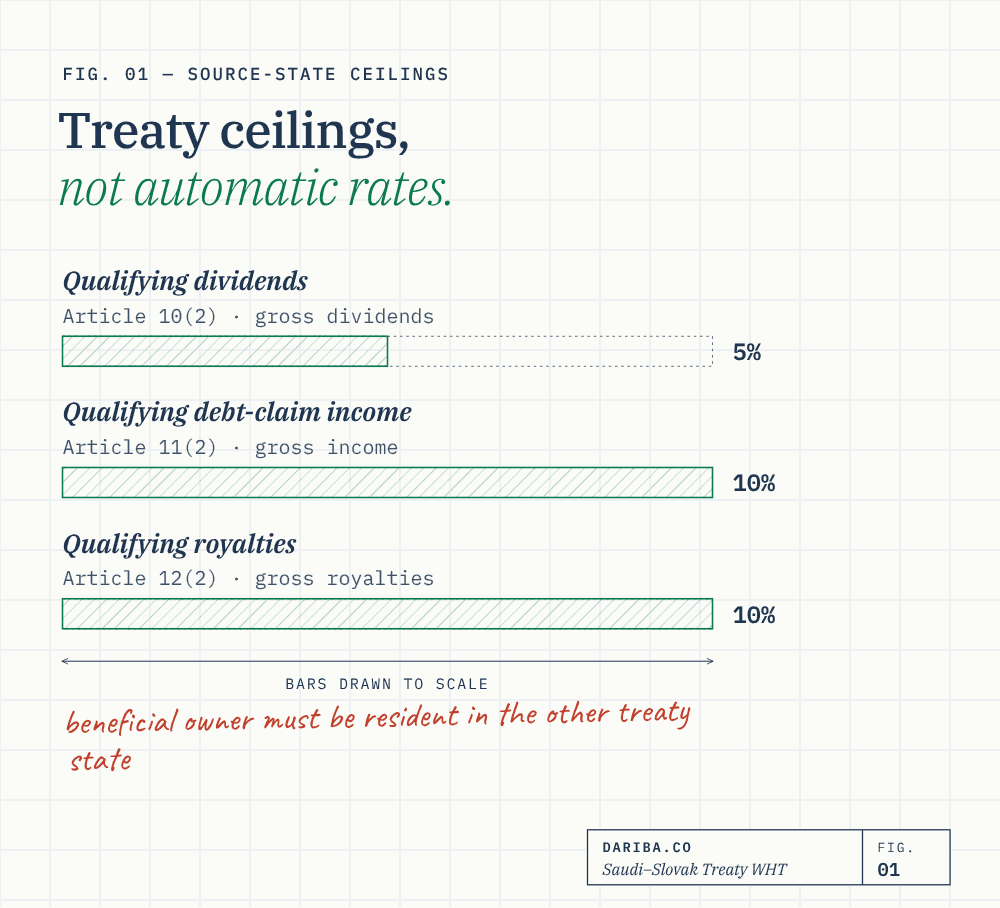
The agreement caps qualifying dividends at 5% and debt income and royalties at 10%. Article 11(3) exempts debt income derived and beneficially owned by specified public investors.
A Saudi borrower paying a Slovak lender should check the lender’s role and the source of the financing return. The Saudi–Slovak Double Taxation Agreement entered into force on 1 August 2024, according to the Slovak Ministry of Foreign and European Affairs’ treaty notice. Article 28 applies the original withholding provisions to amounts paid or credited from 1 January 2025.
| Payment | Treaty provision | Source-state ceiling |
|---|---|---|
| Qualifying dividends | Article 10(2) | 5% of gross dividends |
| Qualifying debt-claim income | Article 11(2) | 10% of gross income |
| Qualifying royalties | Article 12(2) | 10% of gross royalties |
The ordinary ceilings require a beneficial owner resident in the other treaty state. Where the Saudi domestic loan-charge rate applies below the treaty ceiling, use the domestic charge. Article 12(3) includes payments for specified rights, equipment use and know-how.
Check who derives and beneficially owns the debt income
Article 11(3) exempts qualifying debt income derived and beneficially owned by a listed public body or institution. The Slovak list includes its government, local authorities, central bank, export-import bank and specified development and debt-management institutions. The Saudi list includes the government, Saudi Central Bank, Saudi Fund for Development, Public Investment Fund and General Organization for Social Insurance. The additional similar-institution routes require qualifying public ownership and an agreement through an exchange of diplomatic notes.
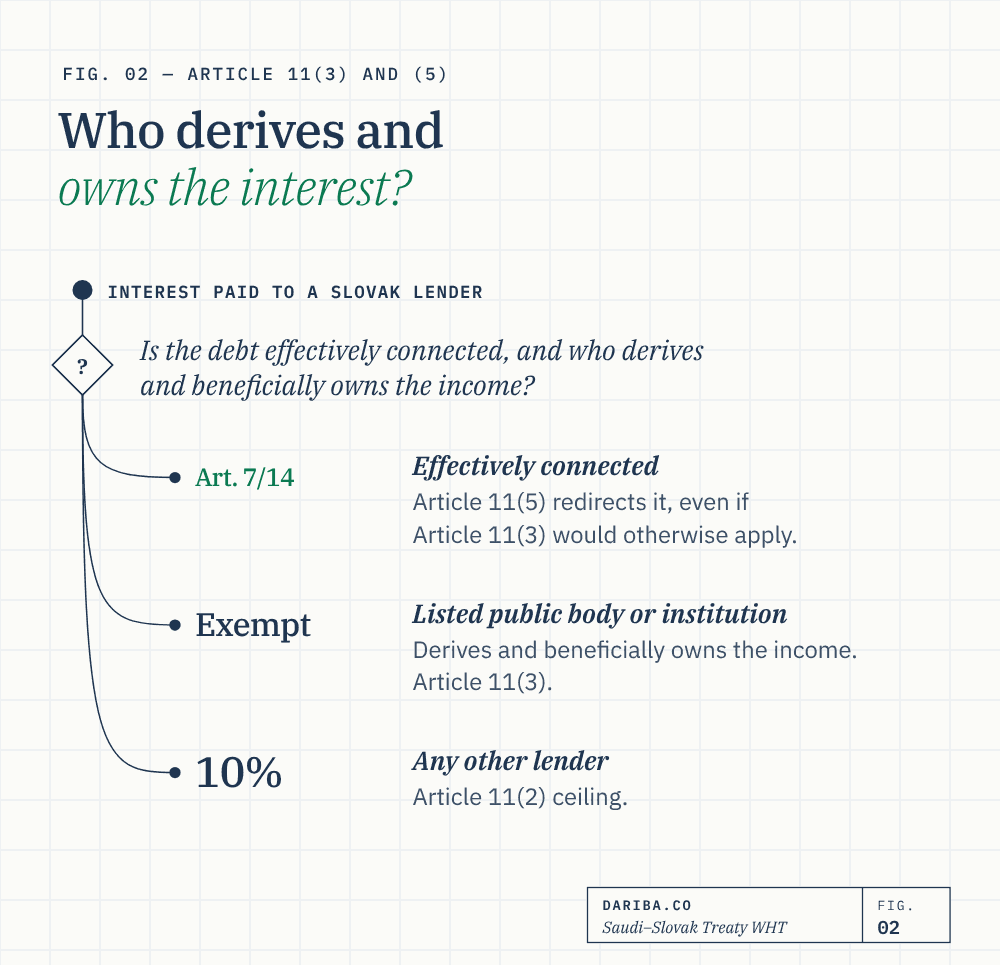
Article 11(5) redirects effectively connected debt income, including income otherwise within Article 11(3), to Article 7 or Article 14 as applicable. Article 11(7) limits relief on related-party debt income to the amount the parties would have agreed without the special relationship. Document the financing, beneficial ownership and the local establishment analysis. Article 27 preserves domestic anti-avoidance rules and denies treaty benefits for income connected with an artificial arrangement. Section 4 of ZATCA’s Tax Circular on Implementation of Withholding Tax Under the Double Taxation Agreement sets out the Saudi filing routes.
Key takeaways
- Original withholding provisions apply to amounts paid or credited from 1 January 2025.
- Article 11(3) has separate lists of qualifying Slovak and Saudi public investors.
- The domestic loan-charge rate remains relevant when the treaty ceiling is higher.
Sources
- Saudi–Slovak Agreement for the Avoidance of Double Taxation with Respect to Taxes on Income and the Prevention of Tax EvasionArticles 4, 10–12 and 27–28.
- Slovak Ministry of Foreign and European Affairs Notice No. 139/2024 on the Saudi–Slovak Double Taxation AgreementEntry into force on 1 August 2024.
- ZATCA Tax Circular on Implementation of Withholding Tax Under the Double Taxation AgreementSection 4 on relief at source and refund claims.