In brief
Article 5 has separate six-month tests for construction and services. The MLI adds preparatory or auxiliary conditions and an anti-fragmentation rule to the activity exemptions.
A South African company that sends a team to Saudi Arabia or holds stock there should test its activities under Article 5 of the Saudi–South Africa Double Taxation Convention. The project and service thresholds sit alongside the fixed-place and agency provisions.
Measure the correct activity period
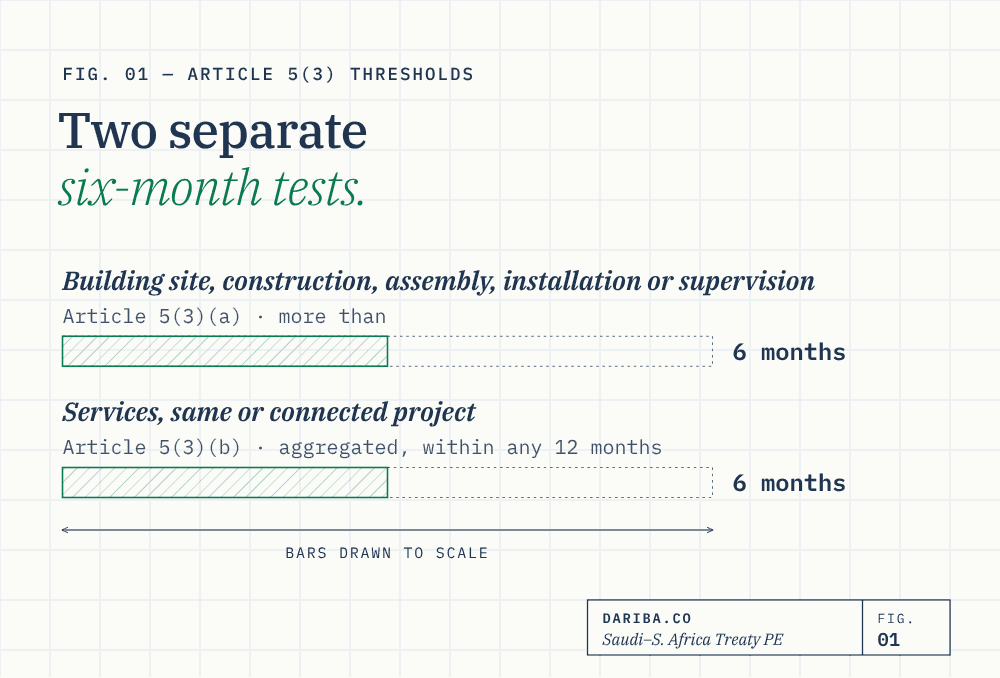
Article 5(3)(a) uses more than six months for a building site, construction, assembly, installation or related supervisory activity. Article 5(3)(b) separately covers enterprise services, including consultancy, through personnel for the same or a connected project. It aggregates periods exceeding six months within any 12 months. Keep the site, personnel and work-order records in the units the Convention uses.
The South African Revenue Service’s synthesised text identifies taxable periods beginning from 1 July 2023 for the general MLI application to taxes other than withholding. Confirm the taxpayer’s actual period and which provision applies to the activity.
Assess the whole operation before relying on a fixed-place exemption
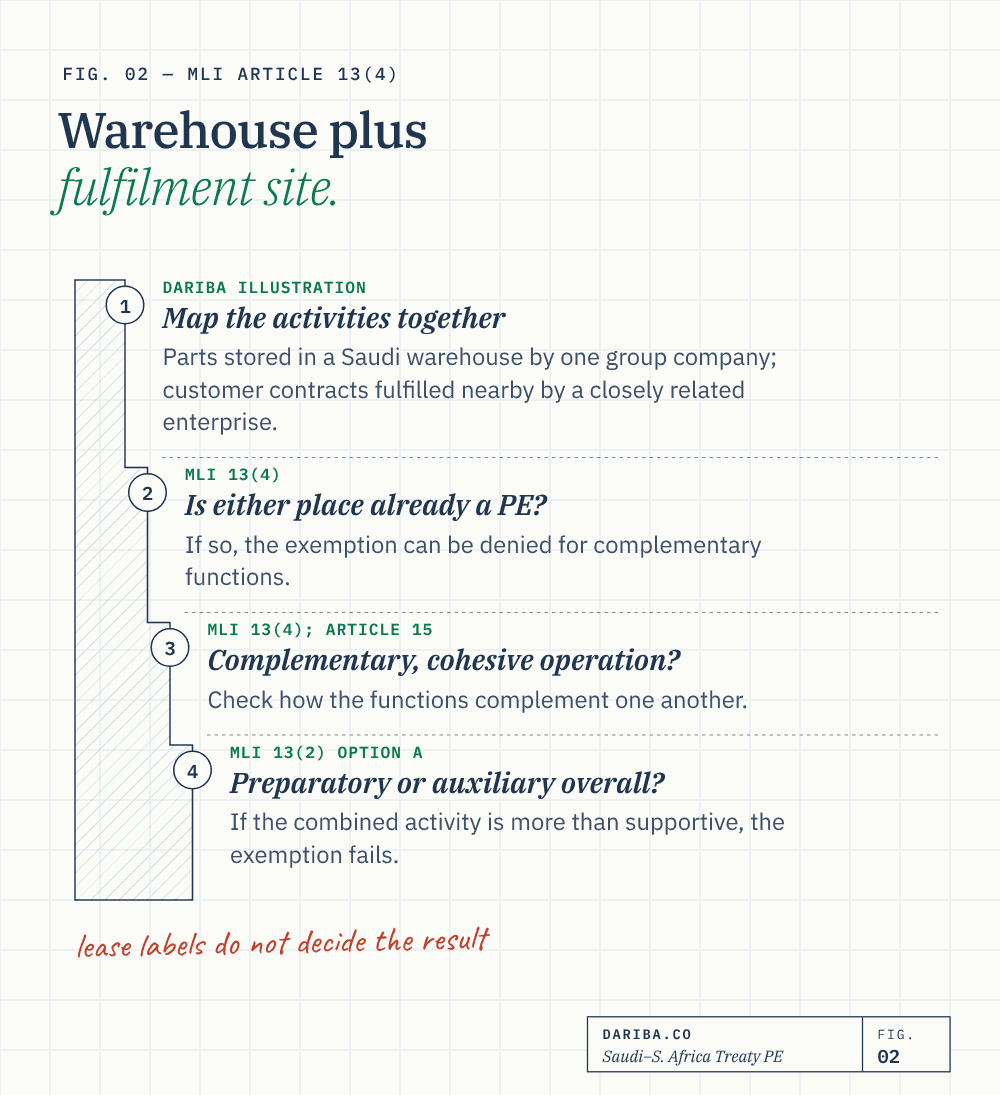
MLI Article 13(2), Option A, modifies the activity exemptions in Article 5(4). Apply the preparatory or auxiliary condition to the relevant activity or combination of activities. Article 13(4) can deny the exemption where complementary functions form part of a cohesive business operation and a place is already a PE or the combined activity is more than preparatory or auxiliary. Article 15 defines the close relationship used in that test.
Dariba illustration. If a group company stores parts in a Saudi warehouse and a closely related enterprise uses a nearby site to fulfil customer contracts, map the activities together. Review whether either location is already a PE, how the functions complement one another and whether the combined Saudi operation is merely supportive. The labels on the leases do not determine the result.
Follow the actual local activities into the profit calculation
Article 5(5) separately addresses agency, including habitual contract authority and specified stock maintenance with regular deliveries. Establish what the representative actually does and consider the independent-agent rule. If there is a PE, Article 7 limits business-profit taxation to the profit attributable to it. Reconcile local functions, contract components and expenses. For work done by an individual in an independent capacity, read Article 14 separately.
Key takeaways
- The original project test uses more than six months for specified construction and similar activities.
- The service test aggregates more than six months within any 12 months for the same or a connected project.
- MLI Article 13 adds a preparatory or auxiliary requirement and an anti-fragmentation rule for complementary activities.
- Article 7 ties business-profit taxation to the profits attributable to the permanent establishment.
Sources
- Saudi–South Africa Convention for the Avoidance of Double Taxation and the Prevention of Tax Evasion with Respect to Taxes on Income and on CapitalArticles 5, 7 and 14.
- South African Revenue Service, Synthesised Text of the MLI and the Saudi–South Africa ConventionArticle 5 and MLI Articles 13 and 15, with general application dates.