In brief
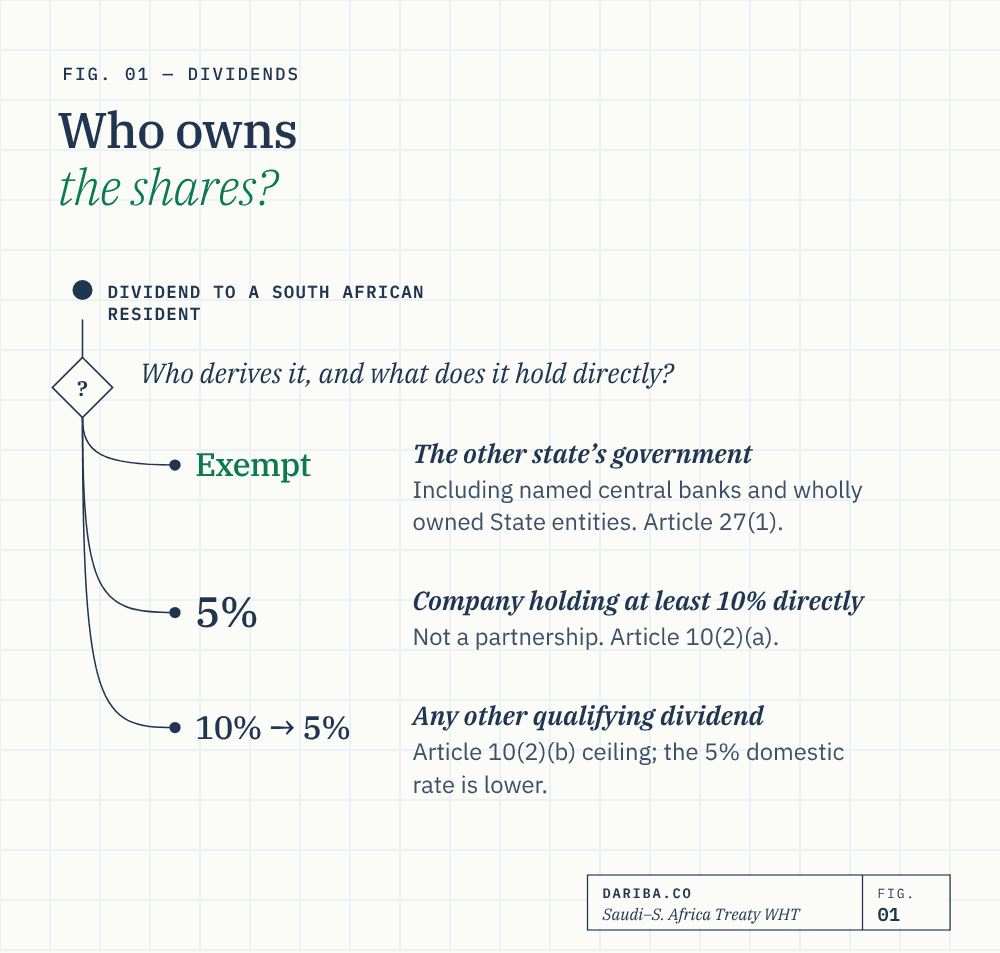
The treaty limits source tax to 5% or 10% on qualifying dividends, 5% on qualifying debt income and 10% on qualifying royalties. Article 27 separately exempts specified government income and related gains.
A Saudi payer should classify each payment to a South African resident before claiming relief under the Saudi–South Africa Double Taxation Convention. Identify the beneficial owner, check any permanent establishment or fixed-base connection and compare the domestic charge with the treaty ceiling. Government investment income has a separate exemption under Article 27.
| Payment | Treaty provision | Source-tax ceiling |
|---|---|---|
| Dividend to a qualifying company other than a partnership directly holding at least 10% of the payer’s capital | Article 10(2)(a) | 5% of gross dividends |
| Other qualifying dividend | Article 10(2)(b) | 10% of gross dividends |
| Qualifying debt-claim income | Article 11(2) | 5% of gross income |
| Qualifying royalty | Article 12(2) | 10% of gross royalties |
The ordinary Saudi domestic dividend rate is 5%. The 10% treaty ceiling does not raise it. A shareholder testing Article 10(2)(a) should retain evidence of the direct holding. Article 10(4) separately directs an effectively connected holding to the applicable business-profits or independent-services provision.
Identify the interest or royalty
Article 11(3) defines debt-claim income and excludes penalties for late payment. Review arrangement fees and guarantee fees separately by what the lender or other provider does. Article 12(3) covers specified intellectual property, know-how and equipment use. For a bundled service, equipment and licence contract, identify the rights actually granted and how consideration is allocated. Apply the effective-connection and related-party excess provisions to the relevant income.
Check the government exemption by recipient and asset
Article 27(1) exempts income covered by Articles 10–12 derived by the other state’s government, including the named central banks and wholly owned State entities. It also addresses gains on disposal of the shares, debt-claims or rights that generated the income. Establish the recipient’s legal identity and ownership and tie each payment or gain to the relevant asset. A government contract or a partial government shareholding alone does not meet the stated recipient conditions.
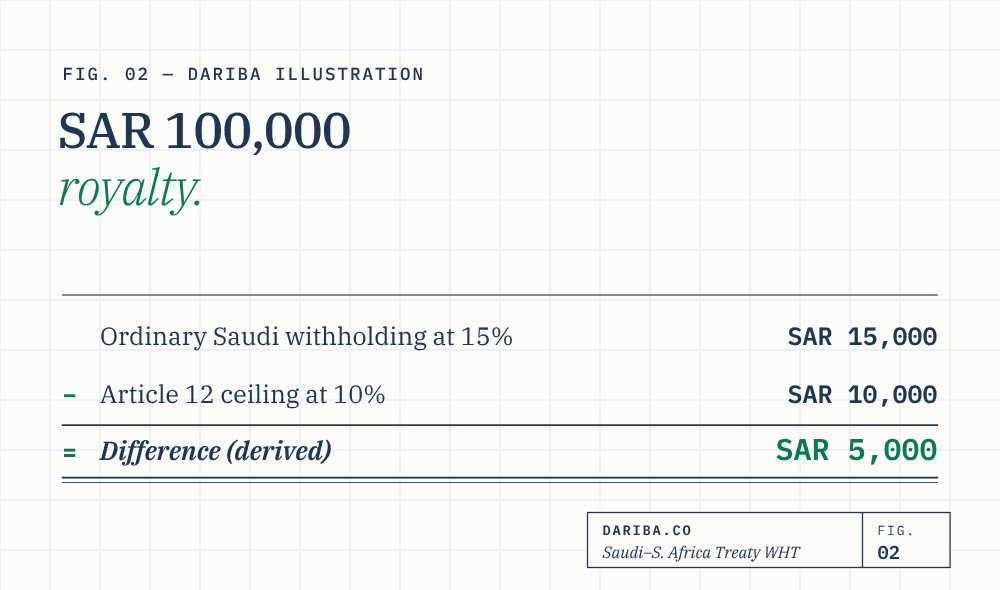
Dariba illustration. On a gross SAR 100,000 royalty, ordinary Saudi withholding at 15% would be SAR 15,000. If the Article 12 ceiling applies, tax is limited to SAR 10,000. A claimant relying on Article 27 would need separate evidence for the exemption.
Apply the rule for the payment date
The Convention entered into force on 1 May 2008. Article 29 applies its original withholding provisions to amounts paid or credited from 1 January 2009. The South African Revenue Service’s synthesised text records that the applicable MLI withholding provisions generally took effect for events from 1 January 2023. Apply the principal purpose test for current claims. Section 4 of ZATCA’s Tax Circular on Implementation of Withholding Tax Under the Double Taxation Agreement explains the relief-at-source and refund routes. Retain the residence evidence, payment record and analysis supporting the particular claim.
Key takeaways
- The 5% dividend treaty ceiling requires a qualifying company with a direct holding of at least 10% of the payer’s capital.
- Article 11 caps qualifying debt income at 5%.
- Article 12 caps qualifying royalties at 10%.
- Article 27(1) covers specified government recipients, including wholly owned State entities, and associated gains.
Sources
- Saudi–South Africa Convention for the Avoidance of Double Taxation and the Prevention of Tax Evasion with Respect to Taxes on Income and on CapitalArticles 10–12, 24, 27 and 29.
- South African Revenue Service, Synthesised Text of the MLI and the Saudi–South Africa ConventionApplication dates and MLI Article 7, which supersedes Article 27(2) to the extent stated in the synthesis.
- ZATCA, South Africa ConventionEntry into force on 1 May 2008.
- ZATCA Tax Circular on Implementation of Withholding Tax Under the Double Taxation AgreementSection 4, relief at source and refunds.