In brief
The Saudi–Spain treaty has a 5% ordinary dividend ceiling and a separate exemption for qualifying direct holdings. Ordinary debt income has a 5% ceiling and qualifying royalties an 8% ceiling.
A Saudi company distributing profits to a Spanish shareholder should check the ownership conditions in Article 10 of the Saudi–Spain Double Taxation Convention before it files its withholding return. A qualifying direct holding can give an exemption. Interest and royalties have their own conditions, even when the same Spanish company receives all three payments.
Apply the dividend rule to the shareholder and the holding
Article 10(2) generally caps source-state tax at 5% of gross dividends where the beneficial owner is resident in the other state. Its next sentence exempts dividends paid to a company other than a partnership resident in the other state if it directly holds at least 25% of the paying company’s capital. Keep the share register, residency evidence and payment records, and review the recipient’s beneficial ownership and any onward payment arrangements.
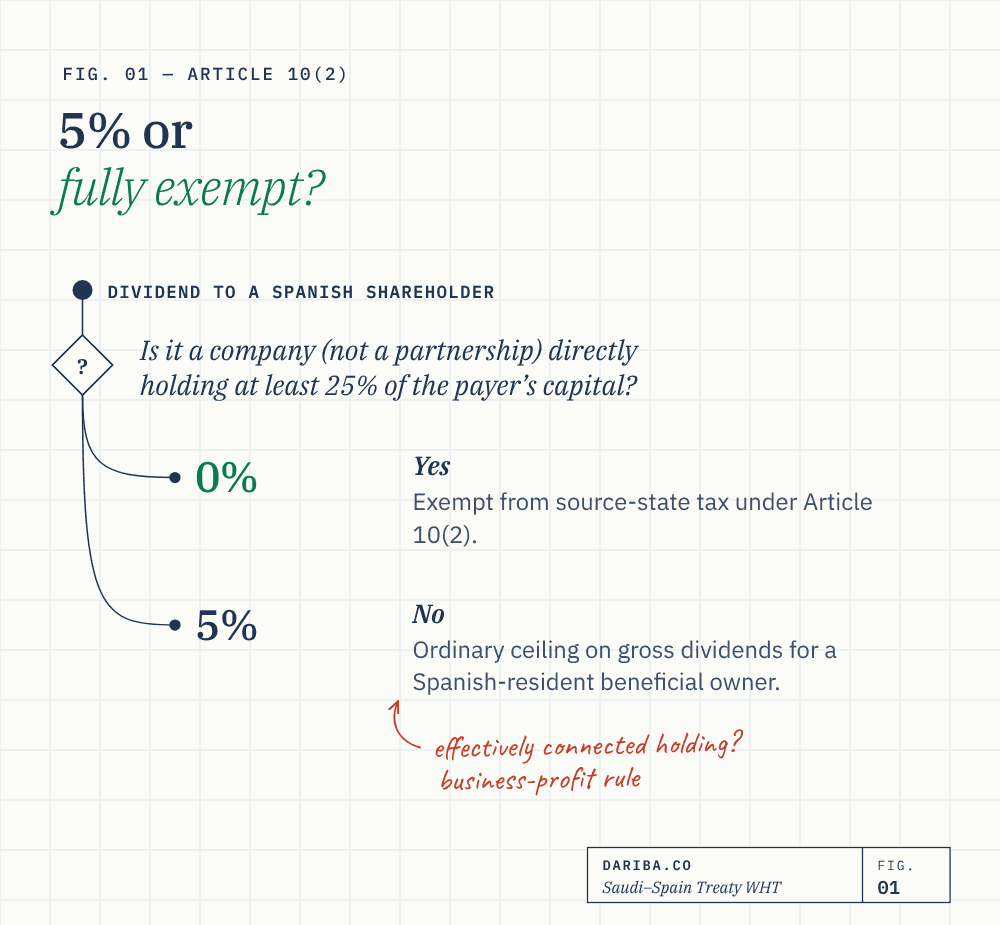
Article 10’s effective-connection clause redirects the specified holding to the business-profit or fixed-base rule. Protocol IX separately permits a state to tax remittances of PE profits, or amounts treated as such, to a company resident in the other state. Establish any domestic charge on the remittance before applying that clause.
Test debt income and government involvement
Article 11(2) caps ordinary qualifying debt-claim income at 5%. Article 11(3) assigns qualifying income exclusively to the beneficial owner’s residence state when a specified government, subdivision or local authority pays it, or when it is paid to the specified government, authority, central bank or wholly state-owned bank or financial institution. Document the actual debtor, lender, payment and public-sector status.
Article 11(4) excludes late-payment penalties from the treaty’s debt-income definition. Check the character of each fee and financing component, and apply paragraphs 5–7 to effective connection, source and any excess due to a special relationship.
Classify a royalty before applying the 8% ceiling
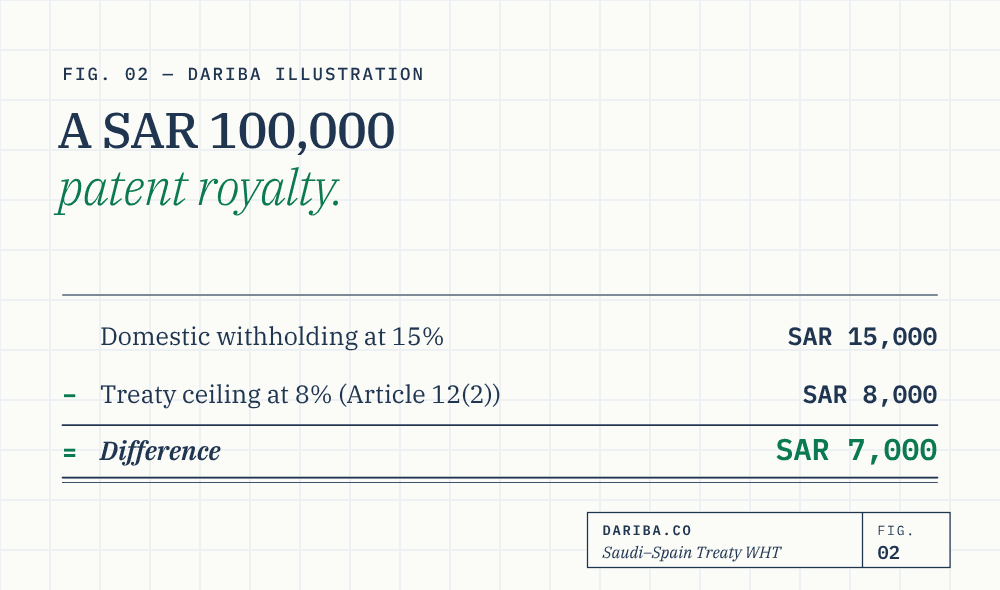
Article 12(2) caps qualifying royalties at 8% of the gross amount. Article 12(3) includes specified intellectual property, know-how and use of industrial, commercial or scientific equipment. Read the executed agreement for the rights granted and the payment allocation. Apply the separate domestic category and any lower charge before claiming the treaty rate.
Dariba illustration. A qualifying patent royalty of SAR 100,000 gives SAR 8,000 under the treaty ceiling. If the applicable domestic withholding rate is 15%, the difference is SAR 7,000. The example assumes the whole amount is a royalty and all treaty conditions are met.
Keep the anti-abuse and claim analysis with the payment
Spain’s Ministry of Finance identifies 1 January 2023 as the withholding application date for the matched Multilateral Instrument provisions. Apply the principal purpose test to the actual structure. Keep the commercial reasons for the arrangement, the ownership and residence evidence, the agreement and the withholding calculation. Section 4 of ZATCA’s Tax Circular on Implementation of Withholding Tax Under the Double Taxation Agreement explains when to seek relief at source and when to file a refund claim.
Key takeaways
- Article 10(2) contains a source-state exemption for a qualifying company directly holding at least 25% of the payer’s capital.
- Ordinary debt-claim income has a 5% ceiling. Article 11(3) separately addresses specified public-sector payments.
- Article 12 applies an 8% ceiling to qualifying royalties, including equipment-use royalties.
- The principal purpose test must be considered for current claims.
Sources
- Saudi–Spain Convention for the Avoidance of Double Taxation and the Prevention of Fiscal Evasion with Respect to Taxes on Income and on Capital and its ProtocolArticles 10–12 and Protocol IX on remittances of PE profits.
- Spanish Ministry of Finance, Synthesised Text of the Multilateral Instrument and the Saudi–Spain ConventionSets out the matched MLI provisions and 1 January 2023 withholding application date.
- Spanish Official State Gazette, Saudi–Spain Double Taxation Convention and ProtocolOriginal publication of the Convention and Protocol.
- ZATCA Tax Circular on Implementation of Withholding Tax Under the Double Taxation AgreementSection 4 on relief at source and refund claims.