In brief
The Saudi–Spain treaty uses a six-month project test. The MLI expands the agency test and imposes preparatory or auxiliary conditions on specified fixed-place exemptions.
A Spanish company can create a Saudi permanent establishment (PE) through a construction project, a fixed place or the activities of a local representative. The original Saudi–Spain Double Taxation Convention and the applicable Multilateral Instrument (MLI) provisions work together. Spain’s Ministry of Finance identifies 1 January 2023 as the start date for the matched provisions on withholding, and for other taxes for periods starting on or after that date in both states.
Establish the project duration and local place of business
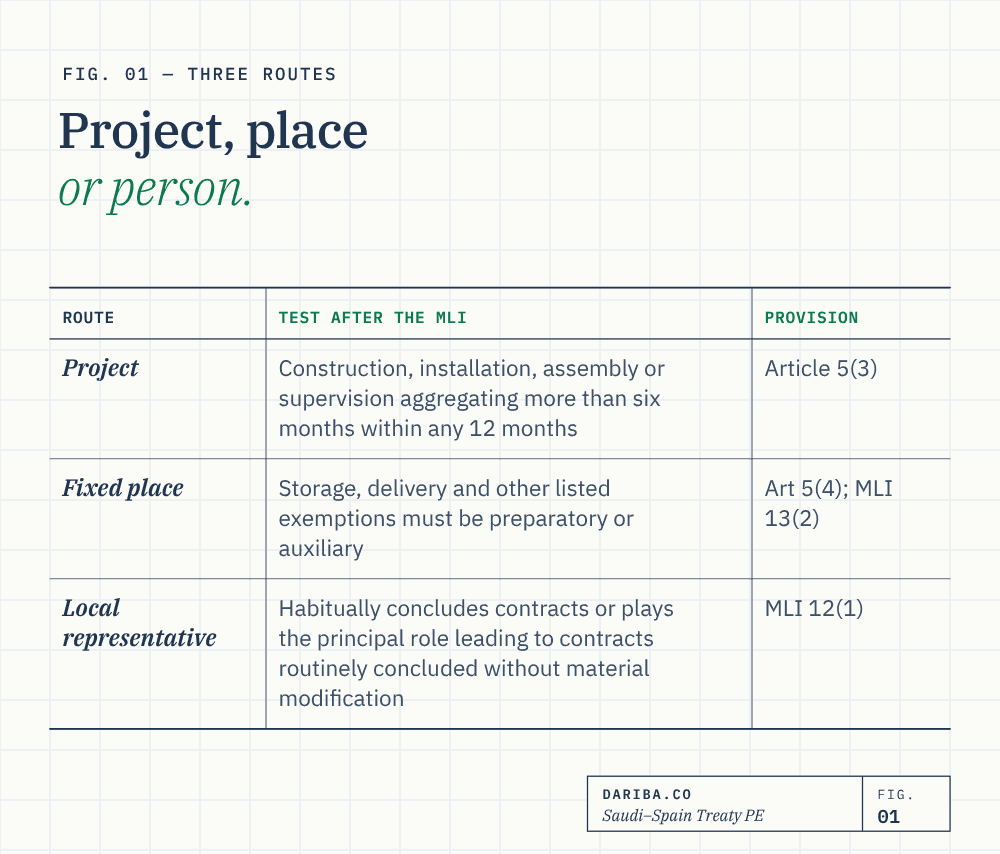
Article 5(3) covers a building site, construction, installation, assembly or related supervision lasting for periods aggregating more than six months within any 12 months. Keep the project dates and scope of the related activities. For a service engagement, Protocol V confirms that services can fall under Articles 5(1) and 5(2) where the fixed-place requirements are met. Evaluate the premises and their actual use.
Apply the MLI tests to storage, delivery and agents
Spain’s Ministry of Finance shows MLI Article 13(2) applying to Article 5(4). Check whether the relevant listed or combined activities are preparatory or auxiliary. Protocol VI also addresses delivery facilities used as retail premises and delivery stock sold in the state. For a warehouse serving Saudi customers, record what staff do, whether customers buy from it and how it supports the enterprise’s sales.
MLI Article 12(1) covers a person who habitually concludes specified contracts or habitually plays the principal role leading to contracts the enterprise routinely concludes without material modification. Check who negotiates terms, what the foreign office changes and who agrees the price and scope. Article 12(2) addresses agents acting independently in their ordinary business, including limits where a person acts exclusively or almost exclusively for closely related enterprises. MLI Article 15 supplies the close-relationship definition.
Attribute the profit arising through the PE
Article 7 limits Saudi taxation under the business-profit rule to profits attributable to the Saudi PE. Protocol VII(2) distinguishes profits from exporting merchandise from profits on other activities carried on through the local PE under the export contract. For a contract that includes machinery and on-site work, reconcile the price, work records, functions and costs for each component. Protocol VIII requires expenses under Article 7(3) to relate directly to the PE activity and calls for the domestic calculation to follow the treaty principles.
Record the Saudi functions, contracting role, project dates and the costs used in the attribution. For payments involving dividends, financing, equipment use or intellectual property, apply the relevant income article and its connection rule before settling the withholding position.
Key takeaways
- Article 5(3) aggregates more than six months of specified project activity within any 12 months.
- Protocol V explains when services are covered by the fixed-place rule.
- MLI Article 12 includes a habitual principal role in certain contracts routinely concluded without material modification.
- MLI Article 13 applies a preparatory or auxiliary condition to the specified activity exemptions.
Sources
- Saudi–Spain Convention for the Avoidance of Double Taxation and the Prevention of Fiscal Evasion with Respect to Taxes on Income and on Capital and its ProtocolArticles 5 and 7 and Protocol V–VIII.
- Spanish Ministry of Finance, Synthesised Text of the Multilateral Instrument and the Saudi–Spain ConventionArticle 5 and the applicable MLI boxes on activity exemptions, agency and close relationships.
- Spanish Official State Gazette, Saudi–Spain Double Taxation Convention and ProtocolOriginal Convention and Protocol.