In brief
Qualifying debt income is taxable only in the beneficial owner’s residence state. Dividend and royalty ceilings depend on voting rights and the kind of royalty.
The Saudi–Sweden Double Taxation Convention distinguishes a dividend’s voting-rights test from the allocation of debt income. Review the share or debt instrument before choosing the treaty provision. The original Convention entered into force on 31 August 2016 and Article 29 applies its original withholding rules to amounts paid or credited from 1 January 2017.
| Payment | Treaty provision | Source-tax ceiling or allocation |
|---|---|---|
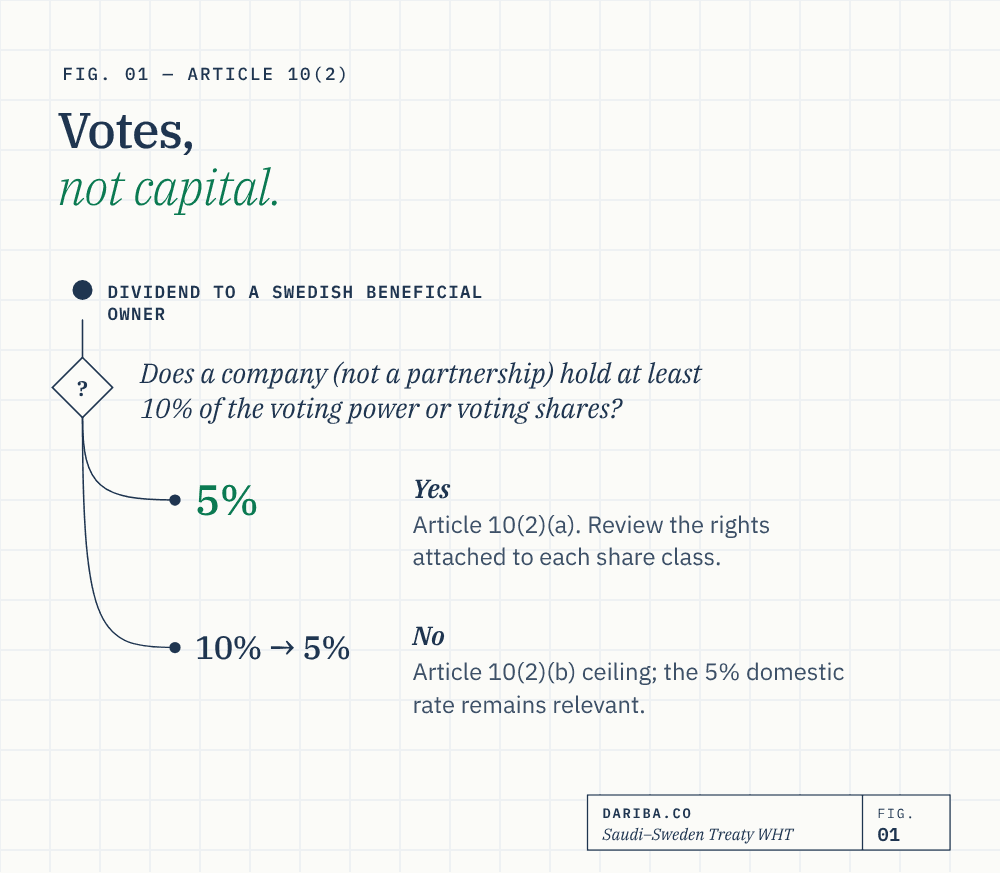
| Dividend to a qualifying company other than a partnership holding at least 10% of the payer’s voting power or voting shares | Article 10(2)(a) | 5% of gross dividends |
| Other qualifying dividend | Article 10(2)(b) | 10% of gross dividends |
| Qualifying debt income | Article 11(1) | Taxable only in the beneficial owner’s residence state |
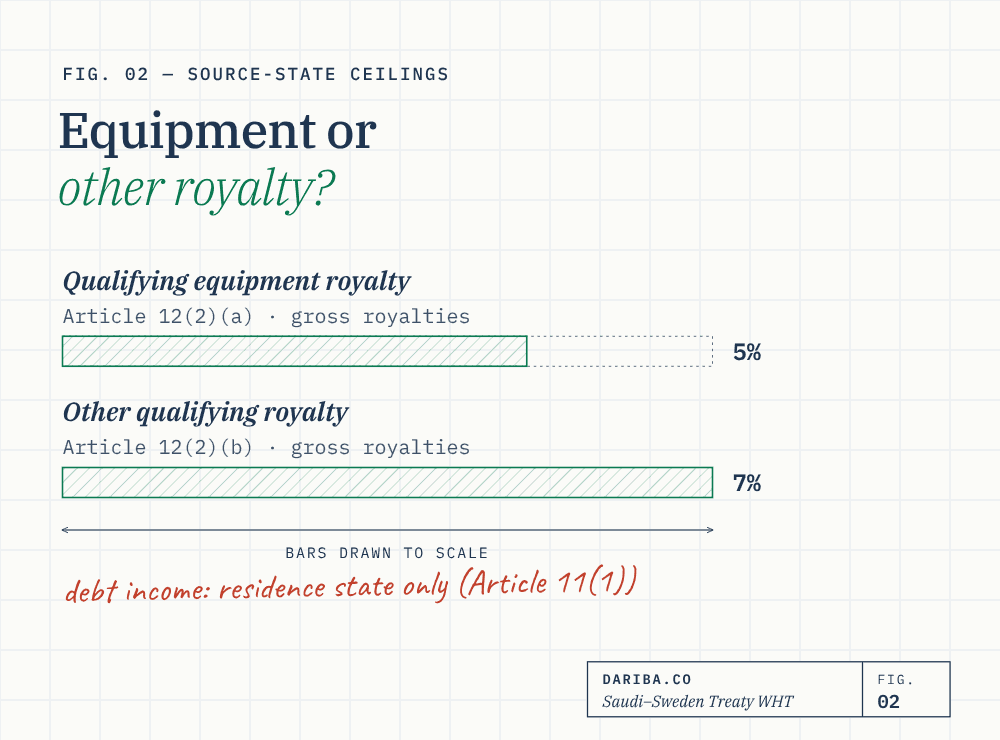
| Qualifying equipment royalty | Article 12(2)(a) | 5% of gross royalties |
| Other qualifying royalty | Article 12(2)(b) | 7% of gross royalties |
Review the rights attached to each share class and retain the ownership evidence. The ordinary Saudi domestic dividend rate of 5% remains relevant if the treaty ceiling is 10%. Article 10(4) addresses an effectively connected holding.
Identify the debt, the beneficial owner and any Saudi connection
Article 11(1) assigns qualifying debt income exclusively to the residence state. Paragraph 2 excludes late-payment penalties from the debt-income definition. Paragraph 3 redirects effectively connected debt to the applicable business-profits or independent-services rule. Paragraph 4 limits the treaty treatment where a special relationship causes excess income. Document the loan, funding and onward payments, and test any separate fees. Protocol paragraph 1 addresses income derived through fiscally transparent persons to the extent the residence state treats it as a resident’s income.
Check the royalty contract and anti-abuse conditions
Article 12 distinguishes equipment-use royalties from other royalties. Review what the Saudi customer can do with the asset, whether personnel are supplied and how the contract allocates the price. Apply the domestic category, the relevant treaty limit and the effective-connection clause.
Original Article 28 addresses specified domestic anti-avoidance provisions and certain low-tax foreign-facing activities or headquarters arrangements. Sweden’s MLI position also requires a treaty-specific entry-into-effect check under Article 35(7). Its general MLI entry-into-force date does not establish commencement for this bilateral Convention. Retain the commercial rationale, residence and beneficial ownership evidence and the calculation supporting the filing route under ZATCA’s treaty withholding circular.
Key takeaways
- Article 10(2)(a) uses at least 10% of voting power or voting shares for the 5% dividend ceiling.
- Article 11(1) assigns qualifying debt income exclusively to the beneficial owner’s residence state.
- Article 12 sets a 5% ceiling for equipment royalties and 7% for other royalties.
- Review both the original Article 28 anti-abuse rules and the treaty-specific MLI commencement evidence.
Sources
- Saudi–Sweden Convention for the Avoidance of Double Taxation and the Prevention of Tax Evasion with Respect to Taxes on Income and on Capital, with ProtocolArticles 10–12 and 28–29 and Protocol paragraph 1.
- Swedish Parliament, Act 2016:408 on the Saudi–Sweden Tax ConventionSwedish implementing law and treaty annex.
- Sweden’s Deposited MLI Reservations and NotificationsListed Saudi agreement and Article 35(7)(a) reservation.
- OECD, Signatories and Parties to the BEPS Multilateral InstrumentDepositary status and treaty-specific notification references.
- ZATCA Tax Circular on Implementation of Withholding Tax Under the Double Taxation AgreementSection 4 on relief at source and refunds.