In brief
The Saudi–Swiss treaty applies separate tests to projects, services, fixed places and agents. Its export rule turns on whether the merchandise profit is attributable to a permanent establishment.
A Swiss enterprise may sell equipment to a Saudi customer and send personnel to supervise its installation. The Saudi–Swiss Double Taxation Convention first asks whether the enterprise has a Saudi permanent establishment (PE). If it does, Article 7 determines what profits Saudi Arabia can tax through it. The team’s work, authority and access to the site all affect the analysis.
Apply the project and service tests
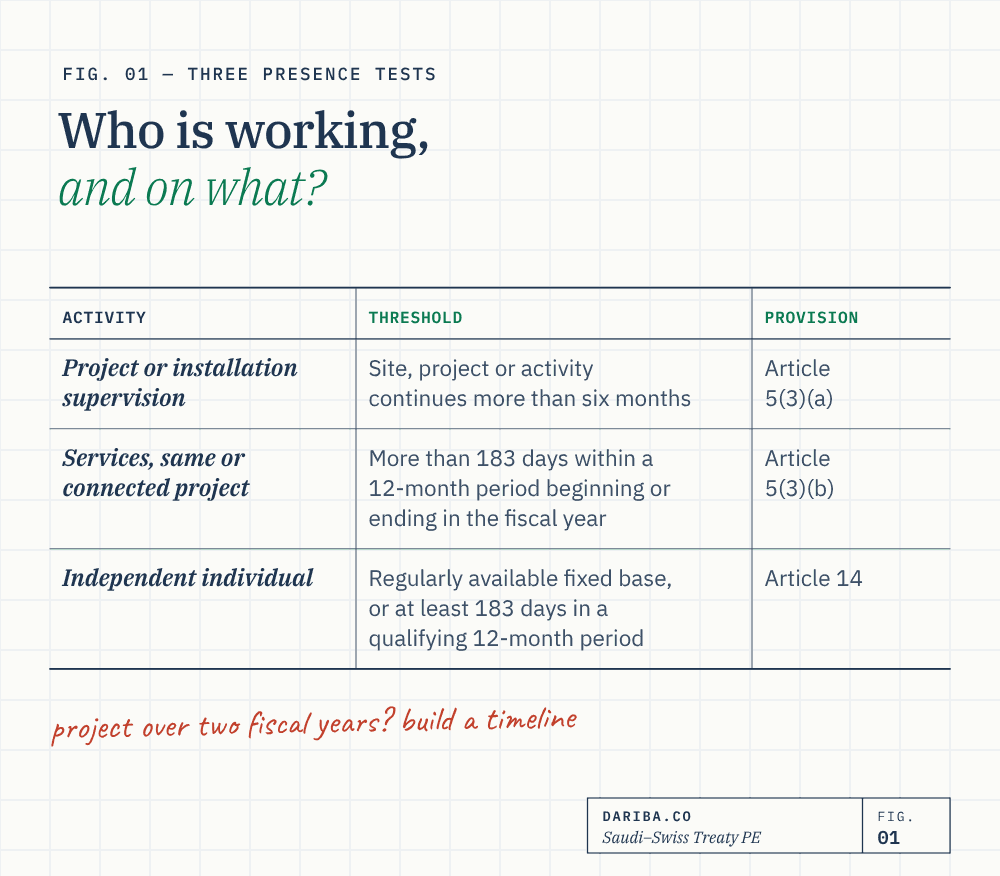
Article 5(3)(a) covers building sites, construction, assembly, installation and connected supervision where the site, project or activity continues for more than six months. Article 5(3)(b) covers enterprise services through employees or other personnel, including consultancy. For the same or a connected project, the activities must aggregate more than 183 days within a 12-month period beginning or ending in the fiscal year concerned.
For a project spanning two fiscal years, build a timeline from actual activities. Identify connected work orders and test the relevant 12-month periods using site logs, travel and personnel records. The fact that a customer issued separate purchase orders does not establish that the work relates to separate projects.
Review premises, agents and group companies
Article 5(1) also addresses a fixed place through which the enterprise carries on all or part of its business. Review access to the premises, how they are used and the particular exception in Article 5(4). Where the place combines listed activities, Article 5(4)(f) requires the combined activity to be preparatory or auxiliary.
Article 5(5) addresses habitual exercise of authority to conclude contracts in the enterprise’s name. Article 5(6) addresses an independent agent acting in the ordinary course of its business. Under Article 5(7), control between companies is insufficient by itself to establish a PE. For a local sales arrangement, review actual authority and contracting conduct alongside any premises and service activities.
Attribute export and local profits using Article 7
Article 7(4) limits Saudi taxation of merchandise export profits where the profit is outside the Saudi PE’s attribution. If the export contract also includes other activities carried on through a Saudi PE, Saudi Arabia may tax the profit from those activities. Trace the sale and on-site work to the people, functions and risks that produced the profit. Contract prices and invoices help reconcile the allocation, alongside the project records and cost ledger.
Article 7(2) uses a separate-enterprise standard. Paragraph 3 permits qualifying expenses incurred for the PE and sets specific limits for certain internal royalties, service charges and financing returns. Paragraph 8 calls for a consistent attribution method unless there is good and sufficient reason to change it. Read Article 12 separately where the customer pays for equipment use or intellectual property rights.
Protocol paragraph 4(b) extends the principles of Article 7(4) to other business activities, subject to the separate-income rule in Article 7(9). Paragraph 4(c) also provides for wider PE deductions if Saudi Arabia agrees to them with another state. Identify the actual agreement, deduction and applicable period before applying that clause to a Swiss enterprise.
Distinguish the enterprise from the people performing the work
Article 14 applies to an independent individual and includes a regularly available fixed base or presence of at least 183 days in a qualifying 12-month period. The income attributable to the fixed base, or to activities performed in the other state under the presence limb, is the relevant amount. Article 15 has its own employment conditions, including the employer and who bears the remuneration. A conclusion on the enterprise’s PE does not settle each person’s tax exposure.
Key takeaways
- Article 5(3)(a) uses more than six months for specified projects and related supervision.
- Article 5(3)(b) uses more than 183 days for enterprise services on the same or a connected project, within the stated rolling window.
- Article 7(4) distinguishes merchandise profit from the profit on other activities carried on through the permanent establishment.
- Article 14 uses a separate fixed-base or presence test for independent individuals.
Sources
- Saudi–Swiss Convention for the Avoidance of Double Taxation with Respect to Taxes on Income and on Capital and the Prevention of Tax Evasion, with ProtocolArticles 5, 7, 12, 14, 15 and 28. Read the Protocol as part of the Convention.
- Swiss State Secretariat for International Finance, Entry into Force of the Double Taxation Conventions with Brazil and Saudi ArabiaEntry into force and first application dates.