In brief
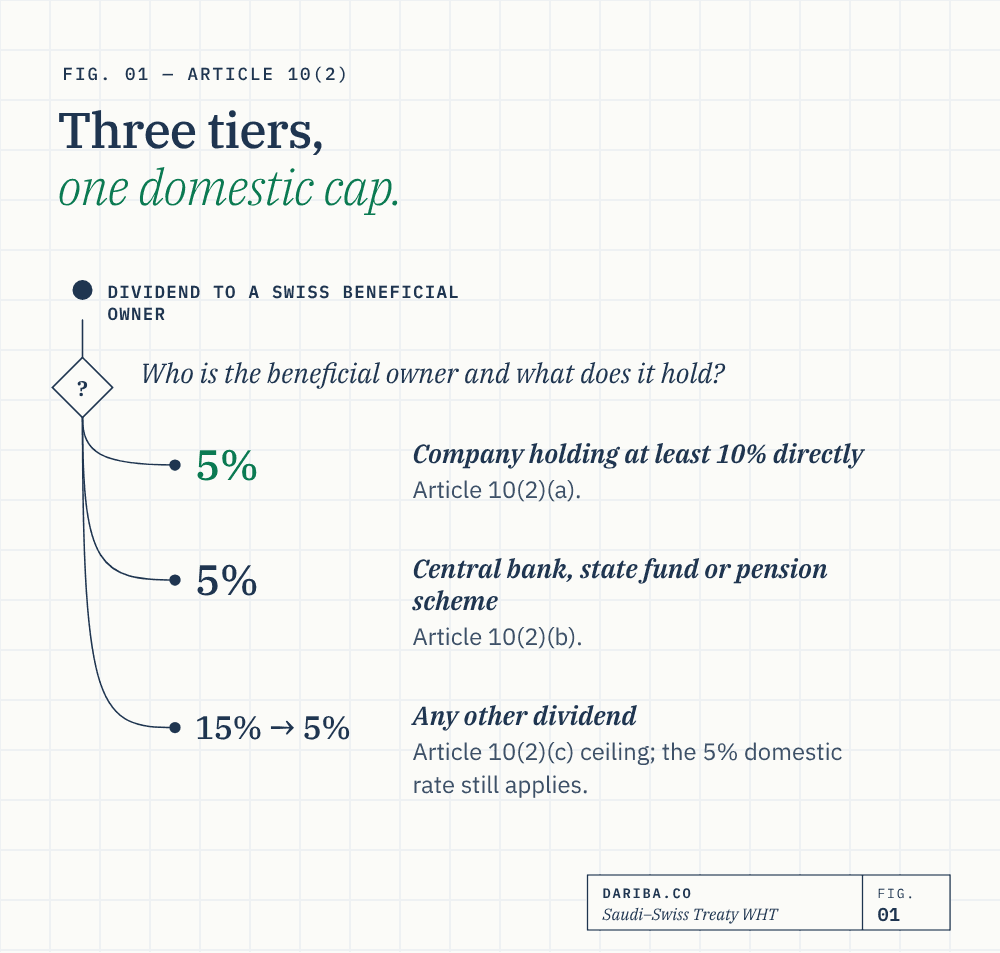
The Saudi–Swiss treaty gives specified debt income exclusive residence-state taxation. It also limits source tax on qualifying royalties to 5% or 7% and divides dividends into 5% and 15% treaty tiers.
A Saudi company paying a Swiss supplier may have a debt return, a royalty or consideration for services. For the Saudi–Swiss Double Taxation Convention, those categories matter because Article 11 can remove Saudi source taxation on qualifying debt income, while Article 12 limits it on qualifying royalties. The Swiss State Secretariat for International Finance confirms entry into force on 1 April 2021. Article 29 applies the treaty to withholding on amounts paid or credited from 1 January 2022.
Compare domestic withholding and the treaty ceiling
| Income | Treaty provision | Source-tax ceiling or allocation |
|---|---|---|
| Dividend to a qualifying corporate beneficial owner directly holding at least 10% of the payer’s capital | Article 10(2)(a) | 5% of gross dividends |
| Dividend to the qualifying central bank, wholly state-owned institution or fund, or resident pension scheme | Article 10(2)(b) | 5% of gross dividends |
| Other dividend | Article 10(2)(c) | 15% of gross dividends |
| Ordinary debt-claim income | Article 11(2) | 5% of gross debt income |
| Debt-claim income meeting Article 11(3) | Article 11(3) | Taxable only in the qualifying beneficial owner’s state |
| Equipment-use royalty | Article 12(2)(a) | 5% of gross royalties |
| Other royalty | Article 12(2)(b) | 7% of gross royalties |
The ordinary Saudi domestic dividend rate under Article 63 of the Income Tax Implementing Regulations is 5%. A 15% treaty ceiling does not increase that rate. Article 10(5) directs an effectively connected holding to the applicable business-profit or fixed-base provision.
Identify which debt exemption the facts support
Article 11(3) applies to a resident beneficial owner and covers payments to the other state’s government, its specified subdivisions or authorities, its central bank and its pension schemes. It also covers debt arising from credit sales of equipment, merchandise or services, loans granted by a financial institution, and loans between companies.
A Saudi buyer paying a Swiss supplier for machinery on deferred terms should identify the debt and how the financing return is calculated. For a group loan, retain the signed agreement, drawdown and payment evidence, the lender’s residence and evidence of beneficial ownership. Classify any guarantee or service fee separately. Article 11(5) addresses effective connection for paragraphs 1 and 2. Paragraphs 6 and 7 address source and special-relationship excess. Review the wording of the particular exemption and the other applicable provisions when the debt is booked to a Saudi establishment or a related-party return exceeds an arm’s-length amount.
Identify the rights behind a royalty
Article 12(3) covers specified intellectual property and know-how as well as equipment use. A contract that gives a Saudi customer use of machinery can qualify for the equipment ceiling. A contract for a result produced by the supplier’s machinery calls for a review of the actual rights and activities. Check the allocation of a bundle across licence, equipment, support and installation, along with the effective-connection, source and excess provisions in paragraphs 4–6.
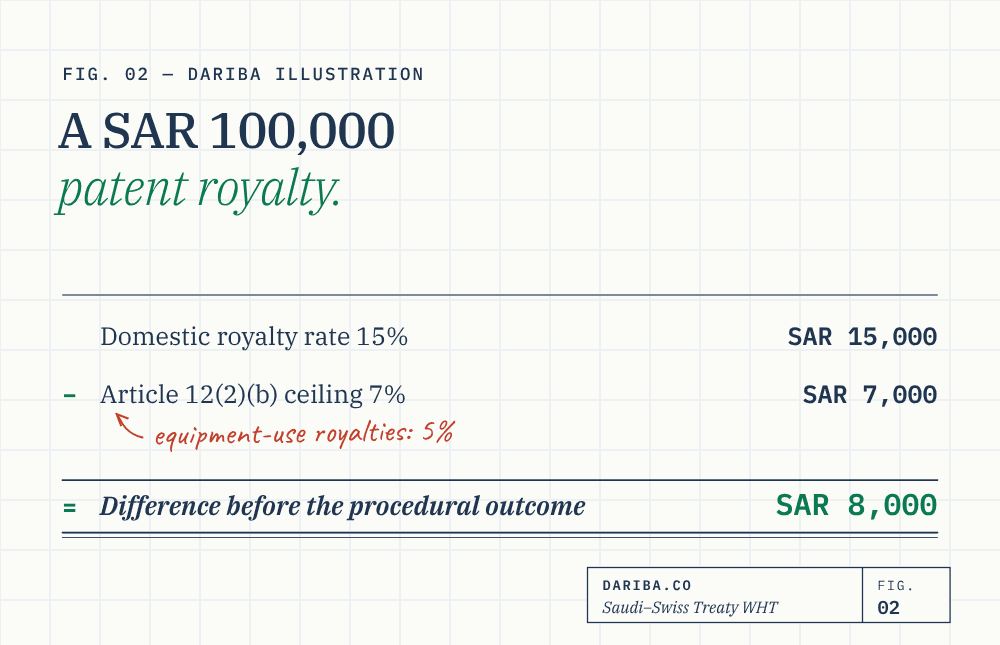
Dariba illustration. For a gross SAR 100,000 patent royalty, the ordinary Saudi domestic royalty rate of 15% gives SAR 15,000. If Article 12(2)(b) applies, the 7% ceiling gives SAR 7,000, a difference of SAR 8,000 before the procedural outcome.
Apply the principal purpose test and retain evidence for the claim
Article 28 of the Convention contains its own principal purpose test. Record the commercial purpose, payment flows and the recipient’s role. Section 4 of ZATCA’s Tax Circular on Implementation of Withholding Tax Under the Double Taxation Agreement sets out the relief-at-source and refund routes. Support the chosen route with the treaty residence certificate, the applicable forms, payment evidence and the income classification.
For a treaty dispute, Article 25 allows presentation to either competent authority within three years of the first notification. The same article sets a separate implementation limit of ten years after the end of the taxable year concerned. Keep the first notification and confirm the domestic deadlines independently.
Key takeaways
- Ordinary dividends to a qualifying company directly holding at least 10% of the payer’s capital have a 5% treaty ceiling.
- Article 11(3) has six routes to exclusive residence-state taxation, including loans between companies and qualifying credit sales.
- Article 12 distinguishes 5% equipment royalties from 7% other royalties.
- Review the contract, beneficial ownership, any permanent establishment connection and the Article 28 principal purpose test before claiming relief.
Sources
- Saudi–Swiss Convention for the Avoidance of Double Taxation with Respect to Taxes on Income and on Capital and the Prevention of Tax Evasion, with ProtocolArticles 10–12, 25 and 28–29. The Protocol forms part of the Convention.
- Swiss State Secretariat for International Finance, Entry into Force of the Double Taxation Conventions with Brazil and Saudi ArabiaThe Saudi convention entered into force on 1 April 2021 and applies from 1 January 2022.
- ZATCA Tax Circular on Implementation of Withholding Tax Under the Double Taxation AgreementSection 4 explains relief at source and refund procedures.
- Saudi Income Tax Implementing RegulationsArticle 63 sets the domestic withholding categories and rates.