In brief
Make the Saudi taxpayer’s actual functions, transactions and financial results explainable from the same set of reliable evidence.
A Saudi Local File should allow a reviewer to follow the taxpayer’s transaction from commercial facts to the selected pricing method and reported financial result. A benchmark report attached to a generic company description does not, by itself, provide that chain.
Article 17 of the amended TP Bylaws specifies the contents. ZATCA’s Arabic Transfer Pricing Guideline, third edition 2024, section 5.3.2 and Annex 9, pp. 142-143, provide the corresponding explanation. These references follow the actual annex heading. Establish the file obligation and exceptions separately before applying the content requirements.
Prepare the taxpayer’s analysis rather than repeat the group policy
The Local File complements the Master File with detailed information about the Saudi taxpayer, its actual controlled dealings and the economic analysis. The multinational group’s policy is relevant context; the taxpayer’s implementation needs its own evidence.
Guideline section 5.3.2 recognises that one Local File may sometimes cover several taxpayers in the same group, provided it contains sufficient detail for each taxpayer at the required level. A combined document is not a reason to blend unrelated functions, omit entity-level financial data or assume that each company has the same return.
Article 17(b) permits ZATCA to request all or part of the Local File within its specified period, at least 30 days from the request date. The reporting timetable does not remove the duty to maintain adequate records or replace the separate disclosure, certificate and country-report requirements.
Explain the management structure and business changes
Article 17(a)(1) requires the management and organisational structure, the individuals to whom management reports and the countries of their principal offices. It also requires a detailed account of the taxpayer’s business and strategy, including material restructuring or intangible transfers affecting it in the current and preceding year, and the principal competitors.
Dariba recommendation: obtain the actual reporting lines and decision responsibilities from the business, not only the legal chart. Identify who decides pricing, purchases, customer terms, inventory, staffing and risk responses where relevant to the transaction. A job title or an overseas group policy does not alone establish who exercises the function.
Explain the local effect of a restructuring. A change in the invoicing company, licence or distributor arrangement may alter the factual analysis even if the Saudi taxpayer’s trading name remains unchanged. Keep the current and prior-year comparison required by this section distinct from the Master File’s group-year change description.
Build a complete controlled-transaction inventory
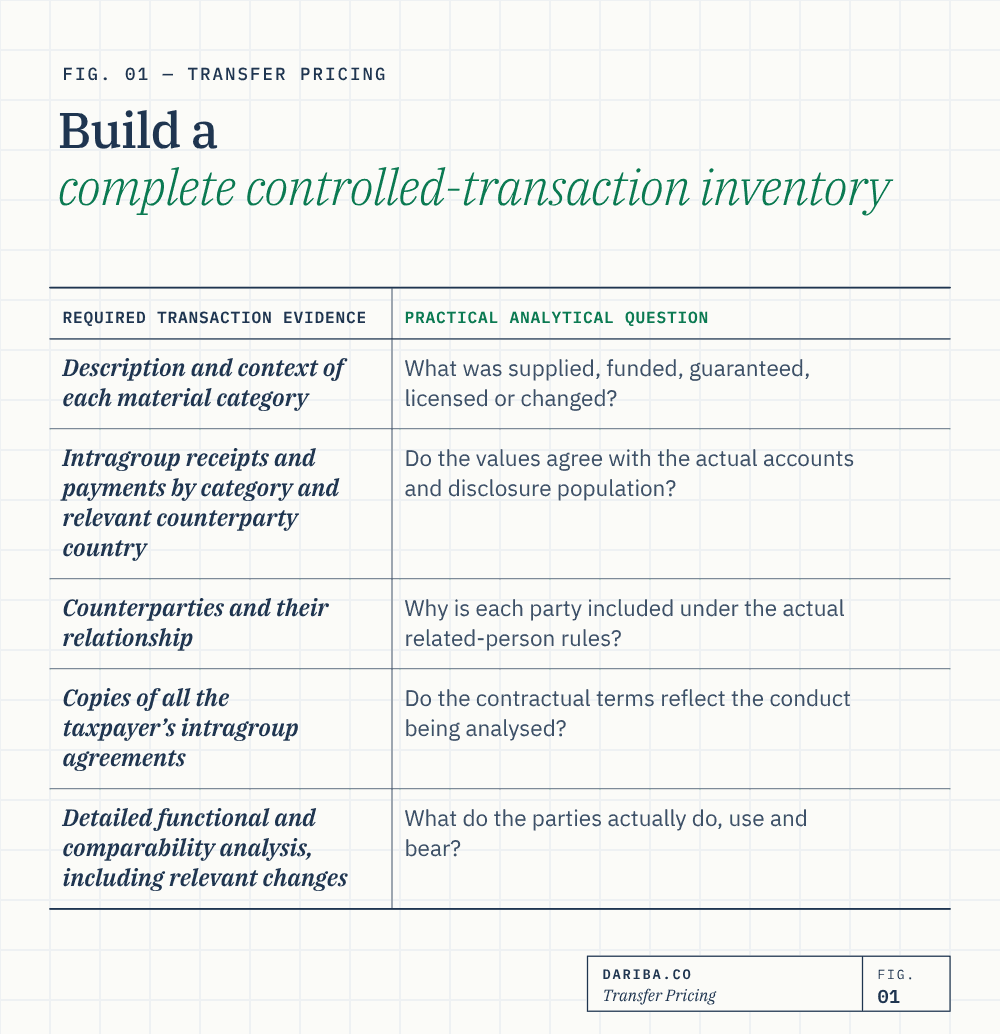
Article 17(a)(2) addresses the important controlled transactions in which the taxpayer participates. Its examples include manufacturing services, goods purchases, services, lending, financial and performance guarantees, and intangible licences. Identify the context as well as the invoice label.
| Required transaction evidence | Practical analytical question |
|---|---|
| Description and context of each material category | What was supplied, funded, guaranteed, licensed or changed? |
| Intragroup receipts and payments by category and relevant counterparty country | Do the values agree with the actual accounts and disclosure population? |
| Counterparties and their relationship | Why is each party included under the actual related-person rules? |
| Copies of all the taxpayer’s intragroup agreements | Do the contractual terms reflect the conduct being analysed? |
| Detailed functional and comparability analysis, including relevant changes | What do the parties actually do, use and bear? |
The transaction population should not be confined to paid expense invoices. Asset transfers, non-cash arrangements and changes to rights can require analysis. The disclosure guide explains the particular nil/non-monetary reporting provision; the relationship guide explains non-equity control routes.
Connect functions, assets and risks to the proposed treatment
The functional analysis needs the taxpayer and relevant counterparties, not a conclusion that one entity is routine because a template describes it that way. Compare the contract, actual personnel, assets, decision powers and risk-related conduct. Identify material changes from earlier years.
Dariba analysis: a distributor’s title does not establish its inventory, credit or market exposure. A service agreement does not prove that the Saudi recipient received the described service. The file should show how the relevant facts support the selected method and economic outcome, with an unresolved issue identified where the evidence is incomplete.
This is also where inconsistencies with the group account become visible. If the Master File places an important function abroad while the Saudi business records show it performed locally, investigate the facts and explain the result. Do not resolve the discrepancy solely by changing terminology.
Justify the method, tested party and analytical assumptions
Article 17’s transaction section requires more than naming a method. It calls for the most appropriate method and reasons; the tested party where applicable and reasons for choosing it; important assumptions; the reason for multi-year analysis where relevant; and the comparable evidence supporting the result.
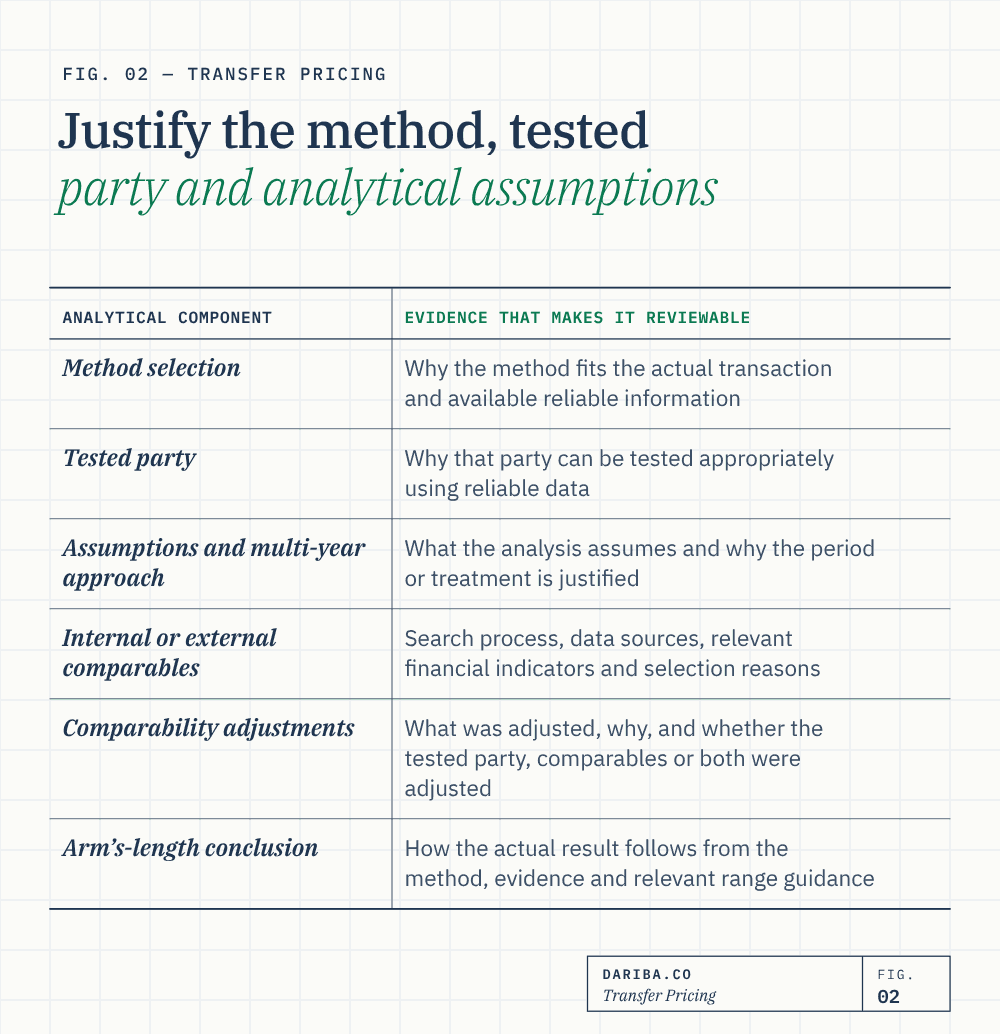
| Analytical component | Evidence that makes it reviewable |
|---|---|
| Method selection | Why the method fits the actual transaction and available reliable information |
| Tested party | Why that party can be tested appropriately using reliable data |
| Assumptions and multi-year approach | What the analysis assumes and why the period or treatment is justified |
| Internal or external comparables | Search process, data sources, relevant financial indicators and selection reasons |
| Comparability adjustments | What was adjusted, why, and whether the tested party, comparables or both were adjusted |
| Arm’s-length conclusion | How the actual result follows from the method, evidence and relevant range guidance |
The methods guide and comparability guide explain those substantive rules. A database printout or an unexplained margin does not substitute for the reasons and financial information required in the file.
Include the relevant financial data and foreign pricing instruments
The transaction section also requires the financial information used to apply the method and copies of relevant APAs and tax rulings to which ZATCA is not a party, concerning the taxpayer’s controlled dealings.
Identify the actual scope and period of any foreign instrument. Its relevance to the transaction does not mean it binds Saudi Arabia or establishes a Saudi deduction. Keep the foreign position visible and reconcile it with the actual Saudi analysis rather than omit an inconvenient difference.
Likewise, distinguish the benchmark result, policy target, booked result and any actual adjustment. A proposed adjustment is not the same as an entry made in the accounts or the tax/Zakat return. The year-end adjustment guide addresses those connected questions.
Make the industry analysis specific to the taxpayer
Article 17(a)(3) identifies the principal competitors; strengths, weaknesses, opportunities and threats; supplier and buyer power; substitutes; market size; supply and demand trends; entry requirements; principal target markets; market share; and delivery or distribution methods.
These are economic facts relevant to the transaction. A generic forecast for the Saudi economy does not explain a particular distributor’s customer concentration or a manufacturer’s input constraints. Use reliable information for the actual product, market, period and business model, and connect it to the pricing analysis.
Dariba recommendation: explain which factors materially affect the taxpayer’s functions, terms, prices or margins. Distinguish an evidenced commercial effect from management’s expectation. A difficult year does not establish that any loss is arm’s length, while a profitable year does not itself validate the selected method.
Build a financial bridge to the accounts and comparables
Article 17(a)(4) requires the specified annual financial statements, audited where available and otherwise the stated unaudited statements; schedules linking the method’s financial data to the financial statements; and the relevant comparable financial-data summary and sources.
Dariba illustration — original assumptions: a properly defined tested segment has SAR 100 million sales and SAR 95 million relevant operating costs. Its operating profit is SAR 5 million and its operating margin on sales is 5%. The financial bridge must show why those amounts and costs belong to the tested activity, and how excluded items reconcile to the accounts. The illustration establishes no acceptable benchmark or standard Saudi return.
Do not add a separate segment’s costs simply because they produce a desired margin. Retain the allocation basis, ledger mapping, accounting adjustments and source data so that another reviewer can reproduce the result. A correct percentage on an unsupported population is not a complete analysis.
Complete the file with a consistency and evidence review
Check the taxpayer, period, counterparties, transactions, methods and figures against the Master File, Article 14 disclosure, financial statements and relevant country-report data. Some differences arise from different scopes or definitions; explain them rather than force every document to contain identical totals.
Maintain an open-points register and update material changes. A file’s value lies in a supported conclusion that can be examined, not simply possession of several documents bearing the right titles. The Local File does not independently settle every CIT deduction, withholding, VAT, Zakat or foreign corresponding-adjustment question attached to the transaction.
Key takeaways
- The Local File is a taxpayer-level analysis rather than a copy of the group policy.
- Article 17 requires management and business facts, material transactions, industry and financial information.
- Current and prior-year restructurings or intangible transfers need their actual local effect explained.
- Each material transaction category needs supported parties, amounts, method, assumptions and comparable evidence.
- The tested party, multi-year analysis and adjustments need reasons rather than labels.
- The industry section must address the prescribed commercial factors, not a generic market introduction.
- The financial bridge must link the method’s actual data to the taxpayer’s accounts.
- A combined file for several Saudi taxpayers must still give sufficient detail for each one.
Sources
- Saudi Transfer Pricing Bylaws, amended Arabic textArticles 15-19: general evidence, Master File, Local File, country reporting and actual file exceptions/request powers. Article 16 and 17 contents reviewed on the original Arabic text.
- ZATCA Board Decision 8-2-23, 20 March 2023Amended Zakat application and staged file requirements; eligibility, file contents and country reporting remain distinct.
- ZATCA Arabic Transfer Pricing Guideline, third edition 2024Sections 5.1-5.5, pp.69-80; actual Annex 8 Master File, pp.140-141; actual Annex 9 Local File, pp.142-143; actual Annex 10 country tables, pp.144-146. Some narrative cross-references use different numbering; these citations follow the annex headings.
General information only. Actual supplies, facts, applicable periods and controlling Arabic legislation determine the result. Official examples are distinguished from Dariba analysis and original illustrations. Seek advice or clarification where the arrangement or source material leaves a specific issue unresolved.