In brief
Explain the multinational group’s value creation and pricing policies, then reconcile that account with the Saudi entity’s actual transactions.
A Saudi Master File should explain how the multinational group actually earns its returns. It is most useful when the supply chain, people, intangibles, funding and financial results tell a consistent story. A long corporate presentation that omits the transactions affecting Saudi Arabia can leave the central transfer-pricing question unanswered.
Article 16 of the amended TP Bylaws specifies the contents. ZATCA’s Arabic Transfer Pricing Guideline, third edition 2024, section 5.3.1 and Annex 8, pp. 140-141, explain the group-level document. The references here follow the actual annex heading. The documentation framework addresses the separate thresholds, phased Zakat requirements, exceptions and request deadlines.
Establish the obligation before assembling the group narrative
Article 16 concerns the Master File for the multinational group to which the taxpayer belongs. Apply the actual taxpayer, group and period definitions, Article 19’s exceptions and Decision 8-2-23’s relevant phase before deciding which obligations arise. A group’s worldwide revenue and its Saudi controlled-transaction value are not interchangeable thresholds.
An exception from a named file is not an exemption from every arm’s-length, disclosure or general evidence duty. Conversely, a domestic-only business should not invent foreign subsidiaries or overseas functions merely to fill a multinational-group template. Record the actual legal basis and scope.
Article 16(b) permits a request for all or part of the Master File within the period ZATCA specifies, at least 30 days from the request. That is a request mechanism, not permission to wait until the request to discover who holds the supporting records. The separate disclosure and country-reporting deadlines remain relevant.
Map legal ownership and geography to the actual business
Article 16(a)(1) requires an organisational structure showing constituent ownership and geographical location. The chart should allow the reader to identify the entities behind the group narrative, rather than use trading names that cannot be connected with contracts or accounts.
Dariba recommendation: reconcile the legal chart with the entity register, relevant establishments, acquisition history and counterparty names used by the Saudi taxpayer. Explain a material difference between the legal chart and the management reporting structure. Neither structure alone proves where the important decisions are made.
Maintain the relevant year’s position. A current chart that silently removes a disposed subsidiary may fail to explain transactions or restructuring during the reviewed year. The purpose is a supported account of the actual period, not a prediction that every entity in the chart must have a Saudi filing obligation.
Describe value creation and the principal supply chains
Article 16(a)(2) requires the group’s business description. The principal elements and their analytical purpose are connected:
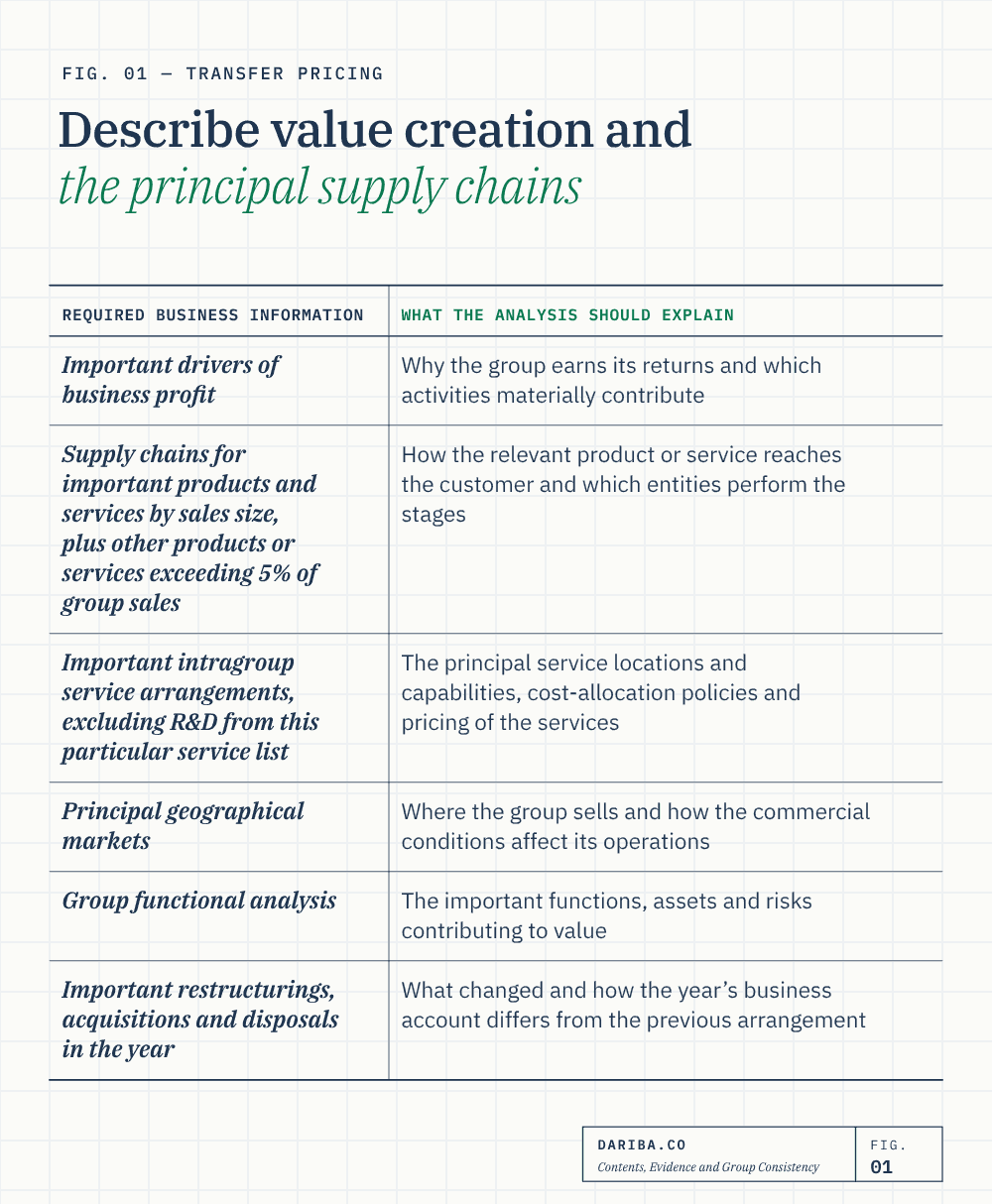
| Required business information | What the analysis should explain |
|---|---|
| Important drivers of business profit | Why the group earns its returns and which activities materially contribute |
| Supply chains for important products and services by sales size, plus other products or services exceeding 5% of group sales | How the relevant product or service reaches the customer and which entities perform the stages |
| Important intragroup service arrangements, excluding R&D from this particular service list | The principal service locations and capabilities, cost-allocation policies and pricing of the services |
| Principal geographical markets | Where the group sells and how the commercial conditions affect its operations |
| Group functional analysis | The important functions, assets and risks contributing to value |
| Important restructurings, acquisitions and disposals in the year | What changed and how the year’s business account differs from the previous arrangement |
The more-than-5% wording is an additional product/service coverage limb, not a rule that every smaller line may be omitted regardless of its importance under the rest of the provision. Do not substitute a profit-percentage test or impose a fixed number of product lines that the actual Arabic provision does not state.
Dariba illustration — original assumptions: an additional product line generates SAR 60 million of a group’s SAR 1 billion sales: 6%, above 5%. A separate line of SAR 50 million is exactly 5% and does not cross the strict numerical limb solely by equality. Its importance or relevance may still require discussion under the other actual content requirements. These assumed figures are not an official ZATCA example.
Explain services without losing the separate R&D analysis
The business-information list asks for material service agreements, the capacity of principal service locations and the policies allocating service costs and determining intragroup remuneration. A statement that the group uses a cost-plus policy does not explain the service, recipient, allocation basis or actual benefit.
The exclusion of R&D from that particular service-agreement list does not exclude R&D from the Master File. Article 16’s intangible section separately requires the group’s development strategy, important R&D locations, management and relevant agreements.
Dariba analysis: connect the Saudi service payments with the actual group functions and the Local File. A group policy describes the approach; the local evidence must still support the actual service, value and Saudi tax treatment. A completed Master File does not itself establish expense deductibility, withholding treatment or VAT recovery.
Reconcile intangible ownership, functions and transfers
Article 16(a)(3) requires the overall strategy for developing, owning and exploiting intangibles, including principal R&D facilities and management. Identify the important intangibles and their legal and actual owners, relevant related-party agreements, R&D and intangible pricing policies, and transfers of an intangible or interest during the year with entities, countries and consideration.
These are connected requirements. A patent register can support legal ownership without explaining who performs and controls the underlying functions. A strategy description cannot substitute for identifying the actual licence, cost-allocation or R&D service arrangement. The intangibles guide explains the separate functional and economic analysis.
Dariba recommendation: keep a schedule linking each material intangible to ownership, development, use, relevant agreements and changes in the year. Investigate where the group narrative and Saudi royalty or development-cost payments do not agree. Do not infer that a legal owner is automatically entitled to every related return merely because its name appears in the Master File.
Explain group funding and who performs the treasury functions
Article 16(a)(4) requires a general account of group financing, including important arrangements with independent lenders; identification of members performing central financing functions, their incorporation countries and management locations; and policies for related-party financing.
The group’s external borrowing and its onward intragroup arrangements should be understandable together. A treasury entity’s incorporation country alone does not explain where financing decisions are made, what risks it controls or what the Saudi borrower actually receives.
Use the financing guide for the transaction-level pricing questions. The Master File does not certify the interest rate, guarantee fee, credit rating, deductibility or treaty treatment of each arrangement. Those conclusions need their own evidence and provisions.
Include the financial and tax instruments that explain the policy
Article 16(a)(5) requires the multinational group’s consolidated financial statements for the relevant year, prepared for financial reporting, regulatory, management, tax or other purposes, and the list of group APAs and other relevant tax rulings concerning income allocation across countries.
Do not describe an APA or ruling as covering all group transactions simply because it exists. Identify the parties, transaction, jurisdiction, period and scope relevant to the group account. A foreign agreement does not automatically bind ZATCA, and the Saudi APA programme has its actual unilateral scope and conditions.
Dariba analysis: the statements and relevant agreements allow the reader to test the narrative against the financial and tax framework. Explain material inconsistencies instead of using a group policy paragraph to obscure a different arrangement followed in practice.
Segmentation must preserve a complete and consistent account
Guideline section 5.3.1 permits appropriate business-line segmentation in some circumstances, including a sufficiently independent business. The complete information about all business parts must remain available on request. Splitting a document is a presentation choice; it is not permission to exclude inconvenient parts of the group.
Reconcile the Master File with the Saudi Local File, disclosure and country report. Differences can arise from scope, accounting definitions or period, but their reason should be identifiable. The group-level description, actual Saudi transaction analysis and jurisdictional data should not give incompatible accounts of the same material activity.
Maintain an issue list for missing agreements, uncertain ownership, unreconciled figures and material changes. A qualified explanation supported by the available evidence is more useful than an unverified claim that every group policy has been implemented uniformly. The Master File’s purpose is a reviewable group context for the actual pricing analysis.
Key takeaways
- First establish the actual Article 16 obligation, exceptions and applicable Zakat phase.
- The Master File covers the group; it does not replace each taxpayer’s Local File.
- The business narrative needs the supply chain, services, markets, functions and restructurings.
- The additional product-line test uses more than 5% of group sales; it is not the whole scope rule.
- Legal ownership and actual intangible functions should be explained consistently.
- Finance, consolidated accounts, APAs and relevant rulings need their own evidence.
- Business-line segmentation does not justify omitting the rest of the group.
- A foreign template is useful only where it satisfies the actual Saudi content and evidence requirements.
Sources
- Saudi Transfer Pricing Bylaws, amended Arabic textArticles 15-19: general evidence, Master File, Local File, country reporting and actual file exceptions/request powers. Article 16 and 17 contents reviewed on the original Arabic text.
- ZATCA Board Decision 8-2-23, 20 March 2023Amended Zakat application and staged file requirements; eligibility, file contents and country reporting remain distinct.
- ZATCA Arabic Transfer Pricing Guideline, third edition 2024Sections 5.1-5.5, pp.69-80; actual Annex 8 Master File, pp.140-141; actual Annex 9 Local File, pp.142-143; actual Annex 10 country tables, pp.144-146. Some narrative cross-references use different numbering; these citations follow the annex headings.
General information only. Actual supplies, facts, applicable periods and controlling Arabic legislation determine the result. Official examples are distinguished from Dariba analysis and original illustrations. Seek advice or clarification where the arrangement or source material leaves a specific issue unresolved.