In brief
The treaty uses separate six-month project and service tests. Article 7 distinguishes similar local business from covered merchandise export profit.
A Tunisian manufacturer selling equipment into Saudi Arabia and sending an installation team should review the project timeline and the nature of the work. Article 5 of the Saudi–Tunisia Double Taxation Agreement sets two distinct duration tests.
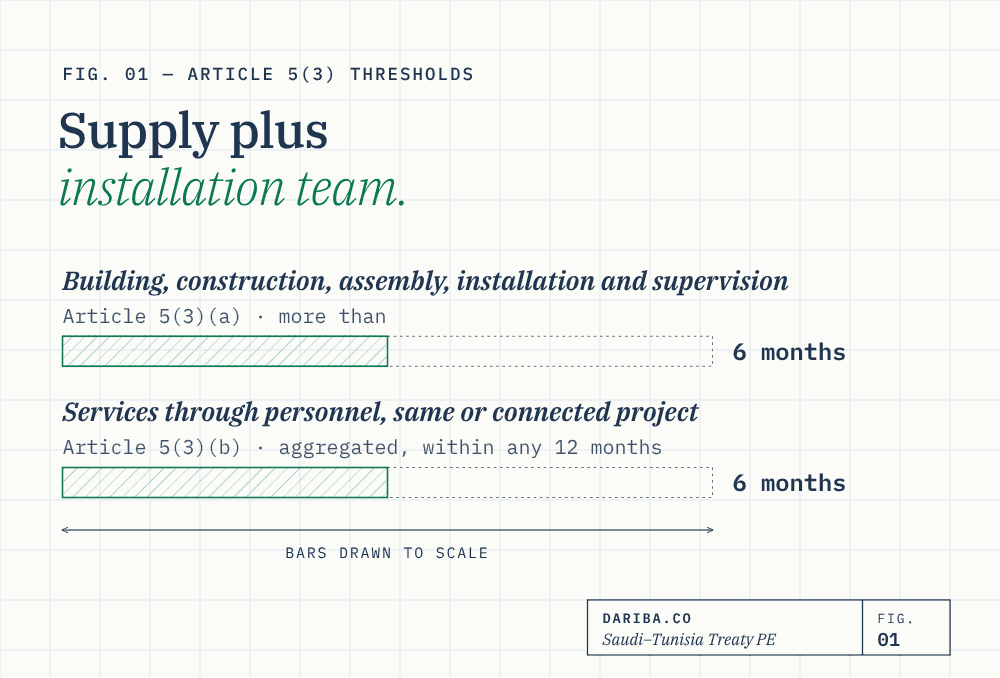
| Activity | Bilateral provision | Duration test |
|---|---|---|
| Specified building, construction, assembly, installation and related supervision | Article 5(3)(a) | More than six months |
| Services through personnel, including consultancy, on the same or a connected project | Article 5(3)(b) | More than six months in aggregate within any 12 months |
Review fixed premises, agency and exempt activities separately. For applicable periods, MLI Article 12 addresses representatives who habitually play the principal role in specified contracts subsequently concluded without material changes. Both states chose MLI Article 13 Option A, which requires the relevant exempt activities to be preparatory or auxiliary. For a project split across related enterprises, apply MLI Article 14’s conditions, including its separate more-than-30-day requirements for the enterprise’s work and each connected period counted under that provision.
Apply the export exception when working out profit
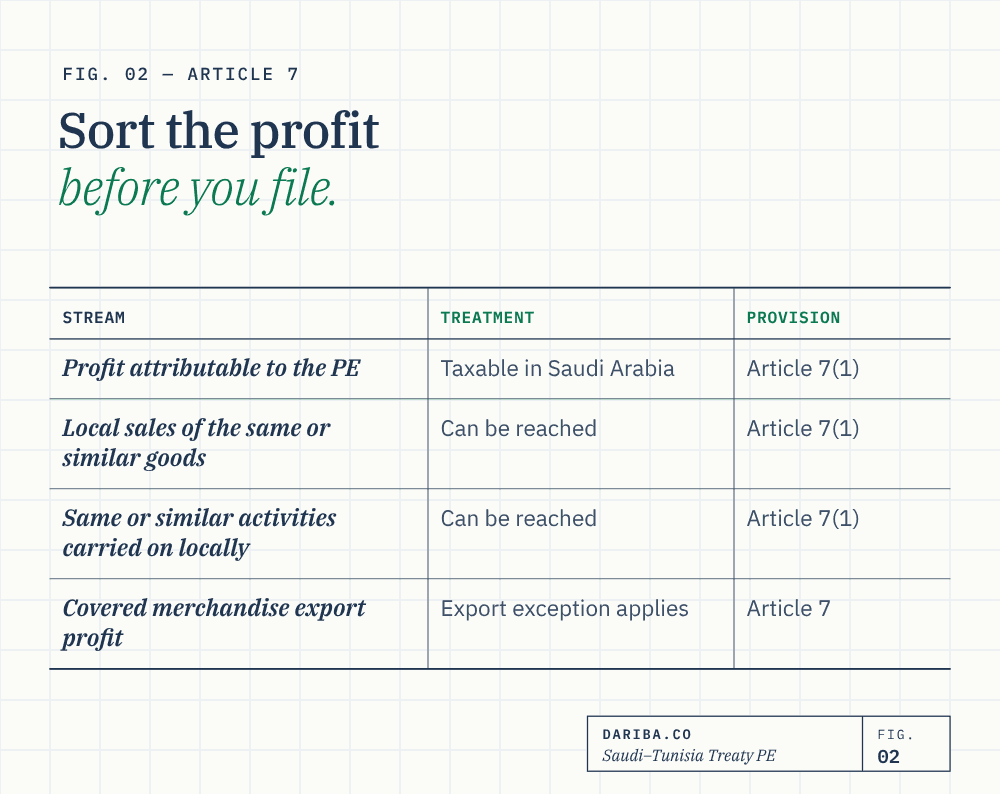
Article 7(1) reaches profit attributable to the permanent establishment, specified local sales of the same or similar goods, and the same or similar activities carried on locally. ZATCA’s Circular 2104001, Force of Attraction Rule in the Context of Permanent Establishment, explains that similarity test. Article 7(4) excludes covered merchandise exports from taxation in the importing state. Profit from other activities under the export contract performed through a local permanent establishment can be taxed there.
Reconcile the supply, installation and other local work to the underlying contract and project accounting. Review Article 7(3) for actual expenses and specified internal charges. Article 28(2) separately preserves domestic law on taxation of insurance income. See the withholding guide for the treaty rules on financing and royalties.
Key takeaways
- Article 5(3) separates project duration and services on the same or a connected project.
- The matched MLI provisions address agency, activity exemptions and contract splitting.
- Article 7(1) covers certain similar local sales and activities, subject to Article 7(4) for merchandise exports.
Sources
- Saudi–Tunisia Agreement for the Avoidance of Double Taxation and Prevention of Tax Evasion with Respect to Taxes on IncomeArticles 5, 7, 14 and 28.
- Tunisia’s Deposited MLI Reservations and NotificationsListed agreement 31, agency and activity notifications and contract splitting.
- Saudi Arabia’s Deposited MLI Reservations and NotificationsListed agreement 41 and relevant treaty notifications.
- ZATCA Circular 2104001, Force of Attraction Rule in the Context of Permanent EstablishmentPartial force of attraction and the similarity test.