In brief
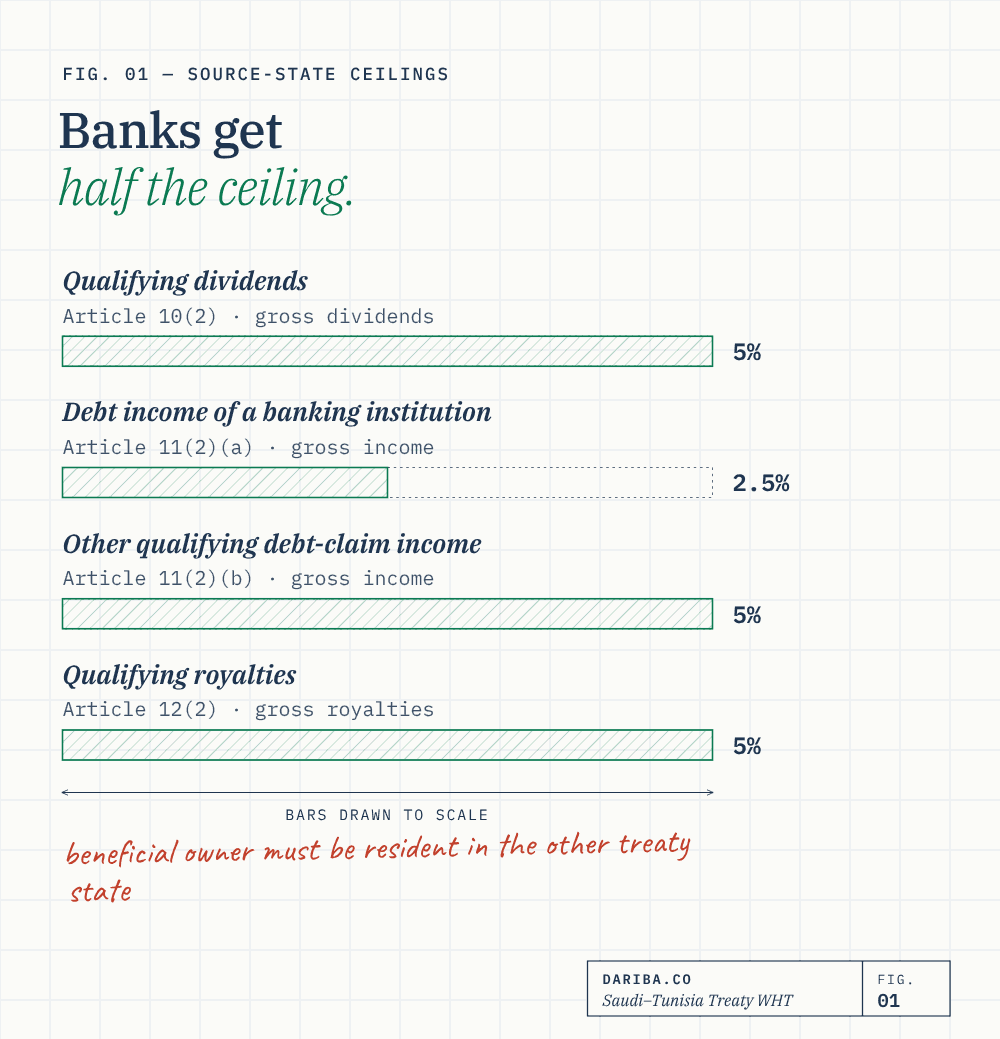
Qualifying bank debt-claim income carries a 2.5% ceiling. The general debt-income, dividend and royalty ceilings are 5%.
For a Saudi payer sending a financing return to Tunisia, the recipient’s status can affect the treaty ceiling. The Saudi–Tunisia Double Taxation Agreement distinguishes banking institutions from other beneficial owners of income from debt claims. The original withholding provisions apply to amounts paid from 1 January 2014 under Article 29.
| Payment | Treaty provision | Source-state ceiling |
|---|---|---|
| Qualifying dividends | Article 10(2) | 5% of gross dividends |
| Qualifying debt-claim income of a banking institution | Article 11(2)(a) | 2.5% of gross income |
| Other qualifying debt-claim income | Article 11(2)(b) | 5% of gross income |
| Qualifying royalties | Article 12(2) | 5% of gross royalties |
Identify the beneficiary of the financing return
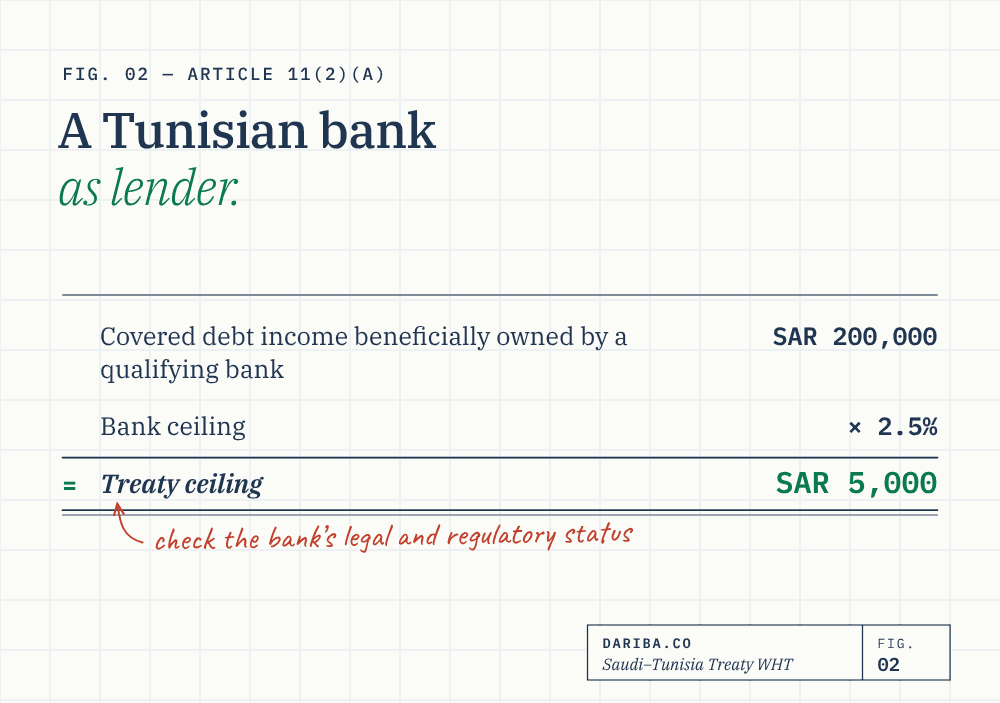
Check the banking institution’s legal and regulatory status and whether it beneficially owns the income. In a syndicated loan, identify the lenders entitled to the income and document the role of the loan agent. Where a qualifying Tunisian bank beneficially owns SAR 200,000 of covered debt income, the treaty ceiling is SAR 5,000. Apply any lower domestic charge and check the related-party excess and effective-connection rules.
Article 26 separately exempts income earned in one treaty state by the other state’s government, including the named central banks and specified bodies, institutions and companies wholly owned by the state. Document the identity and ownership of the actual recipient before relying on the exemption.
Classify the royalty and document treaty relief
Article 12(3) includes specified intellectual property, equipment use and know-how. Identify the rights conveyed and check whether the payment is effectively connected with a local permanent establishment or fixed base. Both states listed the Agreement under the Multilateral Instrument. Apply the principal purpose test for current claims and retain evidence of the transaction’s commercial reasons. Section 4 of ZATCA’s Tax Circular on Implementation of Withholding Tax Under the Double Taxation Agreement describes relief at source and refunds.
Key takeaways
- The 2.5% ceiling in Article 11(2)(a) applies to banking institutions.
- Article 26 exempts qualifying income of specified government recipients in the source state.
- Assess residence, beneficial ownership, effective connection and the principal purpose test.
Sources
- Saudi–Tunisia Agreement for the Avoidance of Double Taxation and Prevention of Tax Evasion with Respect to Taxes on IncomeArticles 10–12, 26 and 29.
- Tunisia’s Deposited MLI Reservations and NotificationsListed agreement 31, agency and activity notifications and contract splitting.
- Saudi Arabia’s Deposited MLI Reservations and NotificationsListed agreement 41 and relevant treaty notifications.
- ZATCA Tax Circular on Implementation of Withholding Tax Under the Double Taxation AgreementSection 4 on relief at source and refunds.