In brief
The Saudi–UAE treaty distinguishes ordinary dividend and royalty ceilings, qualifying debt-income allocation and government investments. Original PE, insurance, anti-abuse and MAP wording matter; unilateral MLI listing is insufficient.
A payment from Saudi Arabia to a UAE recipient needs the actual Saudi–UAE treaty income article, residence, beneficial ownership and relief evidence. Neither a UAE invoice nor a group company address establishes a treaty exemption.
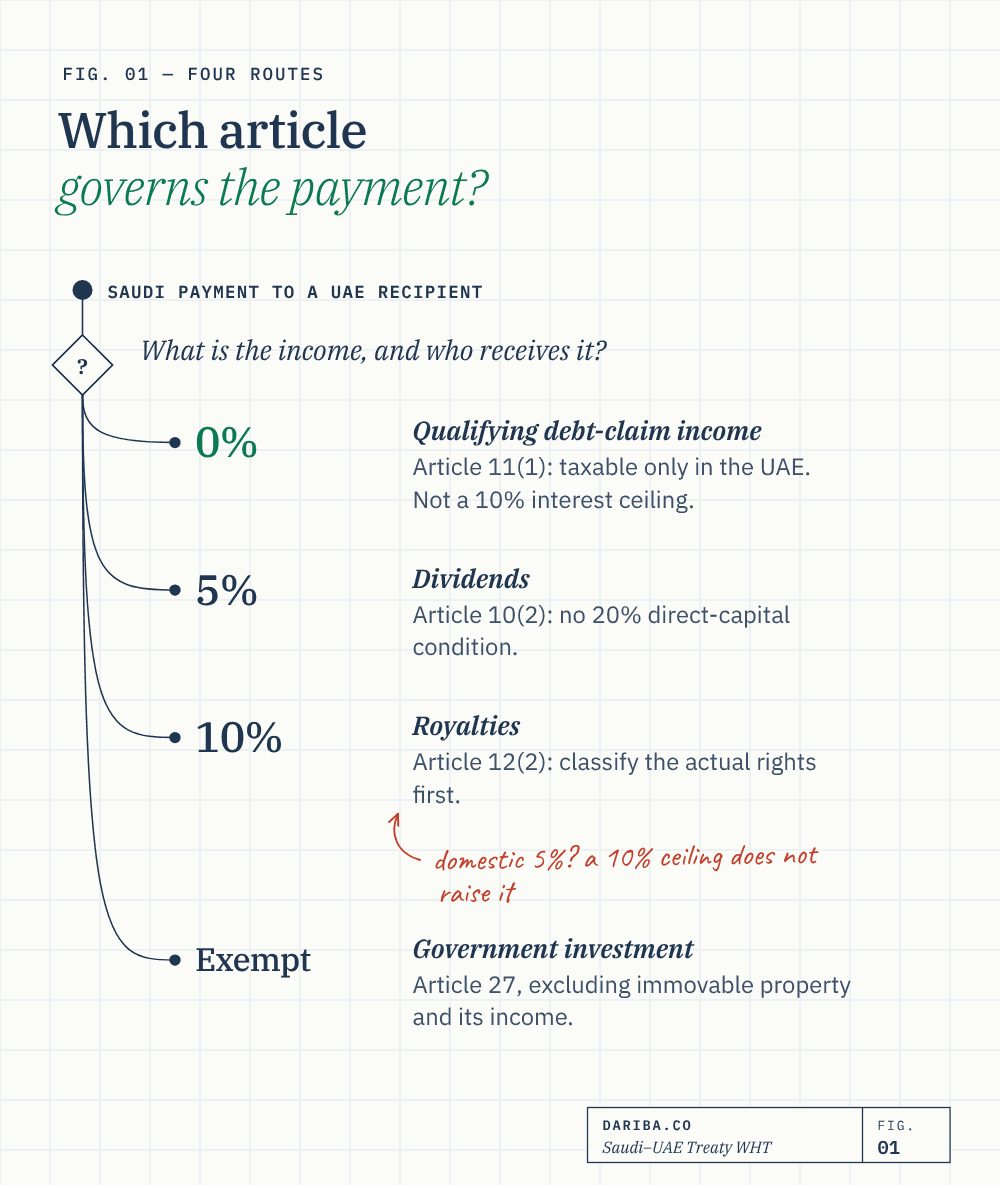
The original treaty has an ordinary 5% dividend ceiling, exclusive recipient-State taxation for qualifying debt income, and an ordinary 10% royalty ceiling. Article 27 separately addresses qualifying government investments. These are different routes with different conditions; a treaty ceiling does not increase a lower applicable domestic charge.
Establish residence and the applicable period
Article 4(1) defines residence by the stated tax-liability criteria and includes specified State and exempt-entity wording. Paragraph (1)(b) must be read for the actual established entity, including its sovereign-fund and exempt-purpose language. A commercial registration, an exemption label or a bank account alone does not settle every condition. The definition excludes the specified person taxable only on local-source income or locally situated capital.
For dual-resident non-individuals, original Article 4(3) uses effective management. Identify the actual management facts and applicable instruments rather than relying solely on the place of incorporation.
ZATCA’s current entry records signature on 23 May 2018 and entry into force on 1 April 2019. Original Article 30(2) applies the following-January rules: withholding amounts paid on or after 1 January 2020, and other taxes for years beginning on or after that date. Entry into force and tax application are separate dates.
Sources: Articles 4 and 30; ZATCA treaty entry. Article 2 identifies the covered taxes, including Saudi Zakat; Article 24(2) separately preserves Saudi Zakat law in the double-tax-relief method. The treaty is not a blanket VAT exemption.
Apply the dividend clause without importing another country’s holding test
Article 10(2) limits source-State tax to 5% of gross dividends where the beneficial owner is resident in the other State. Its ordinary ceiling does not contain Egypt’s separate 20% direct-capital condition. A condition from another Saudi treaty should not be copied into this one.
Paragraph (3) defines dividends by the specified shares, participating rights and corresponding domestic tax treatment. Paragraph (4) redirects its stated effectively connected shareholding to Article 7 or 14 where the recipient has the relevant permanent establishment or fixed base. Paragraph (5) addresses the specified taxation of the distributing foreign company’s dividends and undistributed profits.
The ordinary Saudi domestic dividend rate is also 5% under Regulations Article 63. A matching treaty ceiling is not itself a new reduction. The separate government-investment provision needs its own actual qualification.
Sources: Article 10; domestic Regulations Article 63.
Test the exclusive debt-income allocation and its exceptions
Article 11(1) allocates qualifying debt-claim income arising in one State and paid to its resident beneficial owner in the other State only to that other State. For a qualifying UAE recipient of Saudi-source debt income, this is a source-tax exemption route under the treaty, rather than a 10% interest ceiling borrowed from another country.
Paragraph (2) defines debt-claim income, including its specified securities, premiums and prizes. It excludes late-payment penalties from that definition. An exclusion from this article is not an exemption from every other possible tax rule. Establish the actual loan, return and components before treating arrangement, guarantee or other service fees as debt income.
Paragraph (3) retains the effective-connection exception for the stated permanent establishment or fixed base. Paragraph (4) limits the article’s treatment to the amount that independent parties would have agreed where a special relationship causes excess income. Beneficial ownership, actual connection and the arm’s-length amount require evidence even if the recipient supplies a residence certificate.
Source: Article 11. Actual domestic source, character and collection procedure remain separate steps.
Classify royalties, equipment and digital arrangements on their terms
Article 12(2) gives a 10% gross ceiling where the beneficial owner is resident in the other State. Paragraph (3) covers the specified copyright and industrial rights, equipment use, and industrial, commercial or scientific experience.
A right to use intellectual property, an outright transfer, an equipment lease, hosted software and an independent service can have different facts. The clause should not be reduced to “every technology invoice is a 10% royalty”. Nor should Egypt’s express software/connected-assistance wording simply be presented as wording of the UAE treaty.
Paragraphs (4)–(6) separately address effective connection, payer/establishment source and special-relationship excess. A treaty ceiling limits a charge; it does not impose a higher charge where the actual domestic category is lower.
Sources: Article 12; domestic categories in Regulations Article 63.
Read the government-investment exemption with its property exclusion
Article 27 exempts the stated government investments and resulting income, including gains on disposal, in the other State. Its wording includes central-bank investments and the specified wholly State- or local-government-owned public bodies and financial institutions.
The provision expressly excludes immovable property and income from that property. Do not convert it into a general exemption for every asset owned by an entity associated with government. Establish the actual investment, owner, qualifying institutional category and income. Residence under Article 4 and the investment exemption under Article 27 are separate questions.
Dariba analysis: a commercial payer should retain the actual recipient’s legal identity and ownership/investment evidence, the income classification and the provision relied on. A government-associated name, an intermediary or a minority public shareholding does not by itself establish the exemption.
Source: Article 27. Individual institutional succession and actual entitlement are not certified here.
Separate enterprise services, individuals and the special activity clauses
Article 7 ordinarily links enterprise business profits to a permanent establishment, but its actual attribution, same/similar sales or activities, exports and internal-charge provisions need to be read together. Other specifically governed income retains its own article. Article 29(4) expressly preserves domestic insurance-income taxation; a general no-establishment argument must address that clause.
Original Article 5 includes fixed premises, a project lasting more than six months, and the stated same/connected-project service activity lasting more than 183 days within the specified twelve-month window. Its original anti-fragmentation and principal-role/contract and regular-stock agency routes also matter. Offshore signature or a short individual visit does not alone eliminate those routes.
An independent individual falls under Article 14, with its fixed-base alternative or presence of at least 183 days in the stated twelve-month period. Exactly 183 days meets that individual presence limb; it does not exceed the enterprise service threshold. Employment, international transport and other specific income require their own provisions.
Sources: Articles 5 and 7; Article 14; Article 29. The Saudi–UAE permanent establishment guide explains the duration tests and how Article 7 applies to similar local activity.
Use the original anti-abuse and MAP wording before assuming MLI changes
Original Article 29(3) already contains a principal-purpose benefit test, including its object-and-purpose qualification. Paragraph (2) preserves domestic anti-evasion/avoidance rules. A certificate or contractual label does not remove the need to examine the arrangement and relevant facts.
Saudi Arabia’s deposited MLI position lists UAE as agreement 53. The reviewed UAE deposited list does not list Saudi Arabia. These positions therefore do not establish mutual listing under MLI Article 2(1)(a)(ii). Do not import another country’s optional modifications or a generic MLI effect date merely because both States are MLI parties. The full subsequent-notification history remains a separate verification question.
Original Article 25(1) already allows a qualifying MAP case to either State’s competent authority within three years of first notification. That original route should not be attributed to an assumed MLI change. MAP does not promise relief, arbitration or suspension of domestic filing, payment or objection deadlines.
Sources: Articles 25 and 29; Saudi deposited position; UAE deposited position; MLI Article 2; current MLI status.
Compare the actual charge and complete the relief file
This is Dariba’s original illustration, not an official example. Assume SAR 100,000 of consideration actually classified as royalties, an eligible UAE resident beneficial owner, no applicable connection or excess exception, satisfied anti-abuse conditions and the correct relief procedure.
| Conditional computation | Amount |
|---|---|
| Domestic royalty: SAR 100,000 × 15% | SAR 15,000 |
| Treaty royalty ceiling: SAR 100,000 × 10% | SAR 10,000 |
| Arithmetic difference | SAR 5,000 |
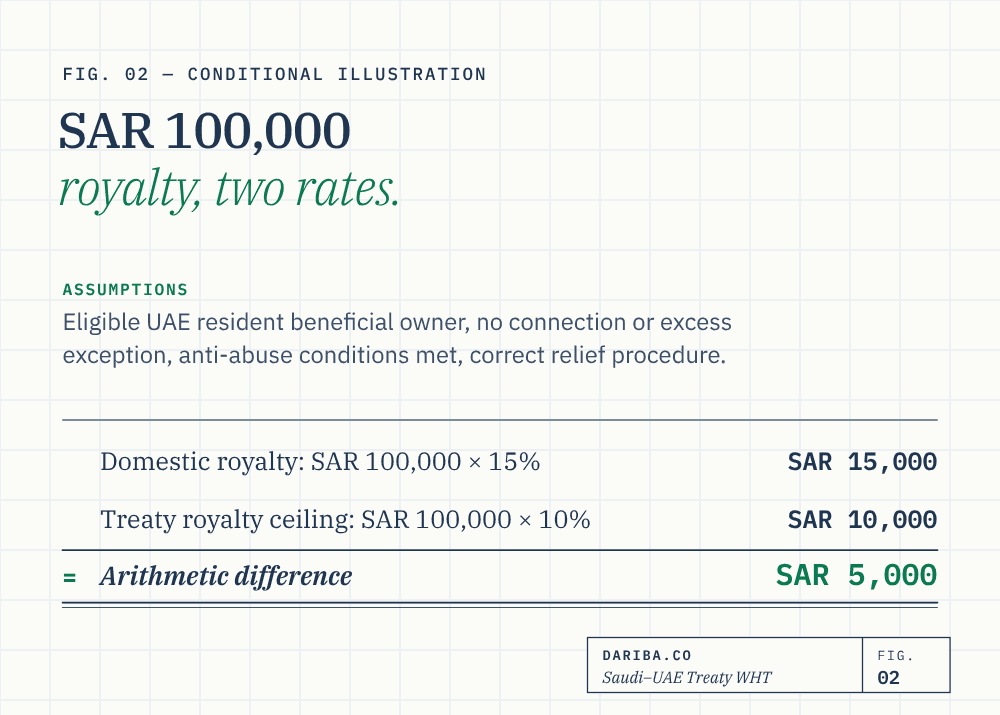
The illustration does not classify an actual licence, establish the government exemption or approve a refund. If the actual applicable domestic category were 5%, a 10% treaty ceiling would not raise it to 10%.
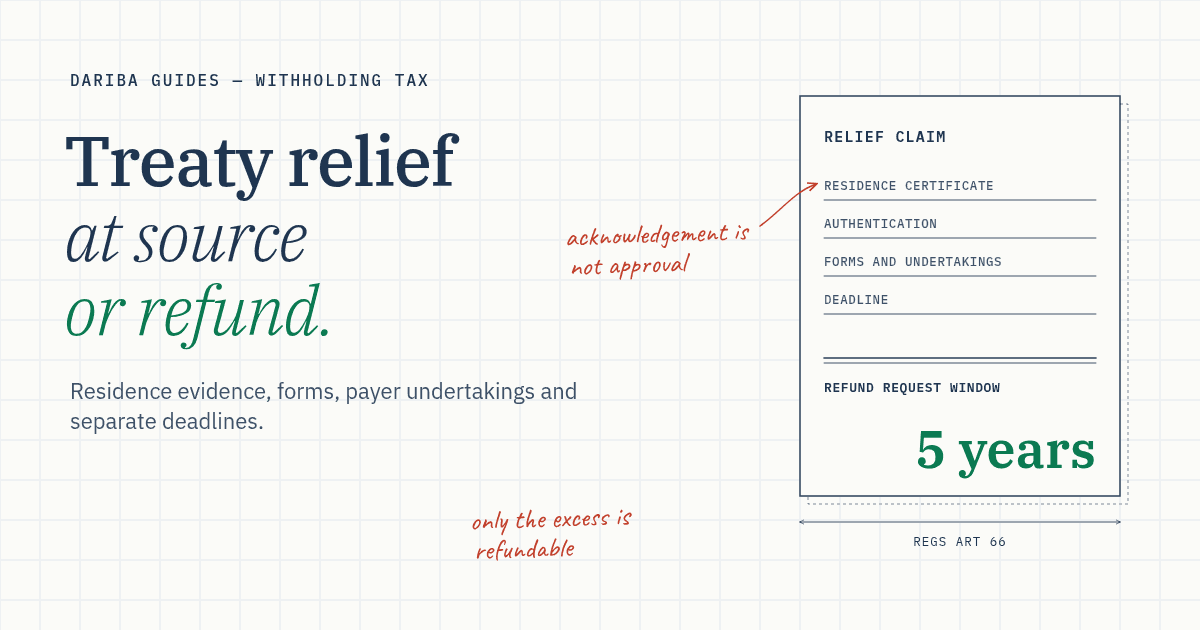
ZATCA’s treaty-withholding circular section 4 distinguishes supported relief at source from domestic withholding followed by refund. Keep the actual forms, residence/authentication or Apostille evidence, undertakings, payment/remittance and claim/decision. A submitted request is not an approval.
Sources: Article 12; Regulations Article 63; ZATCA circular section 4. The relief-at-source and refund guide explains the procedural distinction. Actual competent-authority agreements, later instruments and individual claims require their own evidence.
Key takeaways
- Ordinary dividend and royalty ceilings are 5% and 10%, subject to actual conditions.
- Qualifying debt income is allocated exclusively to the resident beneficial owner’s State, with connection and excess exceptions.
- Article 27 government-investment relief excludes immovable property and its income.
- Enterprise services use more than 183 days; the individual presence limb is at least 183 days.
- Original anti-fragmentation, agency, PPT and either-authority MAP wording must not be attributed to an assumed MLI change.
- A treaty ceiling does not raise a lower domestic charge, and relief paperwork is not approval.
Sources
- Saudi–UAE treaty, current ZATCA Arabic originalArticles and paragraphs identified in the analysis; Articles 27/29/30 read separately from ordinary income clauses. Actual later instruments and individual claims remain separate.
- UAE deposited MLI reservations and notifications, 29May2019Actual deposited agreement list read; Saudi Arabia is not listed. Not a complete certification of later notifications.
- Saudi deposited MLI positionAgreement53 lists UAE; unilateral listing is insufficient under MLI2(1)(a)(ii).
- Authentic English MLIArticle 2(1)(a)(ii), actual mutual-listing requirement; no generic effect date or optional modifications inferred.
- OECD current MLI status and linked positionsStatus and actual linked deposited positions checked separately from treaty original dates.
- Saudi Income Tax Implementing Regulations, current ArabicArticle 63 domestic categories and actual exceptions; lower applicable domestic charge retained.
- ZATCA circular on withholding under double-tax agreementsSection 4 actual relief-at-source versus refund procedure; submission is not approval.
- ZATCA Saudi–UAE treaty entryCurrent entry records signature23May2018 and force1April2019; treaty30 governs actual tax application.
General information only. Actual supplies, facts, applicable periods and controlling Arabic legislation determine the result. Official examples are distinguished from Dariba analysis and original illustrations. Seek advice or clarification where the arrangement or source material leaves a specific issue unresolved.