In brief
Check the Saudi–Uzbekistan treaty’s 7% dividend and debt ceilings, 10% royalty ceiling and government-income exemption.
The Saudi–Uzbekistan Double Taxation Convention entered into force on 1 November 2010. Under Article 29, the original withholding provisions apply to amounts paid from 1 January 2011. The category of income and identity of its beneficial owner determine the ceiling.
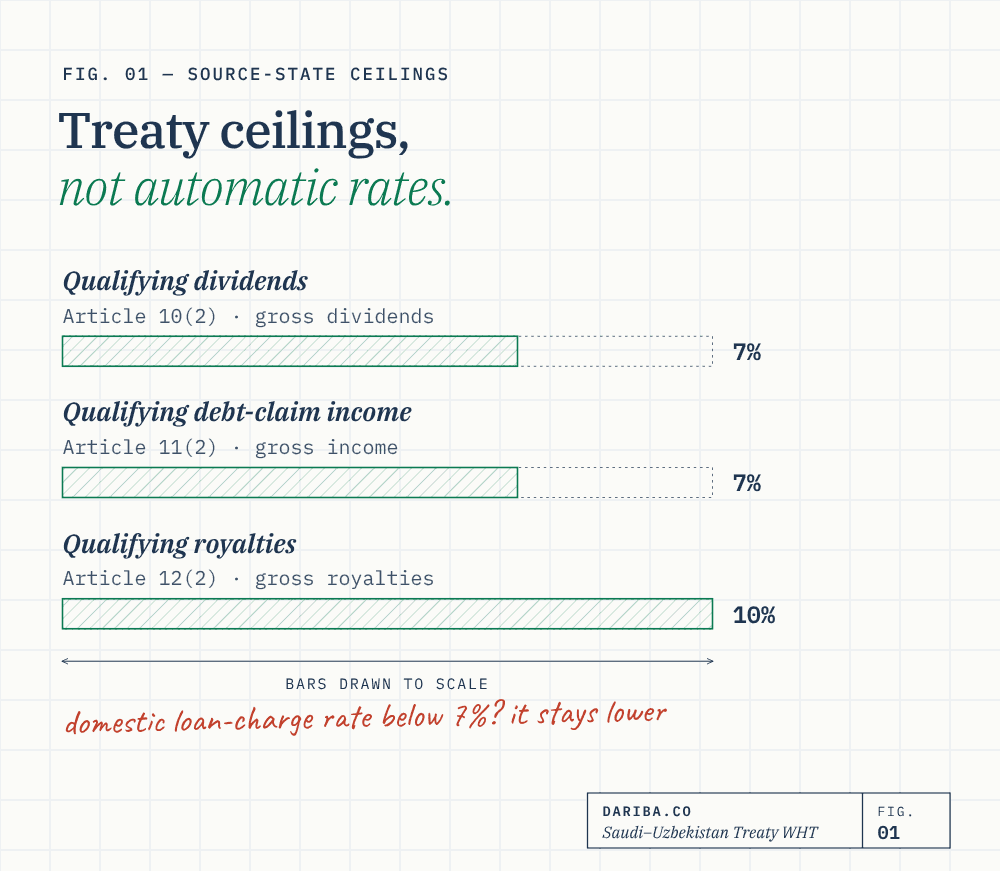
| Payment | Provision | Source-state ceiling |
|---|---|---|
| Qualifying dividends | Article 10(2) | 7% of gross dividends |
| Qualifying debt-claim income | Article 11(2) | 7% of gross income |
| Qualifying royalties | Article 12(2) | 10% of gross royalties |
These ceilings require a beneficial owner resident in the other treaty state. For a Saudi payer, compare the applicable domestic rate and the treaty ceiling. For example, when a Saudi domestic loan-charge rate below 7% applies, the treaty does not increase it. Review effective connection to a permanent establishment or fixed base and distinguish any related-party excess.
Confirm the scope of a government exemption
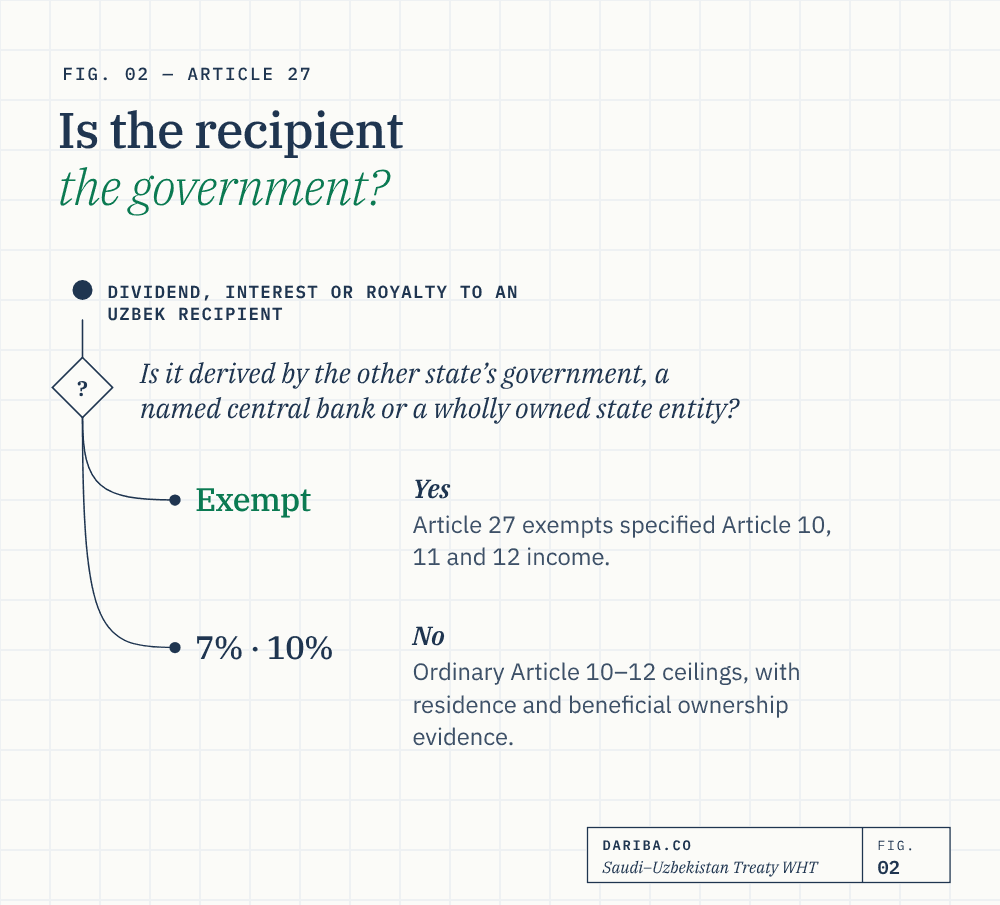
Article 27 exempts specified Article 10, 11 and 12 income derived in one state by the other state’s government, including the named central banks and wholly owned state entities. The exemption also covers specified gains from disposal of the shares, debt claims or rights generating that income. Trace the disposal to the underlying income-producing asset and establish the claimant’s status.
For equipment and licensing payments, Article 12(3) defines the rights and property covered by the royalty article. Record what the agreement conveys and the source of each payment. Section 4 of ZATCA’s Tax Circular on Implementation of Withholding Tax Under the Double Taxation Agreement explains the Saudi relief routes.
Key takeaways
- The ordinary dividend and debt ceilings are 7%, and the royalty ceiling is 10%.
- Article 27 addresses qualifying government income and gains.
Sources
- Saudi–Uzbekistan Convention for the Avoidance of Double Taxation and the Prevention of Tax EvasionArticles 10–12, 25, 27 and 29.
- ZATCA Treaty Register, Uzbekistan ConventionSignature and entry into force.
- ZATCA Tax Circular on Implementation of Withholding Tax Under the Double Taxation AgreementSection 4 on relief at source and refunds.