In brief
Article 59 distinguishes the identified period, prior-period penalties and remaining older balances. Tax-account records, payment deadlines and credit set-off have separate rules; ZATCA Example 1 illustrates the period-first allocation.
A payment leaving the bank and a VAT period being settled are connected events, but the reconciliation must establish both. Article 59 sets the payment deadline, identification requirements, tax-account records and order in which ZATCA applies money received. An overpayment for one period does not necessarily remain available as cash while earlier liabilities are unpaid.
For finance teams, the useful question is where the payment was actually posted and what remains due. Match the taxpayer, period, transfer, account entry and any assessment or set-off notice before treating the liability as cleared.
Identify the payment deadline and the relevant liability
Article 59(1) ordinarily requires tax for a period to be paid by the last day of the following month. Paragraph (2) separately requires payment of a ZATCA assessment by the date specified in its notice. Do not replace an assessment’s actual date with the ordinary return timetable.
Article 74(1) expressly preserves VAT filing and payment dates when they fall outside working days. Its rule differs from paragraph (2)‘s next-working-day treatment for other obligations. Check any actual applicable extension rather than assuming that a weekend changes a payment date. The return-filing guide explains the relevant timetable.
Paying and filing are separate obligations. A payment does not itself submit the return or correct a declaration. Equally, a return acknowledgement does not, by itself, establish that the corresponding tax has been paid.
Source: current Arabic VAT Regulations, Articles 59(1)–(2), pp. 61–62, and 74, p. 78.
Supply the taxpayer and period information
Article 59(3) provides for payment into the Authority’s bank account. Paragraph (4) requires the payer to provide the taxable person’s tax-identification details and the period or periods being paid. The article does not say that an unidentified transfer automatically settles whichever balance the payer intended internally.
Article 57 separately requires the taxable person’s tax identification on tax invoices and correspondence with the Authority concerning VAT. This statutory identifier requirement should be read with the applicable electronic invoice and payment requirements; it is not a substitute for every other reference required by the relevant process.
ZATCA’s Examination, Assessment, Correction and Objection on VAT Decisions guideline, version 3 May 2026, section 4.2, p. 16, describes return acknowledgements, a copy of the return and the SADAD billing notification. Keep the actual official notification and payment trail. This guide does not prescribe bank coordinates, an unverified payment destination or one universal screen sequence.
Dariba recommendation: reconcile the taxpayer’s registered identity, intended period and official payment reference before transfer, then confirm the account posting afterwards. Retain evidence of a discrepancy and seek correction through the applicable Authority process rather than making an unsupported assumption about the allocation.
Read the period account and the running balance separately
Under Article 59(5), ZATCA maintains a tax account recording the VAT due for each period, related penalties and other charges, and the running balance of tax, penalties and other amounts payable. Paragraph (6) makes the account details available electronically to the taxable person.
The account can therefore contain more than the net tax shown in the latest return. A return, later assessment, penalty, payment, correction, credit or offset can explain different entries. A single bank transfer amount is not a complete reconciliation of those movements.
Dariba analysis: distinguish the ledger liability from the Authority account and explain differences item by item. Confirm the relevant date and legal status of an assessment or penalty; do not simply force the company’s books to match an unexplained total. The underlying return or assessment may require its own correction or review process, even where the cash allocation is understood.
Apply the three-stage allocation in Article 59(7)
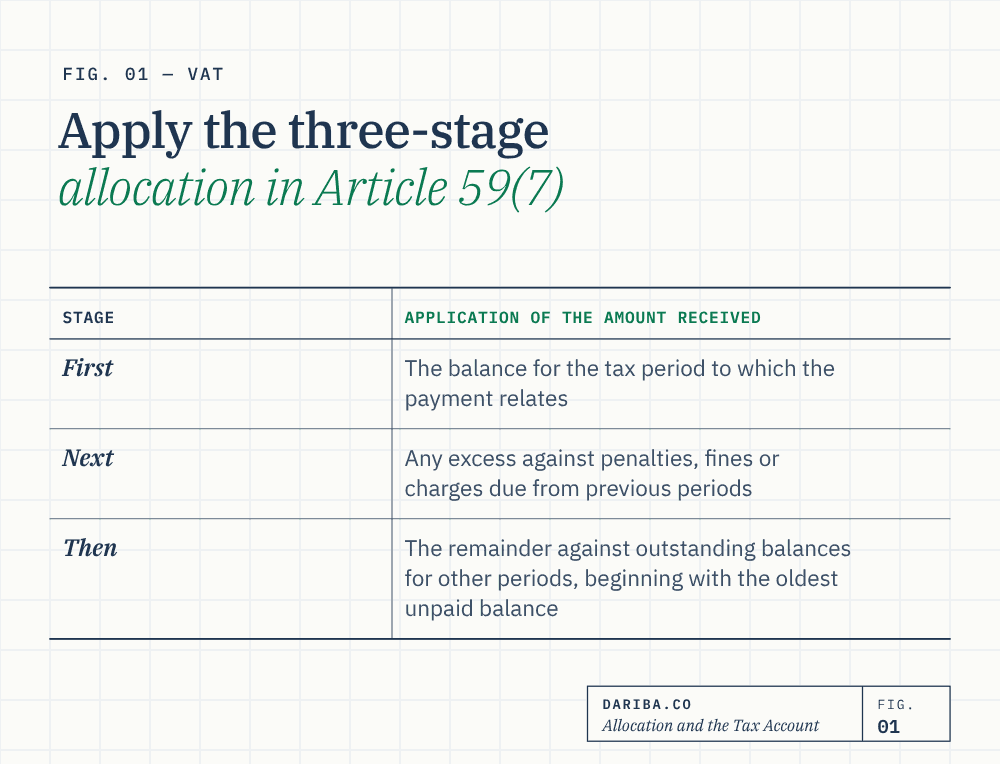
When ZATCA receives a payment, paragraph (7) specifies this order:
| Stage | Application of the amount received |
|---|---|
| First | The balance for the tax period to which the payment relates |
| Next | Any excess against penalties, fines or charges due from previous periods |
| Then | The remainder against outstanding balances for other periods, beginning with the oldest unpaid balance |
It is therefore incomplete to describe the rule simply as “oldest VAT first.” The identified payment period comes first, and the prior-period penalty/charge stage intervenes before the remaining other-period balances. The provision does not set out an additional ordering among several penalties within that intermediate stage; no universal internal priority is invented here.
The wording also does not mean a company can earmark an excess indefinitely while earlier due amounts remain unpaid. Conversely, where the payment identification or account posting is disputed, establish the facts before concluding that the intended period is settled.
Source: Article 59(5)–(8), pp. 61–62.
ZATCA’s example: the August payment also clears July
Example 1 in section 4.2 of the May 2026 examination guideline, p. 19, concerns Al Waha, a Saudi management-consulting company registered for VAT and filing monthly. It owes SAR 2,500 for July 2021 and declares SAR 20,000 net tax for August 2021. It pays SAR 22,500, referring the whole payment to August.
ZATCA applies SAR 20,000 to settle August first, then the SAR 2,500 excess to July’s outstanding balance. These are the official example’s historical periods and amounts. The example does not include a separate outstanding penalty, and its amounts should not be silently expanded to illustrate that additional stage. Read Example 1.
Dariba analysis: the August reference identifies the first stage; it does not prevent the excess settling July. No VAT rate needs to be inferred from the example’s net liabilities, and it does not determine the treatment of an unrelated company’s balance.
Dariba illustration: a prior penalty changes the remainder
Assume a correctly identified payment period has SAR 10,000 due. The same taxpayer also owes one prior-period penalty of SAR 2,000 and an older-period tax balance of SAR 5,000. It pays SAR 14,000 for the identified period. Assume all amounts are valid, due and within the stated allocation rule, with no other entries or intervening set-off.
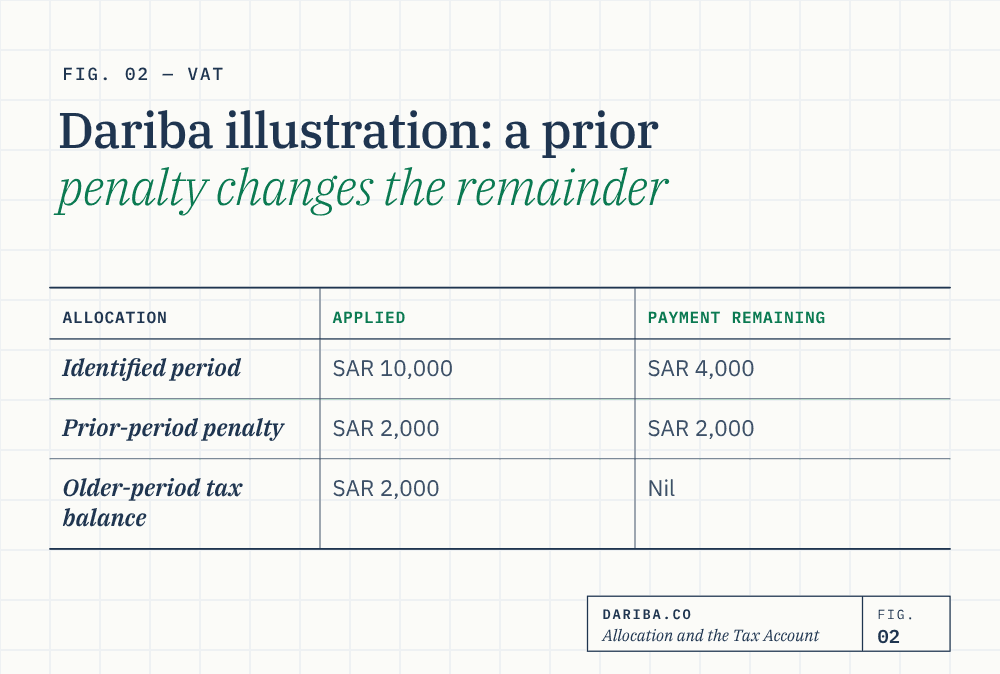
| Allocation | Applied | Payment remaining |
|---|---|---|
| Identified period | SAR 10,000 | SAR 4,000 |
| Prior-period penalty | SAR 2,000 | SAR 2,000 |
| Older-period tax balance | SAR 2,000 | Nil |
The older tax balance is reduced from SAR 5,000 to SAR 3,000. The payment settles the identified period and penalty, but does not clear every debt. Total opening liabilities of SAR 17,000 less the SAR 14,000 payment leave SAR 3,000. These are Dariba’s original assumptions and arithmetic, separate from ZATCA’s Example 1; no penalty rate or actual taxpayer outcome is asserted.
Keep instalments, security and credit set-off distinct
An approved instalment arrangement under Article 60 must identify its relevant periods and payments, subject to Article 59(7). The application alone does not create an approved schedule. Article 65(1)(c) also keeps cash security in an account separate from the tax account; providing security should not automatically be recorded as discharge of the VAT balance. See payment plans and guarantees.
Article 59(8) permits ZATCA to offset a VAT credit balance against other taxes due from the same taxable person and requires notification of that offset. That is a separate power from applying an incoming payment under paragraph (7). It does not mean common ownership automatically pools every group company’s liabilities.
Article 69(5) separately governs the stated refund set-off and retention powers. A credit shown in the account, a refund request, an approved refund and the cash ultimately transferred can differ. Use the refund-offset analysis for those distinctions.
The practical close is a reconciliation showing opening liabilities, the intended payment period, money received, each allocation or offset, supporting notices and the remaining balance. Retain unresolved differences explicitly. Neither an unexplained credit nor a bank debit should be treated as proof that every return, penalty and payment obligation is complete.
Key takeaways
- A return acknowledgement and a payment posting establish different things.
- Supply the actual taxpayer and period details and reconcile the Authority account.
- The identified period is first, then earlier penalties/charges, then remaining other-period balances from oldest.
- ZATCA Example 1 applies SAR 22,500 first to August2021 and then July2021.
- Dariba’s separate SAR 14,000 illustration leaves SAR 3,000 of older tax after paying the stated period and prior penalty.
- Instalment approval, cash security and VAT-credit set-off are separate questions.
Sources
- Saudi VAT Implementing Regulations, current Arabic textArticles 57 and 59(1)–(8), pp.60–62: identifier, payment dates, period references, tax account, allocation and notified VAT-credit set-off. Articles 60(4),65(1)(c),69(5) and 74 preserve separate procedures.
- ZATCA Examination, Assessment, Correction and Objection on VAT Decisions guidelineVersion3 May2026. Section 4.2, p.16: return and SADAD notifications. Example 1 and Article 59(7)–(8) discussion on p.19: Al Waha’s July/August2021 balances and period-first payment allocation. Historical figures retained.
General information only. Actual supplies, facts, applicable periods and controlling Arabic legislation determine the result. Official examples are distinguished from Dariba analysis and original illustrations. Seek advice or clarification where the arrangement or source material leaves a specific issue unresolved.