In brief
The statutory breach, tax base, classification and recurrence conditions govern the penalty. Article 48 separately identifies Board classification and the Governor or Board-delegated decision-maker; relief and objection routes require their actual conditions.
Identify the Breach Before Calculating the Fine
Saudi VAT penalties do not follow one universal percentage or warning schedule. The VAT Law specifies penalties for registration, returns, payment, evasion and other breaches. Article 48 also provides for a classification framework reflecting proportionality between the breach and penalty. ZATCA’s current Arabic classification guide explains particular general VAT and e-invoicing categories.
The first task is therefore to identify the conduct and legal provision, then examine the actual decision, applicable classification, repetition history and any relief conditions. A warning for an invoice-control failure does not establish that late payment or tax evasion always begins with a warning.
The VAT Law Sets Different Bases and Limits
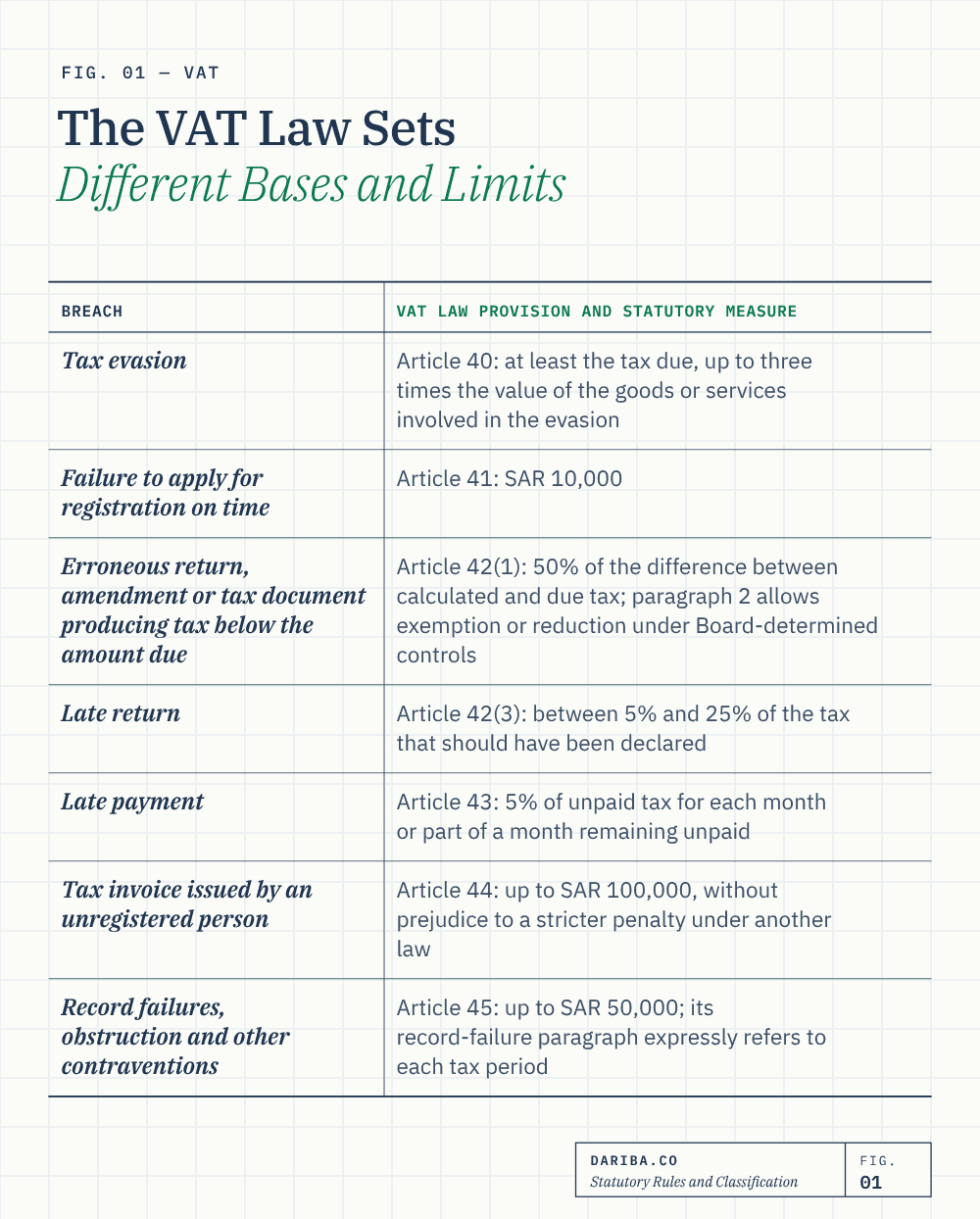
The following table summarises the statutory wording. It does not replace the actual penalty decision, applicable classification or a valid relief rule.
| Breach | VAT Law provision and statutory measure |
|---|---|
| Tax evasion | Article 40: at least the tax due, up to three times the value of the goods or services involved in the evasion |
| Failure to apply for registration on time | Article 41: SAR 10,000 |
| Erroneous return, amendment or tax document producing tax below the amount due | Article 42(1): 50% of the difference between calculated and due tax; paragraph 2 allows exemption or reduction under Board-determined controls |
| Late return | Article 42(3): between 5% and 25% of the tax that should have been declared |
| Late payment | Article 43: 5% of unpaid tax for each month or part of a month remaining unpaid |
| Tax invoice issued by an unregistered person | Article 44: up to SAR 100,000, without prejudice to a stricter penalty under another law |
| Record failures, obstruction and other contraventions | Article 45: up to SAR 50,000; its record-failure paragraph expressly refers to each tax period |
The bases differ. Article 40’s upper limit refers to the value of the relevant goods or services, not simply three times the VAT. Article 43 uses unpaid tax, while Article 42(1) uses the tax difference. Do not substitute turnover, invoice count or a standard flat amount without the applicable rule.
Dariba arithmetic illustration: suppose an ordinary late-payment case has SAR 20,000 tax still unpaid for one chargeable month or part, with no applicable relief or other adjustment. Five per cent is SAR 1,000. This illustrates the percentage calculation only; it does not establish the number of chargeable periods, a live assessment or the treatment of a partial payment.
Distinguish Evasion from an Ordinary Error
Article 39 identifies the statutory evasion conduct. Its first paragraph concerns incorrect, forged or fabricated documents, returns, records or information submitted with the intention of evading tax, reducing it or obtaining an undue refund. The wording places the burden of proving absence of intent on the taxable person. Its second paragraph addresses the stated unlawful introduction, attempted introduction, removal or attempted removal of goods or services and relevant tax or restriction breaches.
An error should not be described as an automatic evasion finding merely because tax is underpaid. Conversely, correcting an amount does not by itself resolve an allegation supported by the actual Article 39 conditions. Preserve original records, the discovery history, calculations and relevant communications, and address the stated allegation rather than relying on a generic assertion of good faith.
Article 46 separately preserves collection of the underlying tax and the operation of penalties under other laws. A fine is not a substitute for paying the principal liability.
Identify the Statutory Decision-Maker
Article 48(1) assigns the Authority responsibility for imposing the Law’s penalties under a classification and graduated-penalty framework issued by Board decision, with proportionality between the breach and penalty. The published classification guide should therefore be read with the actual legal basis and applicable decision, rather than treated as an independent amendment of every statutory penalty.
Under Article 48(2), the penalty is imposed by a decision of the Authority’s Governor or a person delegated by the Board. That identifies the statutory decision-maker and delegation route. Dariba recommends checking the actual decision and relevant authority where that issue arises; the provision does not itself establish that every document signed by another employee is invalid or that an objection deadline can be ignored while authority is investigated.
The General VAT Classification Guide Covers Specified Categories
ZATCA’s Arabic Simplified Guideline for Classification of General VAT Violations, second edition, May 2024, distinguishes seven ordinary VAT categories before its separate e-invoicing entries. Its introductory text starts the listed general framework with a warning and describes correction periods, including a shorter obstruction rule.
The table below reproduces the ordinary category schedules in the guide. “Further” means each occurrence after the sixth under that table; amounts are Saudi riyals.
| Category | First | Second | Third | Fourth | Fifth | Sixth | Further | Listed interval |
|---|---|---|---|---|---|---|---|---|
| 1: Failure to issue tax invoices as required | Warning | 10,000 | 15,000 | 20,000 | 30,000 | 40,000 | 50,000 | 30 days |
| 2: Failure to issue/provide the required credit or debit note | Warning | 5,000 | 10,000 | 15,000 | 20,000 | 30,000 | 40,000 | 30 days |
| 3: Missing required invoice/note data | Warning | 1,000 | 5,000 | 10,000 | 20,000 | 30,000 | 40,000 | 30 days |
| 4: Failure to preserve invoices, records and accounting documents as required | Warning | 1,000 | 5,000 | 10,000 | 20,000 | 30,000 | 40,000 | 60 days |
| 5: Preventing or obstructing Authority personnel | Warning | 1,000 | 5,000 | 10,000 | 20,000 | 30,000 | 40,000 | 10 days |
| 6: Incorrect VAT calculation on invoices to final consumers | Warning | 1,000 | 5,000 | 10,000 | 20,000 | 30,000 | 40,000 | 60 days |
| 7: Other Law/Regulations breach within the classification | Warning | 1,000 | 5,000 | 10,000 | 20,000 | 30,000 | 40,000 | 60 days |
Category 3 states that the fine applies by each required invoice/note field. Category 4 applies separately for each breached requirement. Those qualifications make it unsafe to assume one amount always covers all missing fields, documents and duties.
This is the current published guide’s explanation. It is not a claim that every statutory percentage penalty has been replaced by this table or that a separately issued underlying Board classification decision has been exhaustively audited here. The e-invoicing penalties guide addresses categories 8–18 and their system-specific conditions.
ZATCA’s Official Examples Show Why the Category Matters
In the guide’s first ordinary VAT example, Mohammed’s business does not issue some consumer invoices with the basic tax elements. The first discovery produces a warning; recurrence after 30 days leads to SAR 10,000 under the stated example and category 1.
Its second example separately addresses Mohammed’s failure to issue or provide credit/debit notes. After the warning and 30 days, the next penalty is SAR 5,000 under category 2. The same taxpayer name does not make the two categories interchangeable.
The third example concerns Khalid’s coffee shop. It issues invoices correctly but sometimes fails to preserve them. After the warning, the uncorrected failure after 60 days leads to the second occurrence penalty; a later third discovery produces SAR 5,000 under the illustrated sequence. These are ZATCA’s actual examples, not newly invented assessments or amounts that automatically apply to every business with a record gap.
Do Not Merge the Two Recurrence Rules
VAT Law Article 47 allows doubling where the same violation recurs within three years from the date the earlier penalty decision became final. Its wording is discretionary and its starting point matters.
The classification guide’s closing text uses a separate twelve-month description. It refers first to the time since the last discovery and then to repetition after twelve months from the prior penalty decision when describing a new violation beginning with a warning. Keep both source dates in the review; the text should not be simplified into a claim that all old fines disappear after twelve months.
Identify which rule the actual decision invokes, the breach category, relevant discovery dates and the finality or issue date as applicable. Neither period can simply replace the other, and an automatic multiplication of every table amount by every available repetition rule is not established by this summary.
Corrections, Waivers and Objections Have Separate Conditions
Correct a discovered error through the applicable return or document route. A correction can be necessary without automatically cancelling a fine. Article 42(2) relief operates under its controls; a current general initiative has its own scope and conditions.
As reviewed on 29 October 2026, Ministerial Decision 1117 and ZATCA’s 29 June announcement describe an initiative ending on 31 December 2026. The covered return-related penalties have a return due-date cutoff before 1 July 2026 and payment or approved-instalment conditions. Evasion is excluded, and the current announcement expressly excludes VAT Law Article 45 fines. See the initiative analysis; do not promise blanket relief from the date alone.
Law Article 49 refers objections to the applicable committee framework. Preserve the actual decision, notification evidence, calculation, category and grounds for disagreement. The committee filing guide and settlement analysis explain the separate procedural routes. An application or discussion does not itself prove that every objection deadline has stopped.
Article 48(3) also permits the penalty decision to provide for publication at the offender’s expense, according to the breach and its seriousness and effects, after the decision becomes final. It should not be described as automatic publication of every first warning.
Keep a Penalty-by-Penalty Evidence File
Dariba recommends recording the provision, conduct, affected period, tax calculation, notice, prior events, correction action and relief claim for each decision. Separate principal tax, the statutory penalty, classification treatment, recurrence and any waiver outcome.
That record makes a dispute assessable and prevents a general article, vendor checklist or expired initiative from becoming the basis of a financial assurance. The conclusion must follow the actual decision and current governing material.
Key takeaways
- Statutory percentage fines and the guide’s warning schedules are not interchangeable.
- The evasion ceiling refers to three times the value of the goods or services involved.
- General VAT categories 1–7 have different fine schedules, intervals and per-field or per-requirement qualifications.
- Official examples distinguish invoice issuance, notes and preservation failures.
- Article 47’s three-year rule and the guide’s twelve-month text use different triggers.
- Principal tax remains due, and current waiver relief excludes Article 45 fines.
- Article 48(2) identifies the Governor or a person delegated by the Board as the statutory penalty decision-maker.
Sources
- Saudi VAT Law, controlling Arabic publicationArticle 35 confidentiality and recipient duties; Articles 38–49 violations, statutory penalties, recurrence, classification, publication and objections; Article 51 information obligations.
- Saudi VAT Implementing Regulations, current Arabic compilationArticles 55(1)–(4) and 56(1)–(4): permitted disclosure routes, six official-purpose safeguards, written consent and defined information powers. Operative text distinguished from historical comparison annex.
- ZATCA Arabic Simplified Guideline for Classification of General VAT Violations, second edition, May 2024Ordinary VAT categories 1–7, warning and interval text, per-field/per-requirement qualifications, recurrence text and first three official examples. The separately issued underlying Board decision is not exhaustively certified here.
- ZATCA penalty-waiver announcement, 29 June 2026Current extension to 31 December 2026 expressly excludes VAT Law Article 45 fines.
- Ministerial Decision 1117, official publicationOperative clauses First to Seventh: extension, specified covered relief, return cut-off and payment/instalment conditions; not blanket e-invoicing relief.
General information based on official sources reviewed on 29 October 2026. Arabic legislation controls. Actual conduct, decisions, dates, applicable disclosure conditions and relief rules determine the result. Dariba illustrations and recommendations are distinguished from official examples. This is not independent legal certification or a guarantee of a penalty or remedy.