In brief
Regulations Article 79 preserves original commencement, registration and July 2020 rate-change provisions alongside conditional GCC treatment. Fixed historical dates and actual state/system conditions must be analysed separately.
Article 79 of Saudi Arabia’s VAT Implementing Regulations contains several kinds of transition rule. Some address the original commencement of VAT, others the July 2020 rate increase, and others conditional GCC treatment. A provision remaining in the current compilation is not evidence that every date or relief in it remains available for a new transaction.
For an actual review, identify the transaction date, operative paragraph and all qualifying conditions. Keep a historical return review separate from the treatment of a supply made today. This guide explains the retained text; it does not certify a current country-by-country implementing-state schedule or an individual taxpayer’s entitlement.
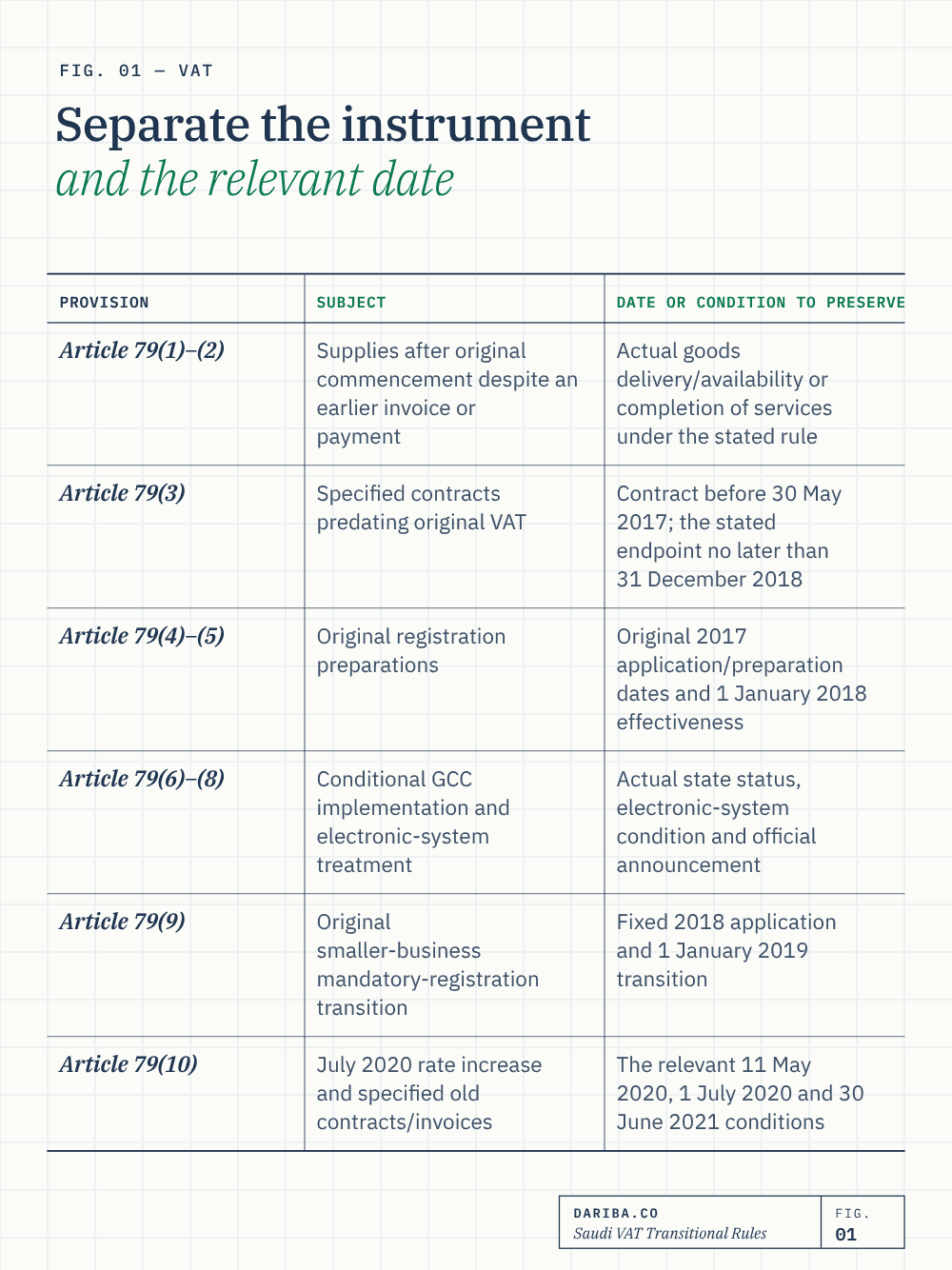
Separate the instrument and the relevant date
VAT Law Article 21 addresses earlier invoices or payments for supplies after commencement or registration, including a separate continuous-supply cut-off. Regulations Article 79 adds commencement and rate-change provisions. An ordinary registration event in 2026 does not restart the fixed 2017, 2018 or 2020–2021 dates in Article 79.
| Provision | Subject | Date or condition to preserve |
|---|---|---|
| Article 79(1)–(2) | Supplies after original commencement despite an earlier invoice or payment | Actual goods delivery/availability or completion of services under the stated rule |
| Article 79(3) | Specified contracts predating original VAT | Contract before 30 May 2017; the stated endpoint no later than 31 December 2018 |
| Article 79(4)–(5) | Original registration preparations | Original 2017 application/preparation dates and 1 January 2018 effectiveness |
| Article 79(6)–(8) | Conditional GCC implementation and electronic-system treatment | Actual state status, electronic-system condition and official announcement |
| Article 79(9) | Original smaller-business mandatory-registration transition | Fixed 2018 application and 1 January 2019 transition |
| Article 79(10) | July 2020 rate increase and specified old contracts/invoices | The relevant 11 May 2020, 1 July 2020 and 30 June 2021 conditions |
The tax-point guide explains Law Article 21 alongside the ongoing-supply rules. A deposit, invoice or contract date should not be selected in isolation from the actual statutory route.
Preserve the original commencement and additional-invoice rules
Article 79(1) addresses the cases specified in the Law where an invoice was issued or consideration paid before commencement but the supply occurs on or after it. The supplier is treated as making the taxable supply at the Agreement’s supply date. Where the earlier invoice did not include the tax, the provision requires an additional invoice showing the VAT due.
Paragraph (2) identifies goods delivered or made available on or after commencement, and services completed on or after commencement, for this purpose. These original commencement rules should not be reduced to “VAT follows whichever document was issued first”. The supply facts and applicable continuous-supply provision still matter.
An additional-invoice obligation does not itself determine every commercial dispute over whether a contract price was inclusive or exclusive. Establish the tax liability, document requirements and parties’ payment rights separately. An old invoice is evidence to examine, rather than proof that the later supply escapes VAT.
Treat the pre-2017-contract relief as a historical exception
Article 79(3) permits the specified historical zero-rate treatment where VAT was not contemplated in a contract concluded before 30 May 2017. The customer had to be entitled to deduct all relevant input VAT and provide the supplier with written confirmation of that entitlement. Treatment continued only until contract expiry or renewal, or 31 December 2018, whichever occurred first.
Each condition matters. An early signature alone did not qualify every customer or remove the written-notification requirement. A customer’s actual full recovery entitlement was part of the rule. The provision should not be repackaged as a general zero rate for an old contract that continues indefinitely, or a present-day exception for any agreement omitting the word VAT.
For a historical review, retain the actual signed version, date, renewal/expiry evidence, qualifying supply and customer confirmation. Do not infer the original entitlement from today’s registration certificate or from a later amended contract.
Keep the original registration windows out of current advice
Paragraph (4) required the specified resident persons already conducting economic activity to estimate annual supplies for the year beginning 1 January 2018 and apply if expected taxable supplies exceeded the mandatory threshold. It used the original 20 December 2017 deadline, subject to the stated Authority power for late applications under that transitional arrangement.
Paragraph (5) permitted transitional registration before 1 January 2018 and made the paragraph (4)–(5) registrations effective from that date. These are original implementation provisions. They do not give a new business a recurring December application deadline or allow it to choose 1 January as its start regardless of the ordinary registration tests.
Paragraph (9) separately provided a historical transition before 1 January 2019 for resident persons above the mandatory threshold whose annual supplies did not exceed SAR 1 million. The stated application deadline was 20 December 2018, and voluntary registration remained possible. Exactly SAR 1 million was within that upper-value wording; this does not make SAR 1 million the current ordinary mandatory threshold.
Use the registration guide for the current historical/expected-supply tests, ordinary SAR 375,000 threshold, applications and actual effective dates. Historic relief should be assessed against its own period and facts.
Apply the GCC conditions rather than a country label
Article 79(6) addresses a Member State that has not implemented VAT or does not have an applied electronic-services system with the Kingdom. Under its stated conditions, that state is treated as outside the GCC territory for applying the Agreement, supplies with it are treated as involving a country outside that territory, and persons resident there receive the corresponding treatment.
Paragraph (7) separately addresses goods before introduction of the electronic-services system: receipt in Saudi Arabia from another Member State is treated as importation with collection under the import provisions; movement of goods from the Kingdom to another Member State is treated as export for VAT purposes. The actual export qualification and evidence requirements must still be established. The word “export” is not unconditional proof of zero-rating.
Paragraph (8) provides for an official announcement of the electronic system’s commencement by ZATCA through a suitable means. An announcement matters to the actual condition; a generic GCC membership list or the date of an accounting-system upgrade does not establish it.
This article does not infer the current status of every state from the retained transitional wording. Confirm the actual relevant official state/system position for the supply period before relying on the route. The goods-movement guide, import guide and export guide explain the separate transaction requirements.
Read the July 2020 rules as a separate historical transition
Article 79(10)(a) addresses invoices or payments before 1 July 2020 for later supplies, normally using the supply-date rate rather than the earlier invoice/payment date. Its specified exception concerns tax invoices issued before 11 May 2020, limited to the value stated in the invoice and actual supply by the stated 30 June 2021 endpoint. Where the earlier invoice omitted the difference in VAT due, an additional invoice for that difference is required.
Paragraph (10)(b) addresses continuous supplies spanning 1 July 2020 and the portion performed after the rate change, while preserving its specified earlier-invoice conditions. It also addresses the adjusted rate on the value of supplies after the contract’s expiry or renewal. Do not assume that one pre-change invoice protects an entire later contract, all later value or a renewed arrangement indefinitely.
Paragraph (10)(c) permits the specified pre-increase-rate treatment for a contract concluded before 11 May 2020 until expiry, renewal or 30 June 2021, whichever occurs first. Supplier and customer must be registered taxable persons, and the customer must be entitled to deduct all relevant input VAT. Paragraph (10)(d) contains a distinct pre-11-May-2020 government-contract route with its stated expiry/renewal/30-June-2021 endpoint; do not silently replace that separate paragraph with every condition of paragraph (c).
These are dated exceptions. A continuing public-sector customer, an archived contract or a pre-2020 supplier relationship does not by itself preserve a lower rate for new supplies in 2026. Actual classification, tax point and applicable current rate must be established.
Retain a transaction-specific historical review file
Dariba recommends recording the relevant paragraph, original contract and amendments, invoice/payment history, delivery or service-performance evidence, registration status, customer recovery conditions where required, and any additional invoice. Keep each fixed end date visible in the conclusion.
For GCC transactions, add the official implementing-state/system basis and the actual import/export evidence for the period. For a current registration cut-off, document the actual registration date and Law Article 21 analysis instead of importing a historical Article 79 deadline. This method supports a reasoned review; it is not a new prescribed form or a guarantee that every past error remains open for correction under the same clock.
Key takeaways
- Retained transitional wording does not restart a fixed historical application window or contract relief.
- The pre-30-May-2017 contract route had customer recovery/confirmation conditions and a 31 December 2018 endpoint.
- SAR 1 million in Article 79(9) concerned the original 2018–2019 registration transition, not the current ordinary threshold.
- GCC treatment depends on the actual implementing-state and electronic-system conditions for the supply period.
- Article 79(10) distinguishes invoice, continuous-supply, registered-customer contract and government-contract routes.
- The 2020 rate-change exceptions preserve their stated 11 May 2020 and 30 June 2021 limits; old customer relationships do not create indefinite relief.
Sources
- Saudi VAT Implementing Regulations, current Arabic textTenth edition April2025. Article 79(1)–(10), pp.80–83: commencement/additional invoice, historical contracts and registration, conditional GCC/electronic-system rules and July2020 rate-transition limbs. Dates retained; no current country-status certification.
- Saudi VAT Law, controlling Arabic publicationArticle 21(1)–(3), p.7: pre-commencement/registration invoice or payment, specified intra-GCC extension and continuous supply performed across the relevant date. Distinct from fixed historical Regulations79 dates.
General information only. Actual supplies, facts, applicable periods and controlling Arabic legislation determine the result. Official examples are distinguished from Dariba analysis and original illustrations. Seek advice or clarification where the arrangement or source material leaves a specific issue unresolved.