In brief
Article 14 covers the Saudi taxable-supply framework and a broad, non-exhaustive services category. Its six listed forms include rights, benefits, undertakings, participation arrangements, undivided interests and intangible rights. Classification alone does not determine taxability or rate.
Saudi VAT classification begins with what one person actually supplies to another. A transaction can be a service even when nothing is physically delivered and the supplier promises to refrain from an act. Implementing Regulations Article 14 provides a broad framework; it does not make every receipt taxable simply because an accountant records income.
Start with goods, services and the scope of tax
The GCC VAT Agreement distinguishes goods from services. Article 1 defines goods broadly as tangible assets, including the specified water and energy forms. Article 5 addresses a transfer of ownership or the right to dispose of goods as owner and its listed transactions. Article 7 treats a transaction that is not a goods supply under the Agreement as a services supply.
That distinction has practical consequences. A physical machine, an entitlement to use intellectual property and an undertaking not to compete are not necessarily analysed under the same supply-place or timing provisions. Equally, a document recording a right is not itself the whole transaction: identify the underlying entitlement and obligations.
Regulations Article 14(1), read with the Law and Agreement, addresses taxable goods and services supplied in Saudi Arabia by a taxable person in economic activity, relevant received supplies subject to reverse charge, and goods imports. These are distinct routes. An imported physical asset should not be entered as an imported service merely because the supplier invoices from abroad.
Article 14 gives a non-exhaustive services list
Article 14(2) describes services as transactions that do not constitute supplies of goods. Its examples are non-exhaustive. The listed forms explain why a service need not resemble consulting, repairs or a conventional hourly engagement.
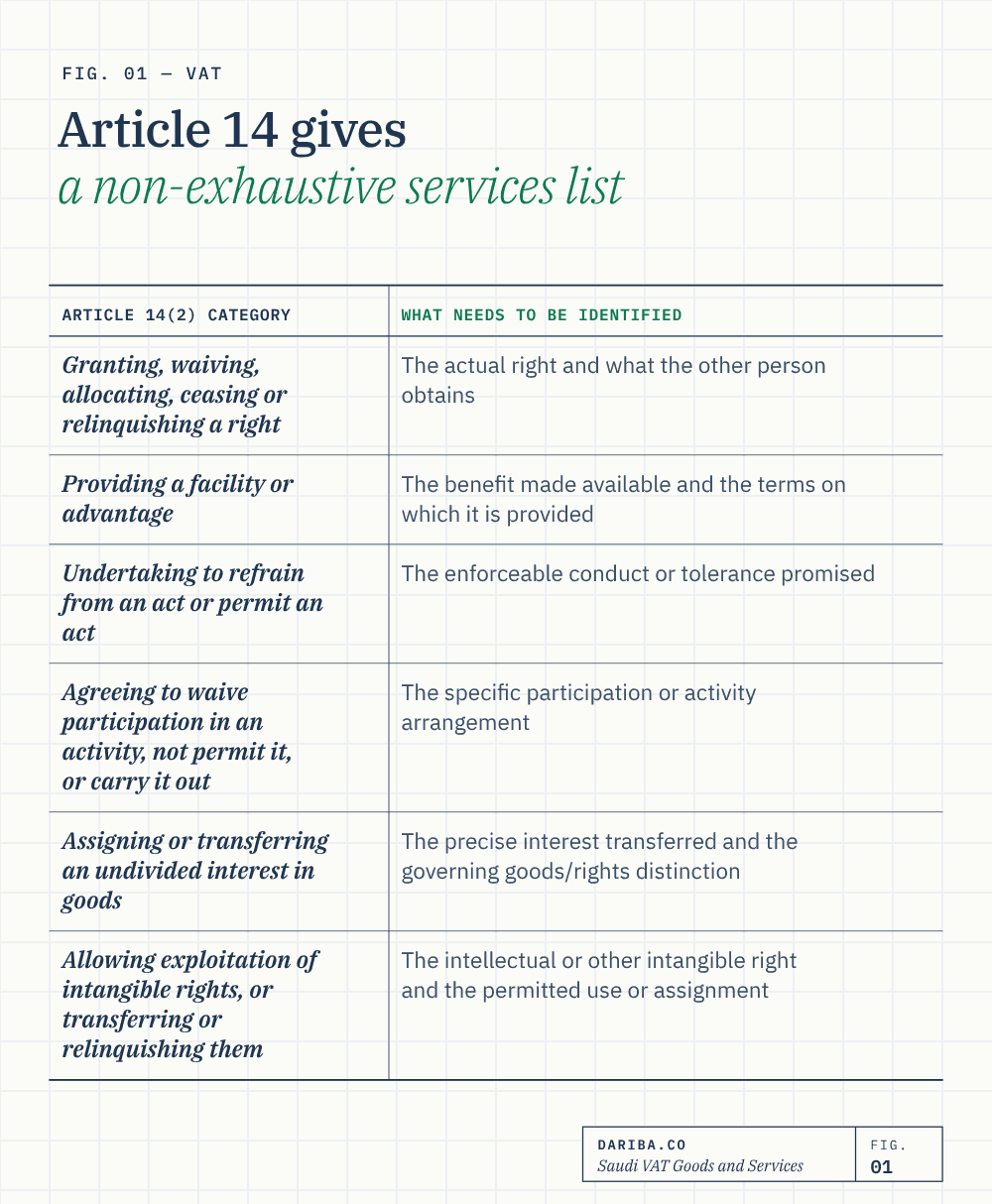
| Article 14(2) category | What needs to be identified |
|---|---|
| Granting, waiving, allocating, ceasing or relinquishing a right | The actual right and what the other person obtains |
| Providing a facility or advantage | The benefit made available and the terms on which it is provided |
| Undertaking to refrain from an act or permit an act | The enforceable conduct or tolerance promised |
| Agreeing to waive participation in an activity, not permit it, or carry it out | The specific participation or activity arrangement |
| Assigning or transferring an undivided interest in goods | The precise interest transferred and the governing goods/rights distinction |
| Allowing exploitation of intangible rights, or transferring or relinquishing them | The intellectual or other intangible right and the permitted use or assignment |
This table paraphrases the current Arabic categories. It is not a list of automatic 15% charges. The remaining statutory conditions still need to be applied to the actual transaction.
Identify the right or benefit supplied
Paragraphs (a) and (b) can be relevant where a business grants a commercial entitlement, waives a right or makes a facility or advantage available. Identify the right before relying on the invoice label. A receipt described as a fee, contribution or compensation may conceal quite different arrangements.
Dariba illustration: a registered business grants another business a contractual right to use a booking facility for an agreed fee. The entitlement and facility are the starting point for service classification. That observation alone does not determine the Saudi place of supply, applicable rate or the recipient’s input deduction.
Conversely, a transfer of money with no identified supply cannot be classified simply by searching for a convenient service description. Establish what the payer receives, any third-party benefit and how the payment relates to an actual obligation. Separate consideration and valuation analysis follows in the value-of-supply guide.
A promise not to act can be a service
Paragraph (c) expressly includes an undertaking to refrain from a particular act or to allow it. Paragraph (d) separately addresses the identified participation and activity agreements. A service therefore need not involve staff performing a visible task or delivering a report.
Dariba illustration: a business agrees, for a separately identified payment, to refrain from exercising a particular commercial right for an agreed period. The relevant question includes whether that undertaking itself is the supplied service. The contract, actual obligations and payment connection matter; absence of physical work does not answer the question.
This does not establish one VAT treatment for every damages award, cancellation fee or negotiated settlement. A settlement may concern a changed original price, a release or other obligation, or compensation with a different legal basis. Article 14’s list cannot replace the analysis of what is supplied and what the payment is for. This guide does not certify a general settlement exemption or a universal rule that all compensation is taxable.
Treat undivided interests and intangible rights precisely
Paragraph (e) specifically lists assigning or transferring an undivided interest in goods. Read it with the Agreement’s goods provisions and the actual legal interest. It does not mean that every transaction described as an interest, security or property transfer has the same VAT result. A company share, an interest in an asset and a contractual right must first be correctly identified.
Paragraph (f) covers allowing exploitation of intangible rights, transferring them or relinquishing them. Its examples include the identified author, inventor and trademark rights and similar rights recognised under Saudi law. A licence permitting use and an outright assignment may both require services analysis, although their contractual rights and other VAT consequences can differ.
Dariba recommendation: retain the licence or assignment, the right holder’s identity, permitted uses, territory, duration and payment terms. Do not infer that an intangible supply is automatically an electronic service, an export or an exempt financial transaction. The relevant service category and special rules need their own support.
Confirm economic activity and the supplier’s capacity
Classification as a service is a different question from whether the person carries on economic activity and has a registration or payment obligation. ZATCA’s Economic Activity guideline, sections 4.1 and 5.1, distinguishes those issues and explains the employment boundary.
In section 5.1, Example 5, Rima independently provides IT consultancy to several companies on short-term contracts at a daily rate of SAR 2,000. The guideline treats her activity as economic activity and links mandatory registration to the applicable threshold. It contrasts this with services within an employer–employee relationship, for which salary or wages are not charged with VAT on that basis.
The example illustrates legal capacity, not an exemption for a particular professional task. A business cannot decide that a person is an employee or independent supplier solely from the description of the work. Actual contractual and working arrangements matter. See the employees, consultants and labour-secondment guide for the separate framework.
Separate the supplier’s service from a payment made as agent
ZATCA’s Professional Services guideline, third version May 2026, section 7.1, Example 20, describes a Saudi design company paying a SAR 15,000 municipal certificate fee with the bank customer’s authority. The authorisation is in the bank’s name. On the stated separately documented facts, the guideline treats the exact separate recovery as a disbursement rather than consideration for the design company’s supply.
Its continuation distinguishes a comprehensive design price including the certificate cost, which is treated as a single service supply. Section 7.2 then addresses expenses incurred in the provider’s own name. Capacity and the actual supply matter more than the word reimbursement.
The example does not make every recovered expense outside scope. For classification, identify which service the design company supplies and which payment belongs to a separate customer transaction. Apply the full agency and valuation conditions before excluding an amount; paying a bill does not by itself identify its recipient.
Classification is the beginning of the VAT conclusion
After identifying goods or services, assess the following decisions separately. This is a Dariba review sequence, not an official worked calculation.
- Identify supplier, recipient, capacity and the actual supply or qualifying deemed event.
- Establish economic activity, registration and the relevant supply or import route.
- Apply the actual place-of-supply rule, including any special category.
- Determine taxable, zero-rated, exempt or outside-scope treatment for the relevant period.
- Identify the liable person, value, tax point and invoice/reporting requirements.
- Assess any input deduction using its separate entitlement and evidence rules.
A foreign payment, related-party relationship or services label does not settle this sequence. Same-person and approved-group supplies also require the separate Article 18 analysis. Do not turn Article 14’s classification list into an exception to those provisions.
Document the commercial arrangement before posting VAT
Retain the signed contract and amendments, entitlement or deliverable, identity and capacity of each party, evidence of actual performance, payment basis and relevant source provisions. Explain why the selected category applies and which further rules determine the result.
The Professional Services guideline, section 10.2.4, stresses contractual arrangements alongside actual facts and surrounding circumstances. A contract is useful evidence, but its description must be tested against what happens. That principle helps explain why small factual differences can change the VAT analysis.
Where rights, a goods transfer and other services are packaged together, identify the components and investigate the applicable treatment of the arrangement. A single invoice or one commercial price is not enough to resolve every mixed arrangement. This focused Article 14 guide does not provide a universal allocation rule or a conclusion on every intellectual-property, property or settlement contract.
Key takeaways
- A service need not involve a physical deliverable or a positive act.
- Article 14(2) lists examples of services; it does not exhaust the category.
- Identify the actual rights and obligations, supplier, recipient and consideration.
- A service classification does not by itself prove Saudi place of supply, a 15% rate or a deduction.
- Official employee and professional-services examples illustrate why legal capacity and actual supplies matter.
- A settlement, recharge or licence label does not settle every VAT question.
Sources
- Saudi VAT Implementing Regulations, controlling Arabic textTenth edition April 2025. Article 14(1) and 14(2)(a)–(f): scope and non-exhaustive services classifications. Read with the Agreement and separate place, exemption, liability and valuation rules.
- Official Arabic GCC VAT AgreementArticles 1 and 2: goods, economic activity and scope; Article 5: goods and specified transactions; Article 7: services other than goods. Saudi implementation and relevant periods remain material.
- ZATCA Economic Activity guidelineSections 4.1 and 5.1; Example 5: Rima’s independent IT consultancy and the distinction from employment. This is an activity/registration example, not an official classification of settlement payments.
- ZATCA Professional Services guidelineThird version May 2026. Section 2 definitions; section 7.1, Example 20 and continuation: design services and a separately documented municipal payment. Section 7.2 distinguishes own-name reimbursements; section 10.2.4 discusses contracts and actual facts.
General information only. Actual supplies, facts, applicable periods and controlling Arabic legislation determine the result. Official examples are distinguished from Dariba analysis and original illustrations. Seek advice or clarification where the arrangement or source material leaves a specific issue unresolved.