In brief
Calculate completed 30-day delay charges, distinguish fraud conditions and assess current penalty-relief eligibility without assuming compounding or immunity.
A withholding shortfall requires the underlying tax, actual due date, delay period and any separate penalty conditions assessed. The statutory delay charge is not described as compound interest. Nor does an ordinary classification error automatically establish fraud or qualify for an amnesty.
Establish the underlying withholding obligation first
Current Arabic Income Tax Implementing Regulations Article 63, pp. 34–36, governs the actual category, relevant gross base and reporting. Identify the payer, non-resident recipient, Saudi source, actual payment and any supported relief before calculating a shortfall.
The Saudi withholding entity remains responsible for the relevant withholding/remittance obligation. Failure to deduct from the recipient does not by itself extinguish that obligation. Whether the payer can recover money from the supplier depends on the actual contract and legal facts.
Use the main WHT guide for that scope analysis. Tax due and a penalty imposed for non-compliance are different amounts and should be reconciled separately.
Apply the actual due date and completed 30-day rule
Arabic Regulations Article 68(1)(e), p. 39, expressly addresses delayed remittance of withholding tax. Article 68(2) states that the 1% charge is not calculated where delay has not completed 30 days from the due date.
ZATCA’s General Withholding Tax Guideline, second version May 2026, section 5, p. 32, explains 1% of unpaid tax for each 30 days of delay under Law Article 77(a) and Regulations Article 68.
Determine the actual statutory/official deadline and complete periods. Do not substitute calendar months, begin at the original supplier-payment date, or universally assume the next month’s eleventh day without checking the applicable due date. The compliance guide explains the monthly deadline context.
Calculate on unpaid tax rather than adding penalties to principal
Dariba original assumptions: SAR 10,000 withholding remains entirely unpaid for exactly 60 days after its established due date; two complete 30-day periods apply, with no relief or other adjustment. The illustrated delay charge is SAR 10,000 × 1% × 2 = SAR 200.
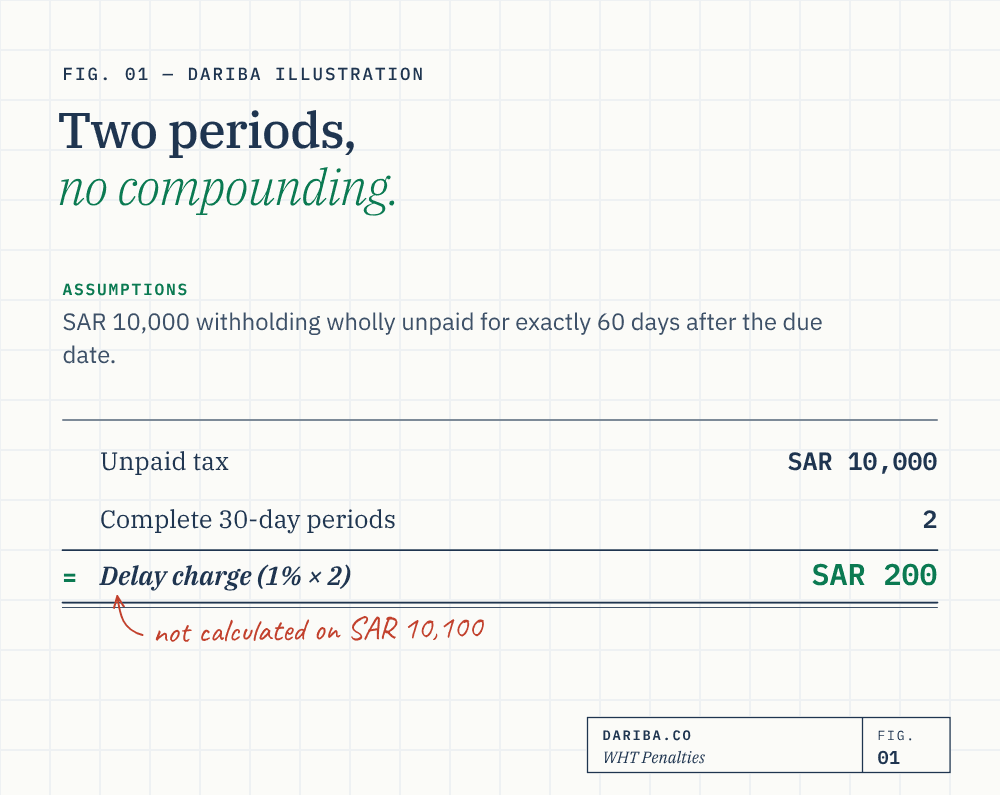
This uses unpaid tax as its base. It does not add the first SAR 100 charge to the principal and calculate the next charge on SAR 10,100. The cited provision does not support describing this calculation as compounding.
Part payments, disputed adjustments, different due dates and relief require their actual facts assessed. A delay shorter than 30 days does not make late payment compliant or erase the tax; it concerns this specific delay-charge computation.
Reconcile each affected obligation and payment
A review can identify several monthly shortfalls with different due dates and balances. Prepare an obligation-by-obligation schedule rather than calculate one percentage on the year’s total from a single date.
Dariba original illustration: one SAR 10,000 shortfall has two complete periods and another SAR 5,000 shortfall has one, each wholly unpaid and without relief. The assumed charges are SAR 200 and SAR 50, totalling SAR 250. These are different obligations, not penalties compounded on earlier penalties.
Preserve returns, actual settlements, payment confirmations, classification changes and the basis for the due dates. Reconcile the calculation with the actual ZATCA account and assessment rather than assume a spreadsheet alone settles every disputed amount.
Distinguish fraud conditions from an ordinary correction
Arabic Regulations Article 69, p. 39, applies the Law Article 77(b) fraud provisions to the withholding entity for concealment or incorrect information. The official guideline p. 32 describes a possible 25% charge on the tax difference in the stated false-information/fraud circumstances involving intent to evade tax.
The guideline identifies false books, contradictory no-books statements, forged/altered documents, undisclosed taxable activities and destroyed/concealed records. Read the actual conduct and applicable legal elements; do not label every wrong rate or late payment fraud automatically.
Equally, calling a deliberate false statement a voluntary correction does not eliminate the legal issue. Retain the facts and obtain appropriate advice where conduct or evidence raises that question.
Keep other penalties and remedies within their applicable rules
Regulations Article 67, pp. 38–39, addresses return failures, while Article 68 addresses delayed payment. Do not automatically transplant annual income-tax return bands onto every monthly WHT reporting issue without establishing the applicable provision and circumstances.
The underlying tax, delay charge, filing consequences and fraud charge require their own basis. A corrected statement does not itself certify that all penalties disappear, and an objection does not automatically resolve payment/collection consequences.
Use the actual notice and current procedural rules for any objection or appeal. This article does not invent a universal appeal deadline or promise that a disputed assessment stops all further charges.
Check the current relief decision and the return’s eligibility date
Position checked 23 October 2026: the official Ministerial Decision 1117 published in Umm Al-Qura and 30 June 2026 Saudi Press Agency announcement describe the initiative extended to 31 December 2026. The extension is not blanket relief for every current return.
Eligibility includes the applicable registration/filing and principal-payment or approved-installment conditions. The stated late-payment/late-return relief concerns returns due before 1 July 2026; tax-evasion penalties and the specified exclusions remain outside relief. Compliance with an approved installment plan matters, including later scheduled payments.
Check the decision and actual case before claiming relief. Do not assume future extension, automatic cancellation, waiver of the tax itself or eligibility merely because the payment is made before December ends.
Correct through a documented reconciliation
Identify affected payments and periods, substantiate source/category/treaty treatment, quantify the actual tax and supported penalty periods, correct through the appropriate process and preserve payment/relief evidence. Distinguish the supplier’s contractual liability from the payer’s statutory obligation.
Keep the analysis, notices, correspondence and records for the applicable retention period, including unresolved matters. Early correction can limit continued unpaid balances and improve the evidence; it does not guarantee immunity or a particular administrative outcome.
Dariba recommends resolving the actual error and eligibility conditions before presenting a total exposure or promised waiver. A defensible assessment explains each amount and period, rather than relying on a broad claim that penalties are immediate, monthly, compound or automatically forgiven.
Key takeaways
- Establish the underlying withholding shortfall and actual due date first.
- The 1% charge uses unpaid tax for each completed 30-day period.
- The cited delay provision does not support compounding earlier penalties.
- Fraud requires the applicable conduct and legal conditions assessed.
- Current relief has return-date, payment and exclusion conditions.
Sources
- Official Arabic Income Tax Implementing RegulationsArticles 63 and 67-69, pp. 34–36 and 38-39: underlying withholding, filing, completed 30-day delay rule and fraud provision.
- ZATCA General Withholding Tax GuidelineSecond version May 2026, section 5, pp. 30–32: reporting and penalties, with fraud conditions. Later relief decision linked separately in the article.
General information only. Actual supplies, facts, applicable periods and controlling Arabic legislation determine the result. Official examples are distinguished from Dariba analysis and original illustrations. Seek advice or clarification where the arrangement or source material leaves a specific issue unresolved.