In brief
Establish the licensed financing-payer route, Article 67 asset-ratio calculation, qualified funding, profit limits and group-consolidation conditions.
The financing-activities Zakat base uses a particular ratio formula and profit-related limits. It should not be reconstructed by taking the ordinary commercial-company additions and deductions and changing a few account captions. Establish the licensed payer, the applicable group route and the qualified inputs before calculating.
Establish the defined financing-activities payer
Current amended Arabic Zakat Implementing Regulations Article 1 identifies banks, financing and refinancing companies licensed by the Saudi Central Bank, and financing funds licensed by the Capital Market Authority during the Zakat year.
ZATCA’s Guideline for Zakat on Financing Activities, issue 1 September 2024, section 3.1 and its scope FAQs, explains that definition. Being a financial-services business, broker, investment company or an ordinary company making a loan does not itself establish this specific route.
Dariba recommends retaining the actual licence, entity and period facts. Insurance activities have a separate regulatory branch; a broad financial-sector label is insufficient to choose the formula.
Read Article 66’s exclusions with the retained provisions
Article 66 applies the financing branch together with the regulations, subject to its stated exclusions. These include the ordinary Article 21 calculation, the general addition/deduction chapters as specified, and the ordinary adjusted-activity-result chapter, while preserving the stated exceptions such as Article 24.
The branch also retains the specified equity, investment and asset provisions within Article 66’s actual cross-references. It is neither an instruction to ignore the rest of the regulations nor permission to import every ordinary-company correction automatically.
Dariba analysis: identify which provision supplies each input. This avoids combining two different calculation frameworks simply because their balance-sheet terminology overlaps.
Apply the Article 67 ratio formula
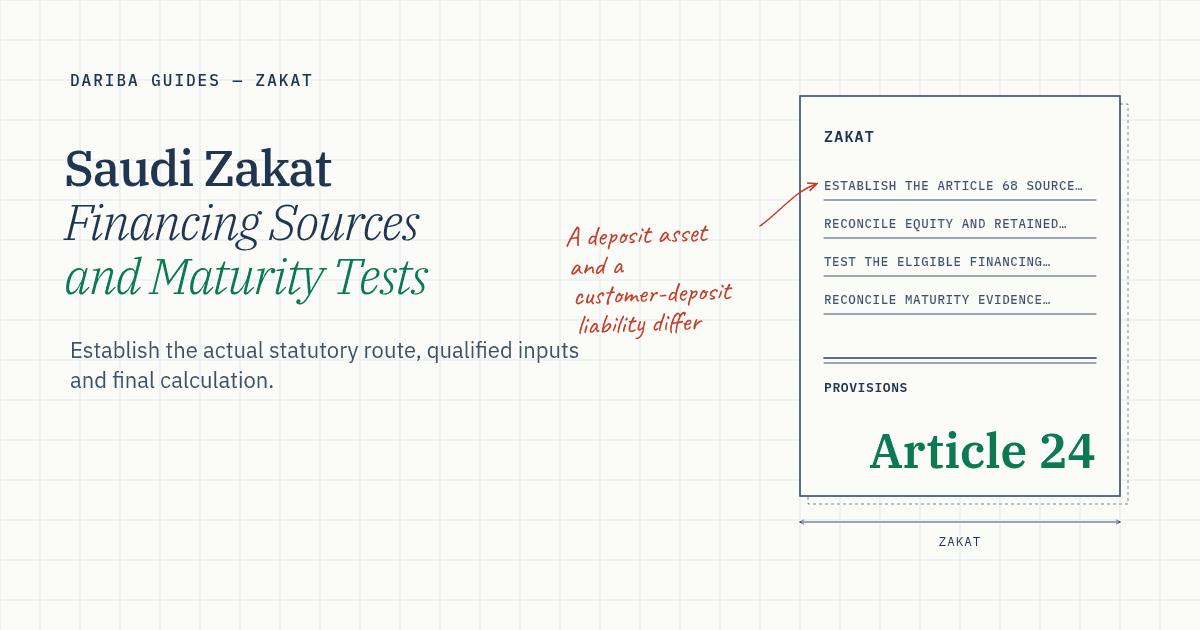
Article 67 calculates the base as qualified sources of funds multiplied by Zakatable assets divided by total assets, subject to Articles 71–72. It uses net values in the audited year-end financial statements.
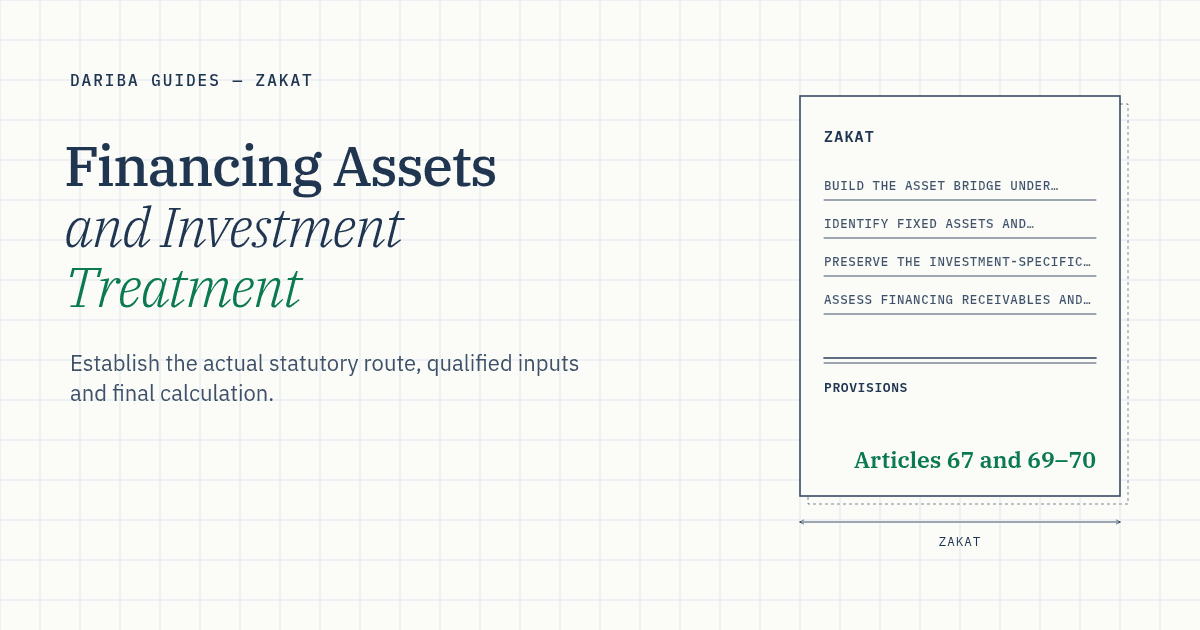
The funding guide explains Article 68, and the asset guide explains Articles 69–70. A raw total of all liabilities and assets is not a substitute for identifying the relevant categories.
Dariba recommends reconciling the numerator, denominator and sources schedule to the same financial statements and period. The resulting figure is a base, not the rate or final Zakat amount.
Use ZATCA’s proportional example within its scope
Official Financing Activities Guideline Example 3: total assets are SAR 200 million, excluded non-Zakatable assets SAR 25 million, and qualified sources are stated as 80% of total liabilities and equity, or SAR 160 million.
The resulting Zakatable assets are SAR 175 million. SAR 160 million × SAR 175 million ÷ SAR 200 million produces SAR 140 million before the applicable profit-limit analysis.
The example illustrates the ratio using its qualified assumptions. Its 80% is not a statutory funding percentage for every bank, and SAR 140 million is not automatically final without Articles 71–72.
Apply the financing-specific limits
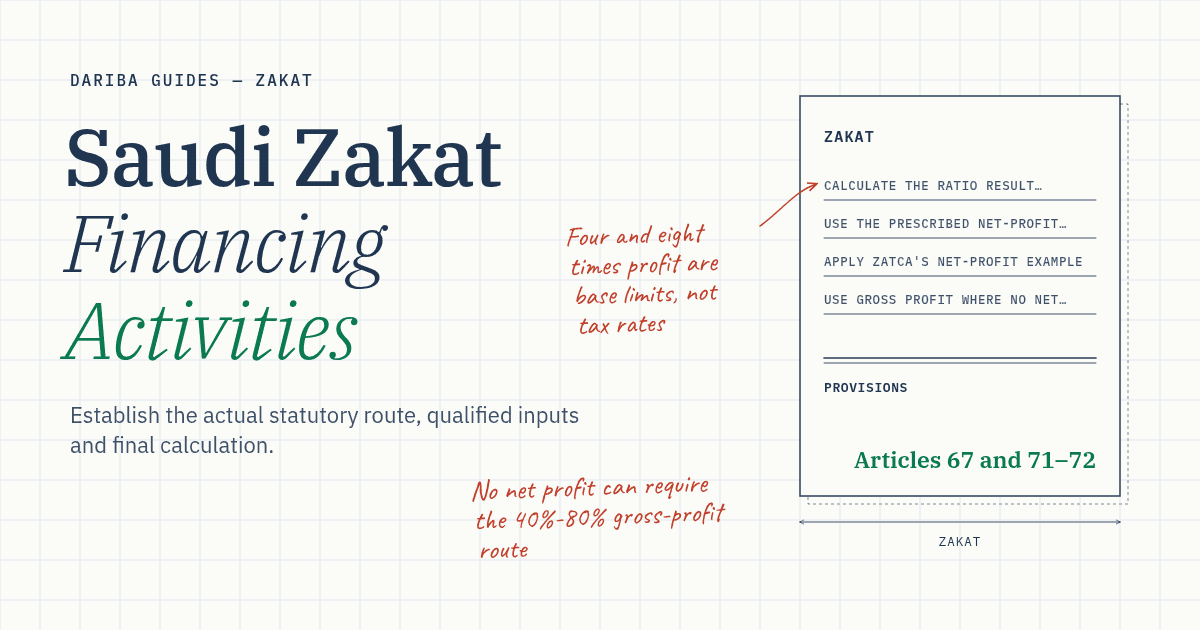
Article 71 uses the prescribed net-profit or gross-profit measures to establish the financing lower and upper limits. Article 72 addresses the case with neither net nor gross profit.
The financing-limits guide explains four/eight times the relevant net profit, the alternative 40%/80% gross-profit limits and the no-limit case. Those are base limits, not Zakat rates.
Dariba analysis: a lender may have a supported ratio result but still owe a different final base after the applicable limit. Present both calculations rather than stopping at the ratio or substituting ordinary Article 27 profit adjustments.
Check the actual consolidation route
Article 67 refers to Article 16. Article 16(6) states that where a financing-activities payer is owned by a non-financing payer and a consolidated Zakat return is submitted, the financing payer is not assessed under the financing branch.
The guideline’s consolidation discussion and FAQs must be read with that actual condition. It is not a blanket ban on every group return or an automatic entitlement to keep the financing formula inside any non-financing group consolidation.
Dariba recommends confirming ownership, approval/procedure, the submitted group return and the calculation route before modelling the result. The consolidation guide explains the remaining general conditions and information returns.
Use the actual period and applicable rate
Article 67 retains Article 15’s rate provisions. The fiscal-year day count and relevant Hijri-year denominator must be established; a guideline’s illustrative denominator does not replace the actual applicable year.
The period guide explains commencement, closing and other special cases. Do not assume liquidation or a short closing period follows the ordinary annual financing formula without reviewing its actual treatment.
Dariba recommends keeping the base and rate calculations separate. A rounded percentage or an inconsistent illustrative line should not silently change the controlling formula or the actual financial period.
Keep the complete route-to-return reconciliation
Retain the licence and ownership facts, audited closing values, qualified funding schedule, asset exclusions and remaining Zakatable assets, ratio calculation, relevant profit limits and actual period/rate.
Reconcile amounts treated separately, including qualifying foreign investments, without counting the same asset twice or assuming an investment exclusion automatically changes a profit-based limit.
Dariba recommends stating the applicable branch and the evidence behind each input. That produces an advisory analysis of the actual obligation while identifying any classification or special-period issue the available facts do not settle.
Key takeaways
- Licence, entity and actual period determine the financing route.
- Article 66 has specific exclusions and retained provisions.
- The base uses qualified funding multiplied by an asset ratio.
- An official ratio illustration is not a universal funding percentage.
- Financing profit limits differ from ordinary accounts-payer limits.
- The actual group-consolidation route can change the applicable branch.
Sources
- Current amended Arabic Zakat Implementing Regulations, 1445HArticle 1, Article 16(6) and Articles 66–74 as relevant. Actual scope, cross-references and controlling Arabic conditions apply.
- Official English Zakat regulations, read with current ArabicTranslation assists navigation. Article 69 terminology and Article 74 purchaser wording are read against controlling Arabic.
- ZATCA Guideline for Zakat on Financing Activities, issue 1 September 2024Sections 3.1–3.3 and relevant FAQs; exact official examples and their limits are identified in the analysis.
General information only. Actual supplies, facts, applicable periods and controlling Arabic legislation determine the result. Official examples are distinguished from Dariba analysis and original illustrations. Seek advice or clarification where the arrangement or source material leaves a specific issue unresolved.