In brief
Zero-rated output preserves conditional taxable-use deduction, while ordinary direct exempt inputs differ. Restrictions, attribution, shared methods, incidental rules, special refunds and capital events prevent blanket all-or-nothing recovery claims.
Zero-rated supplies are taxable at 0%; exempt supplies follow a different statutory category. That distinction affects ordinary input recovery, but it does not make every zero-rated business’s costs fully recoverable or every exempt-related cost permanently lost in all circumstances. Classify the supply, identify the actual input use and apply the specific deduction or adjustment rule.
Separate output classification from the input decision
Articles 29–30 contain financial/property exemptions, while Chapter Six provides conditional zero-rating routes. Articles 49–51 determine deduction. A valid output classification is the start of the analysis, not proof that every invoice qualifies.
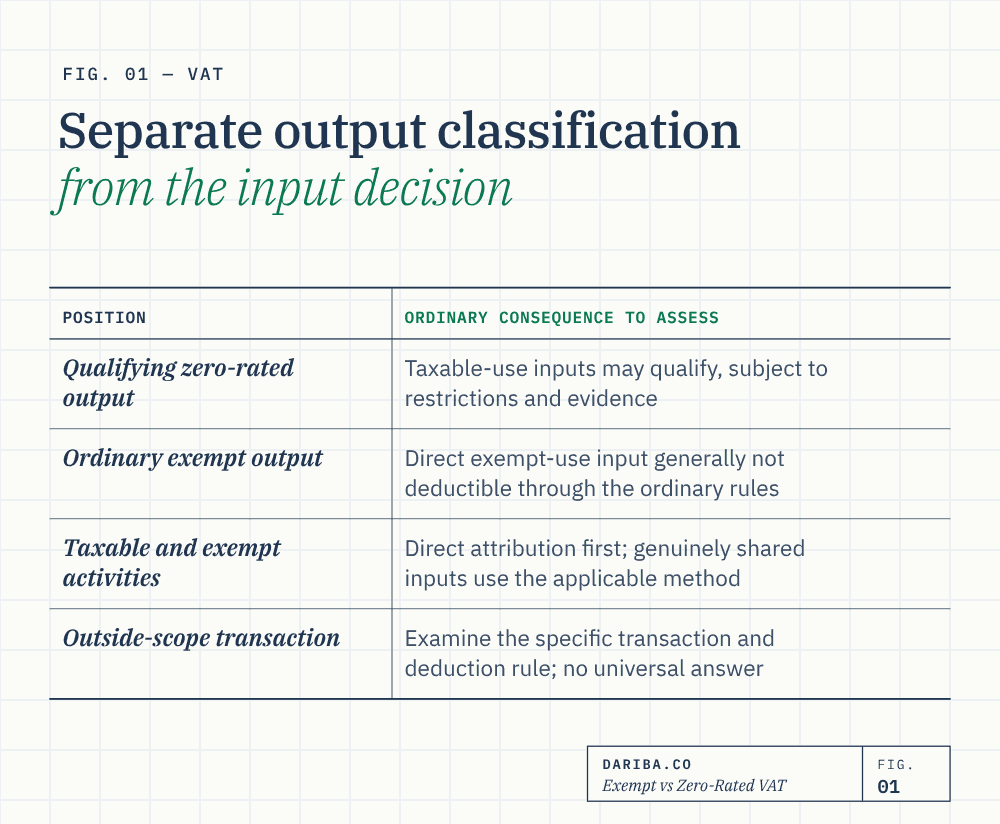
| Position | Ordinary consequence to assess |
|---|---|
| Qualifying zero-rated output | Taxable-use inputs may qualify, subject to restrictions and evidence |
| Ordinary exempt output | Direct exempt-use input generally not deductible through the ordinary rules |
| Taxable and exempt activities | Direct attribution first; genuinely shared inputs use the applicable method |
| Outside-scope transaction | Examine the specific transaction and deduction rule; no universal answer |
This article focuses on cost recovery. The zero-rated versus exempt classification guide covers the output routes, priority rule and export evidence in more detail. The two pages address different decisions rather than creating competing rules for the same invoice.
Zero-rated output does not cure an input restriction
Article 49 requires actual entitlement and evidence, and Article 50 restricts specified inputs. Private/non-economic expenditure, incorrectly charged VAT, inadequate documents and blocked costs cannot be made deductible simply by attributing them to an exporter.
Dariba illustration — original assumptions: an exporter has SAR 120,000 apparent input VAT. SAR 100,000 is otherwise qualifying and directly attributable to its taxable exports; SAR 20,000 is actually blocked expenditure. On those facts, ordinary deduction is SAR 100,000, not SAR 120,000. Zero output VAT does not eliminate the SAR 20,000 cost.
The Input Tax Deduction guideline, third version May 2026, explains entitlement, restrictions and evidence. A refundable return balance is also different from an approved cash payment under Article 69. Do not promise that the full amount will be refunded immediately merely because exported sales have no output VAT.
Exempt supplies require actual attribution and special-rule review
VAT directly attributable to ordinary exempt supplies is generally not deductible. Shared overhead is different, and specific incidental transactions or separate approved refund routes require their own rules. A bank’s exempt income does not automatically block every technology invoice, nor does a property business’s VAT registration guarantee deduction of every construction cost.
ZATCA’s Real Estate Sector guideline, issue 3.0 May 2026, section 8.3, Example 10, p. 22, describes a car dealer with a 90% proportional deduction disposing of a showroom as an irregular/incidental event in July 2022. The exempt disposal is excluded from the ratio and related input follows the stated overall deduction treatment. This does not make ordinary residential development or every property disposal incidental.
Approved developer refunds under Article 70 remain distinct from ordinary deduction and do not automatically apply to landlords. Identify the taxpayer, activity, approval, eligible cost and period rather than describing all exempt-property VAT as either permanently blocked or automatically refunded.
Direct attribution comes before the shared ratio
Article 51 separates inputs wholly attributable to taxable supplies, wholly attributable to exempt supplies and genuinely shared inputs. A business-wide recovery percentage should not be imposed on every purchase without that first step.
Dariba illustration: a mixed business has SAR 30,000 qualifying input VAT directly attributable to taxable activities, SAR 20,000 directly attributable to ordinary exempt activities, and SAR 50,000 genuinely shared VAT. Assume a valid 40% recovery entitlement for that shared pool. Deductible input is SAR 30,000 plus SAR 20,000 shared recovery, totalling SAR 50,000. The non-deductible total is SAR 50,000. Applying 40% indiscriminately to the entire SAR 100,000 would incorrectly produce SAR 40,000.
The assumptions already exclude blocked/private costs and establish a valid shared entitlement. They do not prove that a 40% revenue fraction is correct for another business, or that turnover is the legal measure for every separate financial product.
Use the actual default or alternative method
Article 51 governs the relevant supply values, exclusions, rounding and annual reconciliation. Capital-asset supply exclusions have conditions; they should not be expanded to every asset held for rental or resale. Financial transactions and applicable deemed or incidental treatment also need the correct provisions considered.
An alternative method requires the actual application/approval or other applicable rule; a convenient headcount or floor-area percentage is not automatically authorized. Article 51(9) caps each approved period at five years, renewable through a new application. The actual notification can specify a shorter period and its conditions; approval does not automatically last five years.
See the apportionment guide and financial-sector special-method guide. Dariba recommends modelling whether the method reflects actual use; a higher percentage is not itself evidence that the method is appropriate.
Intended use, actual changes and errors are different
Initial input treatment is important, but it is not correct to say every construction decision becomes legally irreversible at first letting. Articles 49–52 address intended use, subsequent events and capital adjustments; Article 63 addresses actual errors. Each has its own conditions and timing.
A genuine later change in a capital building’s use is different from discovering that the original deduction was wrong. A qualifying business transfer also differs from an ordinary disposal or cessation. The actual asset, original deduction, review cycle and event determine the adjustment; no universal instruction to repay or reclaim all original VAT applies.
The real-estate capital guide explains the ordinary immovable-asset framework and shorter-life cases. Retain evidence of initial intention and later actual use rather than trying to reclassify an original error as a later change for convenience.
Check whether qualifying zero-rating takes priority
Article 31(2) gives zero-rated treatment where the supply actually qualifies both for exemption and the relevant zero-rate route. The Services to Non-GCC Residents guideline, fourth version May 2026, section 4.3, Example 1, p. 12, illustrates otherwise exempt life insurance supplied on qualifying non-GCC facts, provided none of the exceptions applies.
The priority can matter to input use, but it does not remove Article 50 restrictions, turn every overseas customer into a qualifying export or guarantee full shared recovery. Apply the actual recipient, residence, direct-benefit and special-place rules before changing the output code.
Similarly, exclusively zero-rated activity has its own Article 9(1) registration exception and voluntary options. Exempt outputs, qualifying received supplies, expenses and actual registration status require separate analysis; “no output VAT” does not mean one registration answer for every business.
Price the substantiated cost and preserve the review trail
Model VAT that is actually non-deductible rather than assuming all costs in an exempt business are blocked or all export costs recoverable. Keep the classification, direct/shared allocation, method basis, original evidence, adjustment history and any separate refund approval together.
A meaningful advisory conclusion identifies the recoverable amount, unrecovered cost, timing and unresolved factual boundary. It should also distinguish a deduction, a credit carried forward and a refund request. That gives management a usable basis for pricing and investment decisions without turning an assumed recovery percentage into a guarantee.
Key takeaways
- A zero-rated output does not cure blocked costs, invalid evidence or non-economic expenditure.
- Ordinary exempt-use recovery differs from specific incidental or approved refund routes.
- Direct attribution comes before applying a percentage to genuinely shared input VAT.
- The actual method, exclusions, rounding and reconciliation matter; each approved alternative period is no more than five years and renewable by new application.
- Construction and capital use changes are not universally irreversible after first letting.
- Qualifying zero-rate priority and actual input use matter, but no cash refund or full recovery is guaranteed.
Sources
- Controlling Arabic VAT Implementing RegulationsTenth edition April 2025. Article 24 pp. 24–25; Articles 49-52 pp. 48–54; Article 58 pp. 60–61; Articles 59,61-63,66,69,74 for actual timing, evidence and procedure.
- ZATCA Input Tax Deduction guidelineThird version May2026. Actual entitlement, restricted/private inputs, direct attribution, shared recovery and evidence remain conditional.
- ZATCA Capital Assets guidelineSecond version May2026. Article 52 original deduction, actual use changes, asset cycles, transfers and cessation require specific adjustments rather than universal permanence.
- ZATCA Real Estate Sector guidelineIssue3.0 May2026 section8.3Example10 p. 22: car dealer90%ratio and July2022incidental showroom disposal; not ordinary development relabelled incidental.
- ZATCA Services to Non-GCC Residents guidelineFourth version May2026 section4.3Example1 p. 12: otherwise exempt life insurance can qualify for zero-rating on actual facts if no exception applies.
General information only. Actual supplies, facts, applicable periods and controlling Arabic legislation determine the result. Official examples are distinguished from Dariba analysis and original illustrations. Seek advice or clarification where the arrangement or source material leaves a specific issue unresolved.