In brief
Tangible capital assets need positive book value and the other Article 49(3) conditions. Paragraph 4 limits the deduction; the relevant original VAT rate and carrying-value basis matter.
A business holding an asset when VAT registration takes effect should answer two questions separately: does the asset qualify for a pre-registration deduction, and what is the maximum amount? A positive carrying value helps answer the first question for tangible capital assets; it does not establish full recovery of the original invoice VAT.
Articles 49(3)-(4) and section 7 of ZATCA’s Capital Assets Guideline govern the analysis. The goods route has no equivalent six-month condition in paragraph 3, but it remains subject to the other deduction and timing rules. It should not be described as an unlimited right to recover VAT on any old purchase.
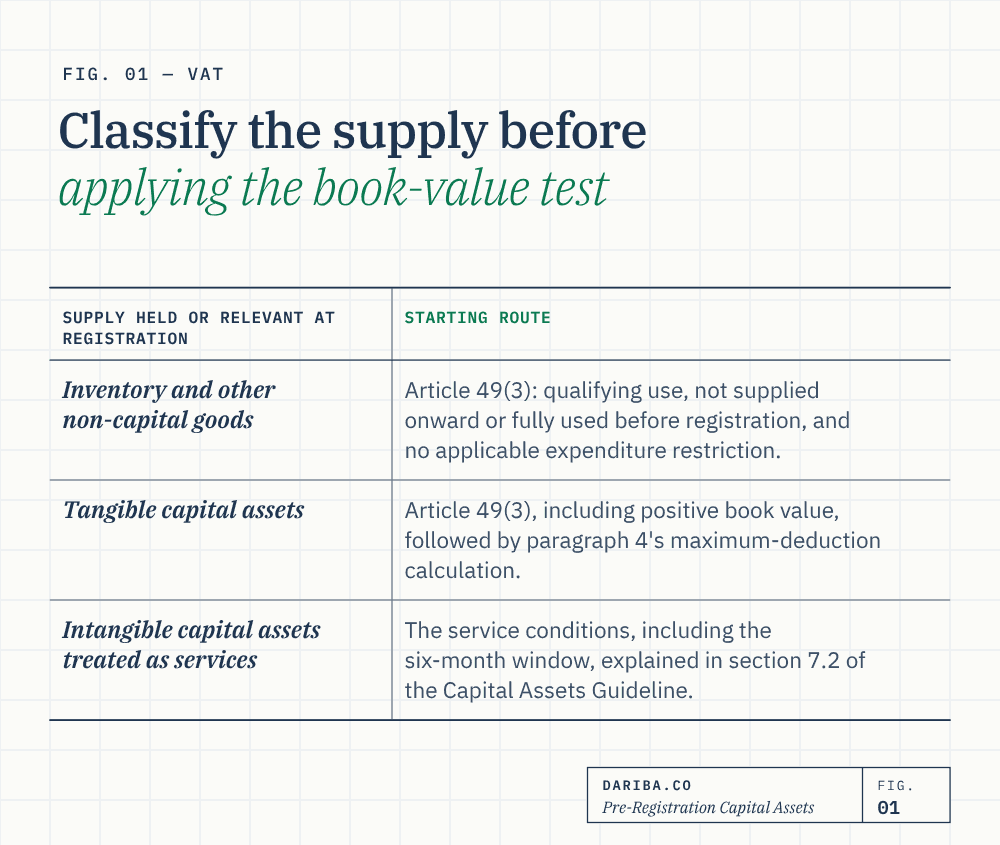
Classify the supply before applying the book-value test
| Supply held or relevant at registration | Starting route |
|---|---|
| Inventory and other non-capital goods | Article 49(3): qualifying use, not supplied onward or fully used before registration, and no applicable expenditure restriction. |
| Tangible capital assets | Article 49(3), including positive book value, followed by paragraph 4’s maximum-deduction calculation. |
| Intangible capital assets treated as services | The service conditions, including the six-month window, explained in section 7.2 of the Capital Assets Guideline. |
ZATCA expressly distinguishes tangible goods in section 7.1 from intangible services in section 7.2, pages 43-44, version 2, May 2026. An accounting label such as capital software does not establish that the supply qualifies under the tangible-goods rule. Establish the nature of the rights, equipment and services received.
For the intangible-service route, do not assume that paragraph 4’s reference to deductions under paragraph 3 can be extended mechanically to every capitalised service. Apply the service conditions and examine any remaining calculation question on the actual facts.
Establish the cumulative goods conditions
For tangible assets, section 7.1 requires VAT charged on the Saudi supply to the person or incurred on its import, intended qualifying economic use, no prior onward supply or full use, positive book value at registration, and no applicable blocked-expenditure restriction. Mixed taxable and exempt use requires the appropriate apportionment.
The importer and customer still matter. A balance-sheet asset owned by one company does not automatically give another company a deduction because it paid the invoice or now uses the equipment. Reconcile the legal recipient, import documents, ownership/use arrangements and registration position.
A fully depreciated tangible capital asset fails the positive-book-value condition even if it remains operational. Conversely, a positive value does not rescue a restricted vehicle or an asset already disposed of. Apply Article 50 and its exceptions before calculating the claim.
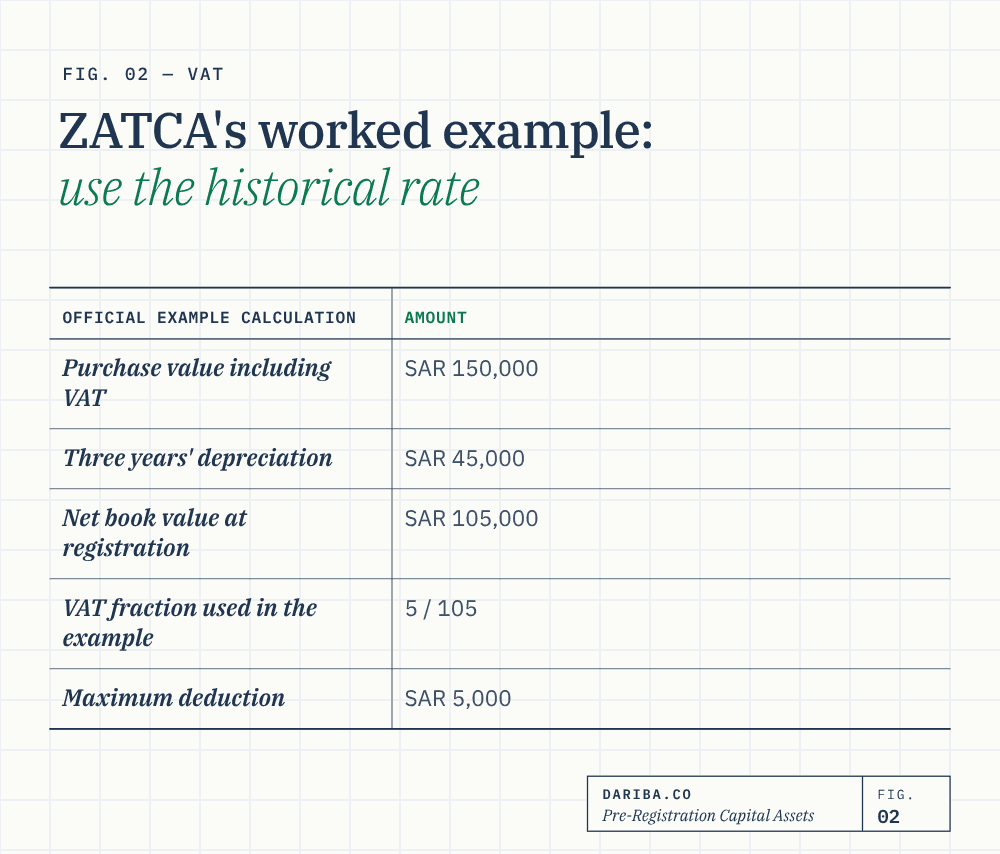
ZATCA’s worked example: use the historical rate
Example 10, section 7.3, page 45 of the Capital Assets Guideline concerns Real Sands Company. It bought a property extension in January 2019 for SAR 150,000 including VAT. The example applies annual depreciation of SAR 15,000 for three years before registration on 1 January 2022.
| Official example calculation | Amount |
|---|---|
| Purchase value including VAT | SAR 150,000 |
| Three years’ depreciation | SAR 45,000 |
| Net book value at registration | SAR 105,000 |
| VAT fraction used in the example | 5 / 105 |
| Maximum deduction | SAR 5,000 |
ZATCA states that the company meets the other eligibility criteria and takes the deduction in its first return, for the quarter ending 31 March 2022. These are the official example’s facts and historical figures, not a current property-acquisition example. The 5/105 fraction reflects the relevant original VAT treatment; registration in 2022 does not reprice the original tax at 15%.
Dariba’s analysis. The example demonstrates why an instruction to multiply every registration-date book value by 15/115 is incomplete. Establish the original tax, applicable rate, carrying-value basis and remaining entitlement. A higher rate at registration does not manufacture additional VAT on an older purchase.
Dariba illustration: a 15% tangible-asset purchase
Assume a machine was bought for SAR 400,000 plus SAR 60,000 Saudi VAT before registration. The unrecovered VAT was capitalised, giving an original carrying cost of SAR 460,000. At registration, accumulated depreciation on that VAT-inclusive basis is SAR 276,000, leaving a net book value of SAR 184,000. All other paragraph 3 conditions and the claim-period requirements are assumed met.
Following the VAT-inclusive approach illustrated by ZATCA, the maximum is SAR 184,000 x 15/115 = SAR 24,000. This is Dariba’s original illustration, not another ZATCA example. It does not permit recovery of the original SAR 60,000 in full.
If the asset is used only 60% for qualifying taxable activity under the applicable attribution method, the assumed recoverable amount is SAR 24,000 x 60% = SAR 14,400. If it is fully restricted under Article 50, recovery is nil despite the positive book value. If its book value is zero, the tangible-capital-asset condition is not met.
The example assumes the carrying value includes the unrecovered original VAT. Do not apply the fraction blindly to a register recorded on a different basis, or add VAT to a value already including it. Reconcile the accounting record with the original invoice and the statutory maximum; obtain clarification where the valuation or tax basis is unresolved.
Inventory requires a different working
For non-capital goods, identify the quantities still held and not fully used or supplied onward at registration. Match those quantities to the relevant original purchase or import records, then apply qualifying use and restrictions. Do not apply capital-asset depreciation or the book-value cap to ordinary stock merely because the stock balance is substantial.
For example, assume an original purchase contains SAR 15,000 correctly charged VAT on 100 identical stock units and 40 remain unused at registration. On Dariba’s assumed facts of equal unit costs, wholly qualifying use and no restriction, the candidate deduction is SAR 6,000. The remaining 60 units do not qualify under this route if already sold or fully consumed before registration. Check the actual stock records and claim timing before filing.
First return, evidence and later monitoring
Section 7.3, pages 44-45 describes the deduction in the return for the first tax period containing the effective registration date. Its example uses the domestic-purchase field; imported VAT has a separate return treatment. Follow the applicable return instructions rather than treating a field number as the source of entitlement.
Retain the original invoice or import evidence, effective registration date, asset register, depreciation basis, carrying-value reconciliation, eligible use and calculation. Article 49(7)‘s permitted evidence alternatives remain relevant; an incomplete invoice should prompt correction and a documented evidence assessment, not an invented automatic waiver.
The absence of a six-month goods condition does not override Article 49(8)‘s later-deduction limit. An omitted first-period item requires review of the lawful claim or correction route and continuing eligibility, rather than an assumption of either permanent forfeiture or unlimited recovery.
After the initial claim, assess the Article 52 capital-asset adjustment rules separately. Do not assume the registration-date book-value calculation creates a new full six- or ten-year period or resolves every later change of use. Preserve the original acquisition date and the history of the deduction.
Primary source: VAT Implementing Regulations, Article 49(3)-(4), (7)-(8), Arabic tenth edition, April 2025, pp. 48-49.
Key takeaways
- Goods, tangible capital assets and intangible services have different pre-registration routes.
- Positive book value is a condition for tangible capital assets, not a guarantee of recovery.
- ZATCA Example 10 uses the historical 5/105 fraction for a 2019 purchase; the registration-date rate does not replace the original tax.
- A 15/115 calculation must be tied to a supported VAT-inclusive carrying-value basis and the other entitlement conditions.
- Qualifying use and expenditure restrictions can reduce recovery below the book-value maximum.
- The absence of a six-month goods condition does not override later-deduction limits or start a new capital-adjustment period automatically.
Sources
- ZATCA - VAT Implementing Regulations, Arabic tenth edition, April 2025Article 49(3)-(4), read with (7)-(8); controlling Arabic text.
- ZATCA - Input Tax Deduction Guideline, third version, May 2026Section 11.1, pp45-46: pre-registration goods and services.
- ZATCA - Capital Assets Guideline, version 2, May 2026Sections 7.1-7.3, pp43-45; Example 10, p45, historical 2019 purchase/2022 registration.
General information only. The treatment depends on the facts, applicable period and controlling Arabic legislation. Dariba analysis and original illustrations are distinguished from official examples. Seek advice or clarification for an unresolved specific arrangement.