In brief
Recovery requires the right tax, recipient, use, evidence and period. Articles 49-52 work with the unpaid-purchase, record and refund provisions; a business expense label alone is insufficient.
Input VAT recovery is a sequence of decisions: establish the tax and recipient, identify qualifying use, apply restrictions, support the claim and select an eligible period. Only then should the finance team calculate how much can be deducted. A registration number or a business expense description does not settle the result.
Articles 49-52 provide the central Saudi framework. Other provisions govern matters such as later changes in consideration, unpaid purchases, records and refunds. This guide brings the decisions together and links to the detailed provision analyses; it does not turn every business purchase into a tax credit.
Start with the right tax, recipient and qualifying use
Article 49(1) covers qualifying economic use for taxable supplies, including zero-rated supplies, the specified GCC internal supplies, and supplies that would be taxable if made in Saudi Arabia. Internal supplies is the GCC cross-border term; it does not mean transactions inside a Saudi VAT group. Apply the relevant transitional and place-of-supply rules before using that limb.
Establish that the charge is correctly incurred Saudi VAT and that the claimant receives the supply or is the relevant importer. Foreign VAT is not deducted in the Saudi VAT return merely because it is a business cost. For reverse-charge purchases, determine the output obligation and input entitlement separately; they do not necessarily cancel in an exempt or mixed business.
Official example. In the Input Tax Deduction Guideline, third version, May 2026, section 4.4, Examples 6-7, pages 20-21, importer identity and qualifying use determine entitlement. Reimbursing an importing agent does not itself give the customer a deduction. Review the customs and contractual structure before shipment, rather than assume payment transfers the right to recover.
Business purpose is necessary but does not override restrictions
Article 50(1) has seven lettered categories: entertainment; catering/hospitality; employee and dependant insurance or healthcare; restricted-vehicle purchase/lease; related vehicle services; vehicle fuel; and private or non-business goods/services. The definition and exceptions matter as much as the list.
Legally required employee meals at the workplace and legally required insurance or healthcare must be considered under their specific exceptions. The restricted-vehicle analysis starts with design capacity of no more than ten persons, then tests the heavy-equipment, taxable-resupply, registered-emergency and exclusive-economic-use exclusions. Private availability remains material.
ZATCA’s April 2025 Amendment Guideline, section 2.11, Examples 23-24, pages 41-42 contrasts a voluntary team dinner with catering provided under the stated legal obligation at a remote construction site. The commercial purpose of the dinner does not remove its restriction; the legal obligation is a material fact in the catering case.
Removing a restriction does not establish full recovery if a cost also serves exempt or non-economic use. See Article 50 and its exceptions and the amendment-focused review.
Evidence supports entitlement; it does not create it
Article 49(7) requires evidence of the input tax paid or payable. Obtain the compliant invoice or import evidence and check the genuine recipient, supply and VAT charge. The provision also recognises specified alternatives, including a correctly issued simplified invoice and commercial evidence accepted at ZATCA’s discretion.
In Example 22, section 8.1, pages 35-36 of the Input Tax Deduction Guideline, an incomplete invoice is considered with other evidence. A missing field should trigger correction and assessment of permitted proof; it is not an automatic waiver or necessarily an irreversible loss. Incorrectly charged VAT does not become valid because the paperwork is complete.
Keep the evidence question separate from use. A perfect invoice for a fully exempt activity does not establish a deductible amount.
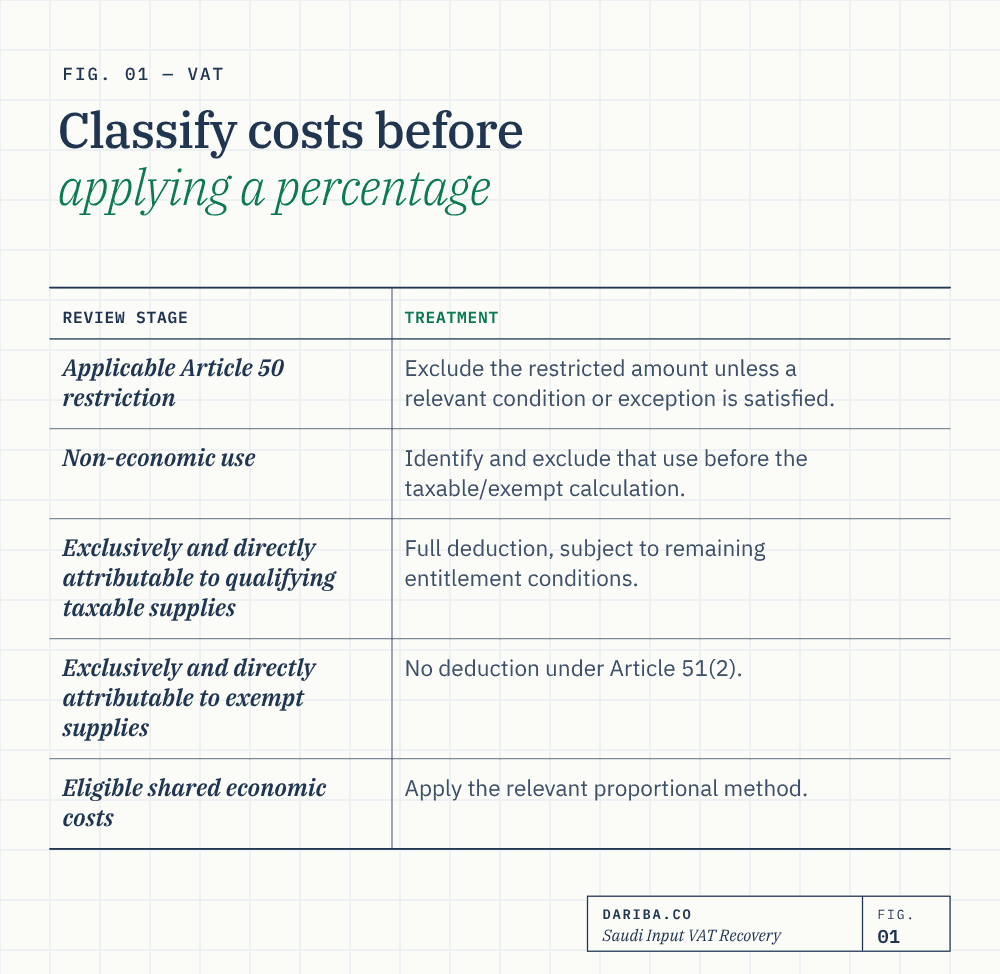
Classify costs before applying a percentage
| Review stage | Treatment |
|---|---|
| Applicable Article 50 restriction | Exclude the restricted amount unless a relevant condition or exception is satisfied. |
| Non-economic use | Identify and exclude that use before the taxable/exempt calculation. |
| Exclusively and directly attributable to qualifying taxable supplies | Full deduction, subject to remaining entitlement conditions. |
| Exclusively and directly attributable to exempt supplies | No deduction under Article 51(2). |
| Eligible shared economic costs | Apply the relevant proportional method. |
Official examples. Examples 8-9, section 5, page 22 allow VAT on demonstration units and sales-team CRM training supporting the taxable activity. They show why a link to one particular sale is not always needed. They do not give all overheads full recovery where the business also makes exempt supplies.
Under the default method, Article 51 uses the previous calendar year’s qualifying taxable supply values divided by taxable plus exempt values, with specified geographic treatment and exclusions. New registrants use the relevant current-year estimate, followed by the annual actual-values comparison. An alternative requires the applicable ZATCA approval or direction; a preferred higher percentage cannot simply replace the default.
For capital raising and other qualifying incidental events, paragraph 11 has specific conditions. Ordinary exempt activity is not converted into an incidental event by describing it as strategic. See apportionment, alternative methods and incidental activities.
Pre-registration purchases need a separate screen
Services under Article 49(2) must fall within the six-month window before effective registration and meet the purpose, no prior onward supply/full consumption and expenditure conditions. Intangible capital assets treated as services retain that timing test; accounting capitalisation does not automatically put them in the goods route.
Article 49(3)‘s goods route has no equivalent six-month condition. Tangible capital assets need positive book value, and paragraph 4 limits the permitted deduction using the registration-date book value. This remains subject to the other entitlement and claim-period rules; it is not an unlimited recovery right for every old asset.
Capital Assets Guideline Example 10, section 7.3, page 45 illustrates a historical 2019 purchase using a 5/105 fraction at later registration. Do not replace that historical tax with the registration-date rate. Read pre-registration services and capital assets/book value for the assumptions and calculation.
The original claim may need later adjustment
Article 52 ordinarily monitors movable tangible/intangible capital assets over six years and immovable assets permanently attached to land or real estate over ten, subject to the shorter-accounting-life rule. The twelve-month reporting cycle starts with the acquisition tax period; it is not invariably a December exercise.
For an asset with total VAT of V, adjustment period N, initial recovery percentage I and actual qualifying-use percentage A, the annual difference is V / N x (A - I) where the normal percentage-based calculation applies. Use decimals. Do not apply the percentage-point change to an already partly deductible annual baseline a second time. Compare actual use with original recovery, not merely last year.
Improvements have their own period from completion. Taxable sale, exempt sale, permanent withdrawal and destruction/theft require different analysis. A permanent switch to wholly exempt use within a continuing business is a boundary requiring particular care; this guide does not prescribe an automatic annual-only or nominal-supply answer. See capital adjustments and real-estate capital assets.
Other adjustments also matter. Under Article 40(10), if a previously deducted purchase has not been paid in full after twelve months from the month following the supply month, adjust the VAT relating to the unpaid consideration in the return for the period in which that interval ends. Its exception for qualifying goods-financing arrangements requires the licensed supplier, periodic instalments, continuing agreement, no judicial dispute, full supplier VAT declaration and written certificate conditions to be examined. An instalment plan alone is insufficient.
Paragraph 11 permits a corresponding increase after later payment in that payment period or a subsequent period; paragraph 12 keeps the applicable statutory time limits in view. Price changes and credit/debit notes have their own treatment. Read the current Arabic provision, p. 39.
Claim periods, credit balances and cash refunds
Article 49(8) permits a later eligible deduction period, subject to its five-calendar-year limit measured from the supply year. For a supply in 2022, the ordinary last eligible deduction periods are in 2027. Distinguish the period from the filing date of its return; an invoice date alone does not determine the underlying supply date. Specific later adjustments and correction routes need their own analysis rather than an assumption that a late payment revives every expired claim.
Deductible input tax can reduce output tax or produce a credit balance. A credit is not automatically a cash refund already due for immediate payment. Article 69 governs requests, review, carry-forward and offsets. Budget cash recovery using the actual procedural position, rather than treating an input-VAT schedule as a bank receivable payable on demand.
We recommend a reconciled claim file showing the original VAT, recipient/importer, activity classification, restriction review, evidence, deductible amount, period and future adjustment triggers. That turns the recovery framework into a repeatable finance process and makes both additional recovery and overclaims visible.
Key takeaways
- Identify the genuine recipient or importer and qualifying use before calculating recovery; GCC internal supplies are not VAT-group transactions.
- Article 50 has seven qualified categories; legally required benefits and the full vehicle definition need individual review.
- Correct evidence supports entitlement, while specified alternatives require their own conditions or ZATCA discretion.
- Direct attribution precedes shared-cost apportionment, with separate rules for new registrants, incidental events and approved alternatives.
- Pre-registration services, tangible capital goods and intangible services require different eligibility and timing checks.
- Annual capital adjustments compare actual use with original recovery; unpaid purchases and later payments create separate adjustment questions.
- A later deduction period, its return filing date and an actual cash refund are separate matters.
Sources
- ZATCA - VAT Implementing Regulations, Arabic tenth edition, April 2025Articles 49-52, document pp 48-54; Article 40(10)-(12), p 39; Article 66, p 67; Article 69, pp 69-70. Controlling Arabic text.
- ZATCA - Input Tax Deduction Guideline, third version, May 2026Sections 4.4, 5, 7, 8.1, 11-14; Examples 6-9 and 22.
- ZATCA - Capital Assets Guideline, version 2, May 2026Sections 6-8; Example 10, p 45, uses historical VAT.
- ZATCA - VAT Amendment Guideline, issue 1, April 2025Section 2.11, Examples 23-24, pp 40-42; issue date alone does not establish every commencement date.
General information only. Treatment depends on the facts, applicable period and controlling Arabic legislation. Dariba analysis and original illustrations are distinguished from official examples. Seek advice or clarification for an unresolved specific arrangement.