In brief
China’s treaty ceilings do not raise lower domestic rates. Government-related exceptions, rights classification, insurance Protocol and the applicable MLI benefit conditions require separate review.
Start with Classification and Treaty Entitlement
A payment to a Chinese supplier does not have one universal Saudi withholding rate. Establish the Saudi domestic source and income category, then determine whether the Saudi–China agreement limits the tax that would otherwise apply. Residence, beneficial ownership where required, effective connection with a permanent establishment and treaty-abuse conditions remain relevant.
The agreement signed on 23 January 2006 includes an integral Protocol. China’s tax authority also publishes a synthesis showing selected MLI modifications. That synthesis is a reading aid: the authentic agreement, Protocol and MLI, with the parties’ reservations and notifications, determine the legal result. The agreement provides that its English text prevails in case of a divergence of interpretation between its authentic language texts.
Compare Treaty Ceilings with Saudi Domestic Categories
The following comparison concerns ordinary Saudi-source payments to an entitled Chinese resident. Treaty ceilings are maximum source-state taxation under the relevant article; they do not create a higher Saudi charge where domestic law is lower.
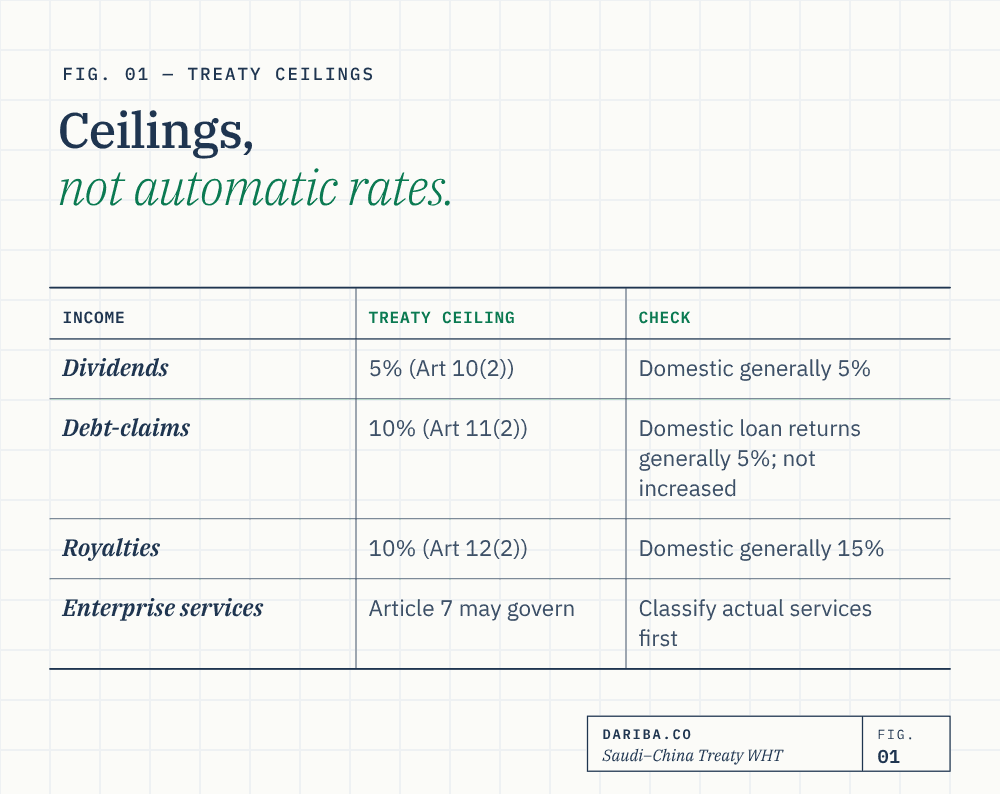
| Income | Ordinary domestic category to examine | Agreement provision |
|---|---|---|
| Dividends | Generally 5% for the defined domestic category | Article 10(2): 5% of gross dividends for the qualifying beneficial owner; paragraph 3 has a separate government-related residence-state-only rule |
| Income from debt-claims | Generally 5% for qualifying domestic loan returns | Article 11(2): 10% ceiling; specified government-related financing has separate exemption conditions in paragraph 3 |
| Royalties | Generally 15% for qualifying domestic royalties | Article 12(2): 10% ceiling, subject to the definition and entitlement conditions |
| Genuine enterprise service income | Classify actual technical, management or other services first | Article 7 may govern, subject to PE and other specific provisions; the Protocol preserves domestic insurance treatment |
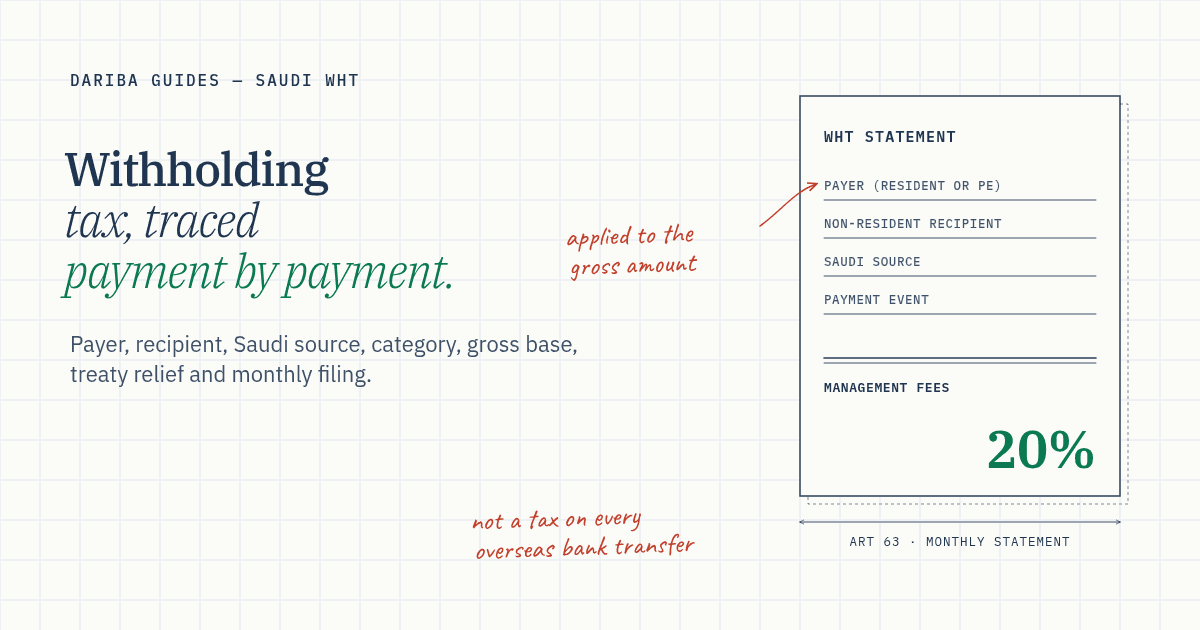
The domestic categories come from Income Tax Law Article 68 and Implementing Regulations Article 63. A treaty heading should not be substituted for the initial source and classification exercise. The domestic WHT guide explains that starting point.
Dividends: No Imported Shareholding Threshold
Article 10(2) states a 5% ceiling where the recipient is the beneficial owner. It does not make that ordinary ceiling depend on a shareholding percentage copied from a different Saudi treaty.
Paragraph 3 separately provides residence-state-only taxation where the beneficial owner is the other state’s government, one of its institutions or another entity wholly owned directly or indirectly by that government. Establish the actual recipient, ownership chain and beneficial ownership before treating a payment as within that rule. The existence of public-sector investment somewhere in a group does not itself establish every condition.
Article 10(5) displaces the ordinary dividend provisions where the holding is effectively connected with the specified PE or fixed base. The treaty does not remove the paying company’s own tax on the profits from which the distribution is made.
Debt-Claims: A 10% Ceiling Does Not Override a Lower Domestic Rate
Article 11(2) limits source taxation to 10% of gross qualifying debt-claim income for the beneficial owner. Where the correct Saudi domestic loan-return category is 5%, that ceiling is not a reason to increase withholding to 10%.
Article 11(3) has a separate exemption for the specified government, local-authority, central-bank and wholly government-owned financial-institution cases, and for the stated indirectly government-financed debt claims. The financing limb requires the actual qualifying funding facts; it is not an exemption for every loan made by any Chinese bank.
The Article’s definition excludes late-payment penalty charges from debt-claim income. Effective connection with a PE/fixed base and an excessive amount arising from a special relationship also have their own provisions. Principal repayment, genuine loan return, a guarantee or independent service fee should not be treated as identical solely because they appear in one financing agreement.
Royalties: Test the Rights and Property Actually Supplied
Article 12 covers the stated copyright, intellectual-property, know-how and equipment-use consideration. It includes use of, or the right to use, industrial, commercial or scientific equipment. Its 10% ceiling requires the recipient to be the beneficial owner and the relevant residence and other conditions to be met.
A software, platform or support invoice does not establish the treaty category by its label. Examine exploitation rights, transferred know-how, equipment rights and independently performed services. The domestic classification can also differ from the treaty definition: a treaty ceiling does not increase a correctly established lower domestic equipment-rent rate.
Article 12(4) addresses effectively connected rights/property; paragraph 5 gives source rules including the relevant PE/fixed-base burden; paragraph 6 restricts the ordinary treatment to the arm’s-length amount where special relationships produce excess consideration.
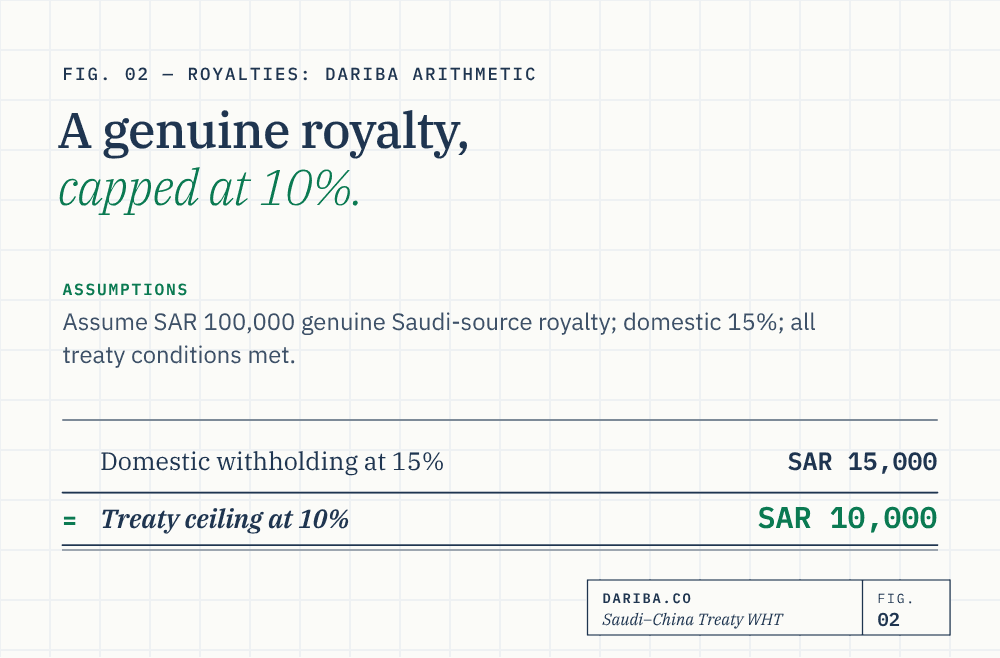
Dariba arithmetic illustration: assume SAR 100,000 is a genuine Saudi-source royalty, the ordinary domestic 15% category applies, and all conditions for the 10% treaty ceiling and relief procedure are met. Domestic withholding is SAR 15,000 and the ceiling produces SAR 10,000, a difference of SAR 5,000. These original figures do not establish entitlement, the correct category for a real contract or automatic relief at source.
Enterprise Services and Insurance Need Their Own Analysis
Article 7 generally allocates enterprise profits to the residence state unless the enterprise carries on business through a PE in the other state, with source taxation limited to attributable profits. Specific income articles retain their separate operation.
The Protocol confirms that business profits include services, but independently performed personal services are dealt with under Article 14. The Protocol also states that each state applies its domestic law to insurance activities. It is therefore unsafe to tell every Chinese insurer that absence of an ordinary Article 5 PE automatically produces zero Saudi WHT.
For a corporate technical-services contract, assess the actual services, any embedded rights, relevant PE facts and the relief process. A domestic Saudi-source rule and a treaty allocation rule answer different questions. See the Saudi–China PE guide before concluding that the enterprise has no Saudi presence for treaty purposes.
MLI Dates and the Principal-Purposes Test Matter
The jointly prepared synthesis identifies MLI effect for withholding events on or after 1 January 2023, and for other taxes in respect of taxable periods beginning on or after 1 March 2023. Those are not identical tests. A calendar-year tax period beginning before the latter date should not simply be assumed to fall within it because a payment occurred during 2023.
MLI Article 7’s principal-purposes test can deny a benefit where, considering the relevant facts and circumstances, obtaining it was one of the principal purposes of the arrangement or transaction, unless granting it accords with the relevant provision’s object and purpose. Beneficial ownership, residence and this test are related checks, not interchangeable certificates.
China’s deposited reservations against the MLI’s PE provisions must also be respected; do not import another country’s modified agency or contract-splitting rule into this agreement merely because both countries apply the MLI.
Build the Relief File Before Selecting a Rate
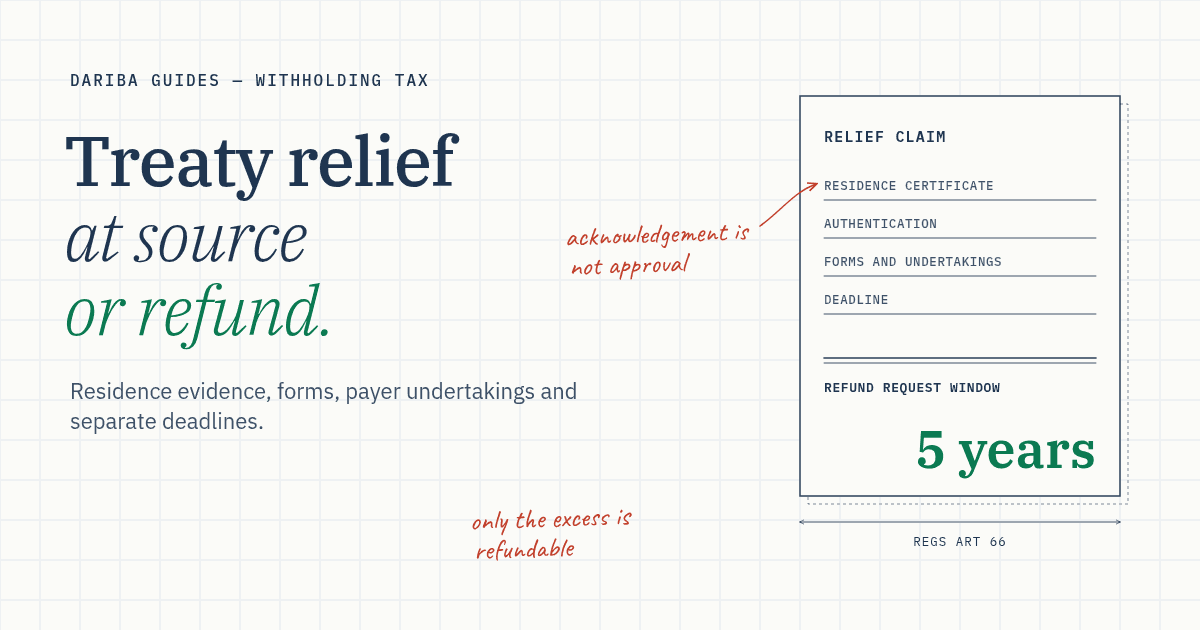
ZATCA’s WHT treaty circular distinguishes classification, treaty conditions and the available procedural route. Retain the actual contract, payee identity/residence evidence, beneficial-ownership analysis, relevant PE information, rights supplied, payment period and source/rate calculation. Follow the current relief-at-source or refund requirements for the actual payment.
This guide does not prescribe one certificate deadline for every case or guarantee that a residence certificate establishes all treaty benefits. The treaty-relief procedure guide explains the general process. The defensible result is a supported payment-specific conclusion, rather than a rate selected solely from the recipient country.
Key takeaways
- Treaty ceilings do not increase an applicable lower Saudi domestic rate.
- Article10 has an ordinary5% dividend ceiling and a separate government-related residence-state-only rule.
- Article11’s10% debt-claim ceiling is distinct from its specified government-financing exemption.
- Article12’s10% royalty ceiling requires actual rights classification and benefit conditions.
- The Protocol preserves domestic insurance treatment; no-PE is not a universal insurance exemption.
- MLI timing distinguishes withholding events from other taxable periods, and the principal-purposes test remains relevant.
Sources
- China tax authority: authentic Saudi–China agreement textArticles 4–5,7 and 10–12, language and final provisions; integral Protocol preserves insurance domestic law and personal-service distinction.
- China tax authority: jointly prepared MLI synthesisReading aid for matched changes and effect dates. Authentic convention/Protocol and MLI prevail; visible original checked separately from extraction artefacts.
- OECD depositary: China deposited MLI positionCovered-agreement and selected MLI reservations/notifications matched with Saudi position. China reserves against selected PE modifications.
- OECD depositary: Saudi Arabia’s deposited MLI positionMatched covered-agreement, reservations and notifications; unilateral choice alone does not modify a treaty.
- OECD: Multilateral Instrument, authentic English textApplicable benefit, PE and entry-into-effect provisions, subject to the parties’ reservations and notifications.
- OECD: current MLI signatories and partiesCurrent depositary listing and links to deposited positions; entry into force and entry into effect are distinct.
- ZATCA Tax Circular: Withholding Tax Implementation under Double Taxation AgreementsSection 3.2 distinguishes business profits, debt-claims, royalties, technical and personal services; actual treaty conditions and procedure govern.
- Saudi Income Tax Law, current Arabic publicationArticles 5 and 68: domestic source and withholding framework; treaty allocations require separate analysis.
- Saudi Income Tax Implementing Regulations, current Arabic publicationArticles 5 and 63: actual source/category, ordinary domestic rates and payment compliance conditions.
General information based on official treaty, MLI and Saudi sources reviewed on 29 October 2026. Authentic instruments, actual facts, payment or tax period, residence, beneficial ownership where required, presence and benefit conditions determine the result. Joint syntheses are reading aids. Dariba illustrations are original; no treaty entitlement, project status or procedural outcome is guaranteed.