In brief
China reserves against the selected MLI PE changes. Apply the original fixed-place, more-than-six-month project/service, activity and agency wording, with period and benefit conditions retained.
Use the Saudi–China Wording and the Applicable Period
The Saudi–China agreement’s Article 5 defines the permanent-establishment framework. Article 7 then addresses business profits attributable to a PE. A Saudi domestic-law presence and a treaty PE are connected but separate analyses; neither a commercial registration label nor a short visit resolves every treaty test.
The agreement and its integral Protocol must be read with the MLI as applicable for the period. The tax authorities’ synthesis assists that exercise, while the authentic instruments and matched reservations/notifications remain decisive. Its MLI timing distinguishes withholding events on or after 1 January 2023 from other taxes for taxable periods beginning on or after 1 March 2023.
China Reserves Against the MLI PE Changes
China’s deposited position reserves against the entirety of MLI Articles 12, 13 and 14 and the related Article 15 application described in that position. Saudi Arabia’s own election to apply a provision is not sufficient to override the other party’s reservation.
The consequence for the selected PE issues is important: do not replace this agreement’s original contract-authority test with another treaty’s MLI principal-role test, assume the MLI makes every listed activity exemption conditional on preparatory/auxiliary status, or automatically import the MLI contract-splitting aggregation mechanism.
This does not make artificial arrangements safe. The actual Article 5 facts and the applicable principal-purposes test still need assessment. A reservation against a particular MLI clause is not a general treaty-abuse exemption.
A Fixed Place Is a Separate Route
Article 5(1) concerns a fixed place of business through which the enterprise’s business is wholly or partly carried on. Paragraph 2 includes a place of management, branch, office, factory, workshop and the specified natural-resource extraction locations.
Do not treat the construction or service thresholds as a universal minimum duration for every listed route. A company can have a fixed-place question even when a particular employee’s visit is shorter than six months.
Dariba recommends documenting the actual premises, use by the enterprise, work performed and relevant time pattern. A contract saying that a customer owns the building does not alone determine how the foreign enterprise uses a place within it. Conversely, the mere existence of a Saudi customer does not itself establish a foreign supplier’s fixed place.
Construction and Supervisory Activities Use More Than Six Months
Article 5(3)(a) covers a building site, construction, assembly or installation project and supervisory activities connected with it, but only where the site, project or activities continue for more than six months.
The wording should not be converted into “183 days” or “six months or more”. Those are different formulations. Identify the actual project, connected supervision, start/end facts and interruptions before counting the relevant duration.
The absence of matched MLI Article 14 treatment does not establish a general permission to divide one real project into artificial contracts. Apply the agreement’s actual project facts and relevant anti-abuse rules. It also does not justify importing an automatic aggregation formula from the Pakistan or another treaty into the China analysis.
Services Use a Same-or-Connected-Project Test
Article 5(3)(b) covers services, including consultancy, furnished through employees or other personnel engaged by the enterprise where activities of that nature continue for the same or a connected project in the state for periods aggregating more than six months within any twelve-month period.
Three points need to remain visible. The activities must be within the relevant state; the same-or-connected-project language matters; and the twelve-month frame is not simply the calendar year or a reset each January. Rotating staff or changing invoice references does not, by itself, establish separate projects.
Dariba illustration: a Chinese enterprise provides engineering personnel for one connected Saudi implementation in several visits crossing year-end. Review the enterprise’s activities and connected project within the rolling period rather than treating each visitor or calendar year as a fresh allowance. This illustrates the test without inventing a universal counting convention for overlapping personnel days.
Independent personal services require their separate Article 14 analysis. Do not replace the enterprise service-PE rule with an individual presence threshold merely because the work is consultancy.
Apply Each Listed Activity Exemption as Written
Article 5(4) separately lists facilities or stock used solely for storage, display or delivery; stock maintained solely for another enterprise’s processing; and a fixed place used solely for purchasing or collecting information. It also includes the specified preparatory/auxiliary activity and combination provisions.
The combined-activity limb requires the overall resulting activity to be preparatory or auxiliary. The individual limbs have their own wording and sole-purpose restrictions. Because China reserves against MLI Article 13, do not silently rewrite all limbs using another treaty’s MLI Option A formulation.
A warehouse label does not prove that its actual functions are confined to the stated exempt activity. Assess sales, contract, service and other functions in the real arrangement. The appropriate conclusion follows the facts and exact paragraph, not the business’s preferred description of the location.
Agency Requires the Original Contract-Authority Analysis
Article 5(5) addresses a person acting on the enterprise’s behalf who has and habitually exercises authority to conclude contracts in its name, subject to the specified activity exception. The agreement’s wording is not the MLI’s broader principal-role formulation.
Paragraph 6 protects an independent broker, general commission agent or other independent agent acting in the ordinary course of business, but does not treat an agent devoted wholly or almost wholly to the enterprise as independent within that paragraph. Do not add a closely-related-party condition copied from another treaty to that original wording.
Review actual authority, repeated conduct and independence. Signing abroad does not, without examining the relevant authority and conduct, establish the result. Paragraph 7 separately states that company control alone does not create a PE between the two companies; that rule does not excuse an actual fixed-place or agency PE.
Attribute Profits and Examine the Protocol
Article 7 generally permits Saudi taxation of profits attributable to the treaty PE, applying the distinct-enterprise approach and its expense provisions. PE existence does not mean that every payment received by the Chinese group becomes attributable to it.
The Protocol confirms that business profits include the stated activities and services, sends independent personal services to Article 14 and preserves domestic law for insurance activities. Accordingly, a no-PE conclusion is not a universal exemption for every insurance payment or income item governed by another article.
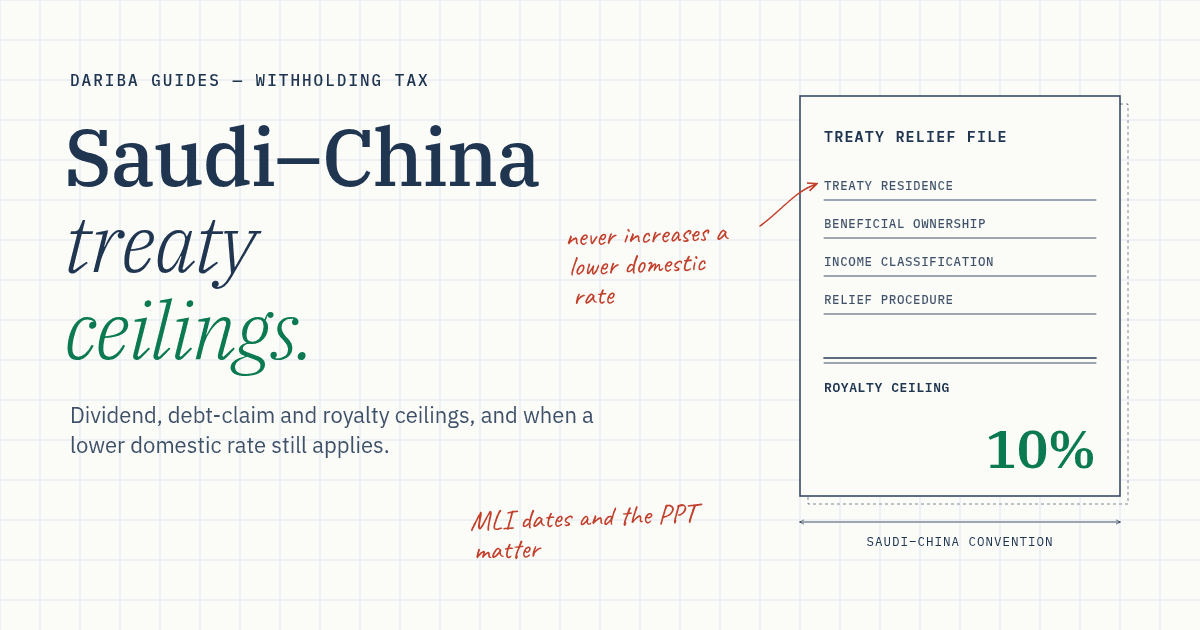
The Saudi–China withholding guide explains dividends, debt-claims and royalties, including their effective-connection exceptions. A treaty ceiling, PE profit calculation and domestic compliance obligation must be considered separately.
Keep the Presence Analysis with the Payment File
Dariba recommends maintaining project and visit histories, contracts and amendments, personnel roles, premises arrangements, agency authority, customer negotiations and a reasoned analysis of connected projects and exempt activities. Identify the actual agreement paragraph and applicable tax period for each conclusion.
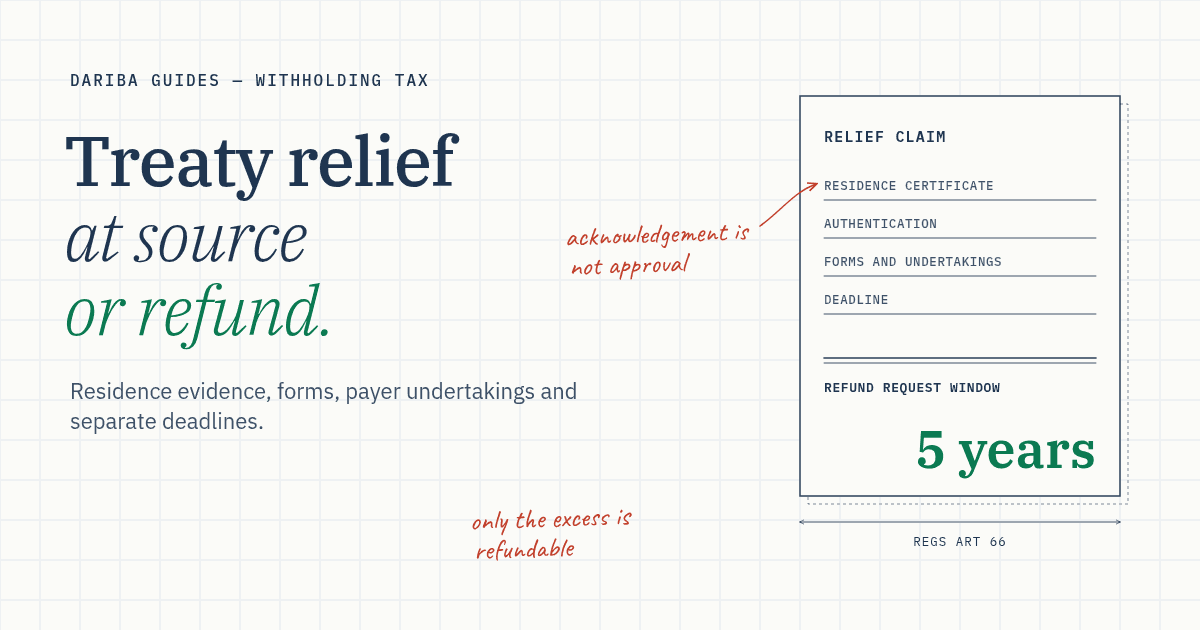
Use the current treaty-relief process when claiming a payment benefit. This guide does not certify a particular project, confer a general six-month safe harbour or resolve every profit-attribution and employment issue. Preserve any unresolved fact or interpretive boundary instead of presenting the residence certificate as the complete PE analysis.
Key takeaways
- China reserves against MLI Articles12–14 and the stated related Article15 application.
- Fixed-place presence is separate from the project and service duration tests.
- Construction/supervision uses more than six months; services use same-or-connected-project activity within any twelve-month period.
- Apply each original activity-exemption limb rather than importing another treaty’s OptionA wording.
- The original contract-authority and independence clauses differ from the MLI principal-role test.
- Protocol insurance treatment, attribution, effective connection and actual relief conditions remain separate.
Sources
- China tax authority: authentic Saudi–China agreement textArticles 4–5,7 and 10–12, language and final provisions; integral Protocol preserves insurance domestic law and personal-service distinction.
- China tax authority: jointly prepared MLI synthesisReading aid for matched changes and effect dates. Authentic convention/Protocol and MLI prevail; visible original checked separately from extraction artefacts.
- OECD depositary: China deposited MLI positionCovered-agreement and selected MLI reservations/notifications matched with Saudi position. China reserves against selected PE modifications.
- OECD depositary: Saudi Arabia’s deposited MLI positionMatched covered-agreement, reservations and notifications; unilateral choice alone does not modify a treaty.
- OECD: Multilateral Instrument, authentic English textApplicable benefit, PE and entry-into-effect provisions, subject to the parties’ reservations and notifications.
- OECD: current MLI signatories and partiesCurrent depositary listing and links to deposited positions; entry into force and entry into effect are distinct.
- ZATCA Tax Circular: Withholding Tax Implementation under Double Taxation AgreementsSection 3.2 distinguishes business profits, debt-claims, royalties, technical and personal services; actual treaty conditions and procedure govern.
- Saudi Income Tax Law, current Arabic publicationArticles 5 and 68: domestic source and withholding framework; treaty allocations require separate analysis.
- Saudi Income Tax Implementing Regulations, current Arabic publicationArticles 5 and 63: actual source/category, ordinary domestic rates and payment compliance conditions.
General information based on official treaty, MLI and Saudi sources reviewed on 29 October 2026. Authentic instruments, actual facts, payment or tax period, residence, beneficial ownership where required, presence and benefit conditions determine the result. Joint syntheses are reading aids. Dariba illustrations are original; no treaty entitlement, project status or procedural outcome is guaranteed.