In brief
Article 79 identifies ministerial powers. Regulations Articles 72–73 add effort, finality, salary-band and committee controls for employee rewards; those controls do not determine a taxpayer’s assessment or remedies.
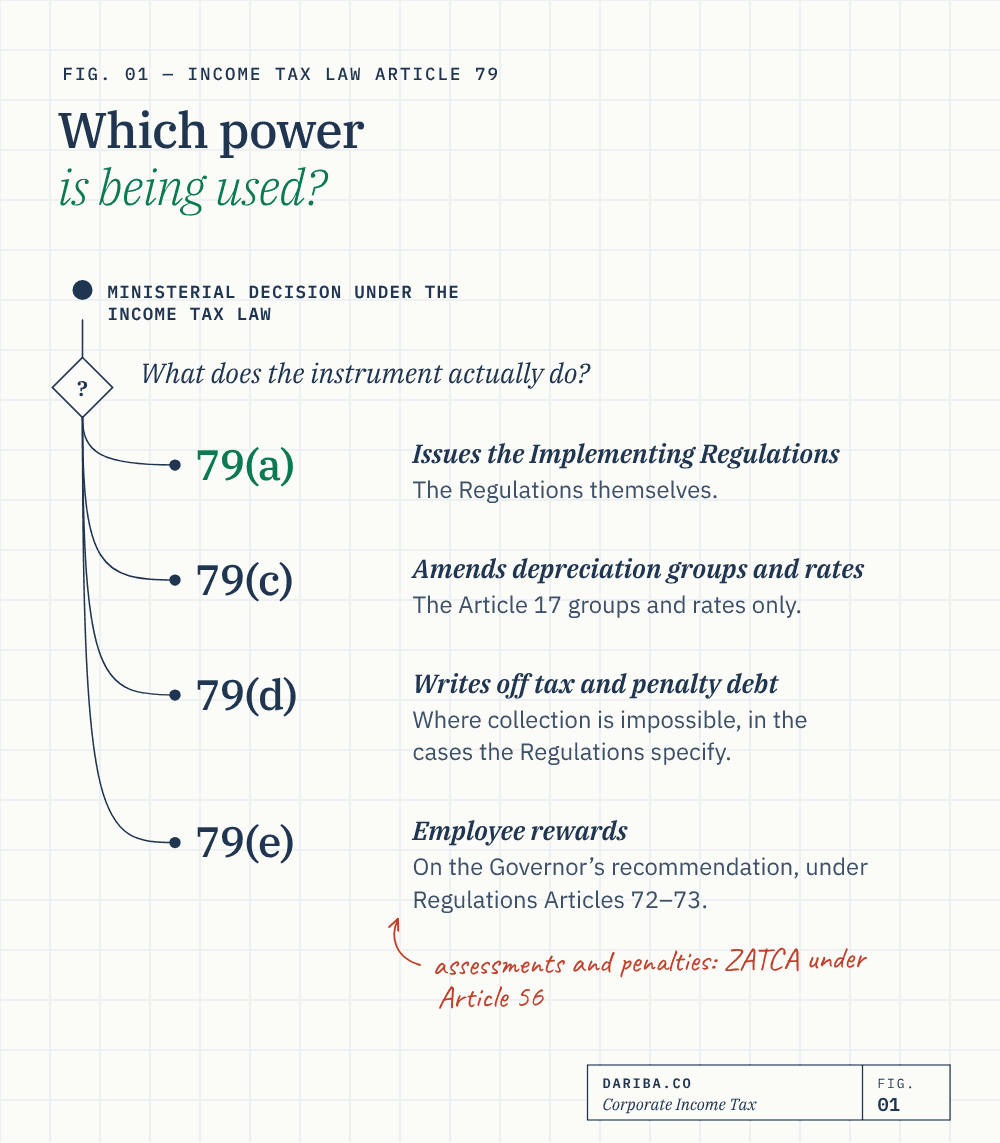
The Saudi Income Tax Law assigns different powers to the Minister and to ZATCA. Identifying the power and the instrument made under it matters when a business relies on a depreciation change, seeks relief or challenges an assessment. Article 79 lists ministerial powers; it does not itself establish that every possible implementing decision has been issued or applies to the taxpayer.
Distinguish the Law, the Regulations and the actual decision
Article 79(a) authorises the Minister to issue the Law’s Implementing Regulations. Paragraph (b) authorises instructions and measures considered necessary to implement the Law. An implementing power and an instrument exercising that power are different parts of the analysis.
Dariba recommendation: identify the actual instrument, issuing authority, operative wording, applicable activity and commencement terms. A reference to Article 79 alone does not establish a particular exemption, extended deadline or approved tax treatment. Guidance explaining a rule must also be distinguished from a decision that changes a rule within the stated statutory power.
Source: Income Tax Law, Article 79(a)–(b), p. 34.
Depreciation powers concern the specified groups and rates
Article 79(c) permits amendment of the depreciation groups and rates in Article 17. It should be read with the actual applicable depreciation provisions and any relevant amendment, rather than as a taxpayer election to use whichever accounting rate produces a preferred result.
The CIT depreciation guide explains tax pools, additions, disposals and the separate measures used in those calculations. Dariba analysis: an asset’s accounting useful life, an internal policy and a ministerial amendment are different evidence. Establish which rule governed the relevant period before changing the tax computation or an inherited pool balance.
Source: Income Tax Law, Articles 17 and 79(c), especially p. 34.
Debt write-off requires its own case and decision
Article 79(d) concerns writing off tax and penalty debt where collection is impossible, with the cases specified in the Regulations. Regulations Article 70 requires a ministerial decision and lists the bankruptcy, no-estate, capital-company liquidation and unsuccessful compulsory-collection cases with their respective conditions.
The tax-debt write-off guide explains those distinctions. A cash-flow difficulty, an accounting write-off or an instalment request does not independently establish the statutory case or the required decision. A decision’s actual scope must be reconciled to the debtor, debt and periods it covers.
Source: Income Tax Law, Article 79(d), p. 34, and Implementing Regulations, Article 70, pp. 39–40.
Employee rewards have a separate statutory framework
Article 79(e) authorises rewards for employees distinguished in performing their work, based on recommendations of ZATCA’s Governor, with conditions and controls specified in the Regulations. This is a separate administrative framework from a taxpayer’s tax base, penalty or refund entitlement.
The published compilation’s Articles 72–73 set out the corresponding employee-reward controls. Their retained institutional terminology should be read alongside the current Law. This guide explains the published provisions; it does not certify a particular employee’s entitlement, award, internal authorisation or the complete amendment history of every underlying decision.
Source: Income Tax Law, Article 79(e), p. 34, and Implementing Regulations, Articles 72–73, pp. 41–42.
The reward provisions specify effort and finality conditions
Regulations Article 72(1) addresses unusual effort in examining, reviewing and following up returns and accounts that discovers or secures amounts for the public treasury, with those amounts’ entitlement established finally. Paragraph (2) separately addresses discovery of tax debts previously written off, unknown, lost or not previously known, with collection and final remittance of the discovered amounts to the State treasury.
Dariba analysis: a proposed assessment is not the same event as finally established entitlement, and discovering a debt is not the same as collecting and remitting it. The stated routes should not be collapsed into a claim that any initial tax demand automatically earns a reward.
Neither route substitutes for proving a taxpayer’s liability under the tax provisions. An assessment remains subject to its own legal basis and the applicable assessment and challenge framework.
Source: Implementing Regulations, Article 72(1)–(2), p. 41.
The published reward schedule uses salary amounts
Article 72(3) caps the incentive reward at three months’ salary in a year and links its amount to the effort and amounts achieved under the following published schedule. These are salary-based bands, not percentages of tax assessed or a charge added to the taxpayer’s balance.
| Amount achieved under the provision | Published salary measure |
|---|---|
| SAR 50,000 to SAR 250,000 | One month’s salary. |
| More than SAR 250,000 up to SAR 1 million | Two months’ salary. |
| More than SAR 1 million in a year | Three months’ salary. |
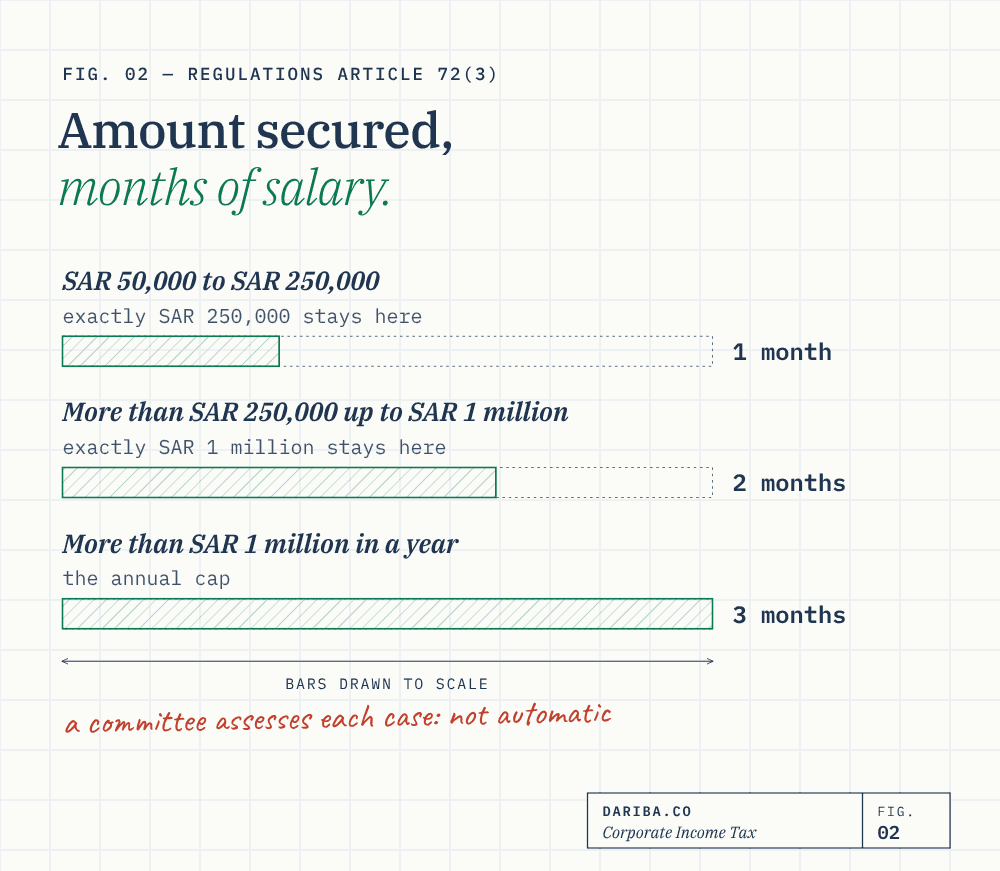
Dariba boundary illustration: exactly SAR 250,000 remains within the first band; exactly SAR 1 million remains within the second. These illustrations explain the stated boundaries only. They do not determine an actual award, aggregate multiple cases, override the annual cap or establish that the other qualifying conditions are satisfied.
Source: Implementing Regulations, Article 72(3), pp. 41–42. The compilation records amendments in footnote 58; individual original amendment decisions and later internal implementation require separate review where material.
A committee evaluates referred reward cases
Regulations Article 73 provides for a committee to consider cases referred to it, assess the effort in each case and propose an appropriate reward in light of the submitted justifications and documents. The paragraph describes an evaluation and proposal process.
Dariba analysis: the schedule should not be read in isolation as an automatic entitlement triggered by the amount in one document. The actual referral, substantiated effort, qualifying amounts, annual control and competent decision remain relevant. This employee committee should not be confused with the taxpayer dispute committees or treated as the forum for challenging a CIT assessment.
Source: Implementing Regulations, Article 73, p. 42.
Keep taxpayer remedies tied to the decision actually challenged
ZATCA’s administration and penalty-decision powers are separately identified in Law Article 56. The CIT penalty guide distinguishes decision-maker, breach, penalty base, delay and relief; the objections guide addresses the separate dispute route.
Dariba recommendation: retain the assessment or penalty decision, legal basis, calculation, issuing capacity and notification, then apply the relevant response process and dates. The existence of a rulemaking or reward provision does not itself establish that a particular assessment is valid, invalid, suspended or eligible for relief. Those conclusions require the actual facts and governing provisions.
Source: Income Tax Law, Articles 56 and 79, pp. 23 and 34, read with the relevant substantive and procedural provisions.
Key takeaways
- Identify the actual implementing instrument and its effective terms.
- Article 79(c) concerns the Article 17 depreciation groups and rates.
- Debt write-off needs its stated case and ministerial decision.
- Employee rewards have separate effort and finality conditions.
- The schedule uses salary amounts, with an annual three-month cap.
- Article 73 describes committee evaluation and a proposal.
Sources
- Saudi Income Tax Law, current amended Arabic textArticles 56 and 79(a)–(e), especially pp. 23 and 34: administrative powers, rulemaking, depreciation groups and rates, debt write-off and employee rewards.
- Income Tax Implementing Regulations, current amended Arabic textArticles 70 and 72–73, pp. 39–42: write-off cases and the separate employee-reward effort, finality, salary-band, annual-cap and committee controls. Original amendment decisions and actual awards are outside this selected review.
General information only. Actual supplies, facts, applicable periods and controlling Arabic legislation determine the result. Official examples are distinguished from Dariba analysis and original illustrations. Seek advice or clarification where the arrangement or source material leaves a specific issue unresolved.