In brief
Taxpayer registration and withholding-agent registration have separate triggers. The final-withholding exception belongs to the qualifying taxpayer, while portal completion, filing, remittance and evidence remain distinct duties.
Identify the capacity in which registration is required
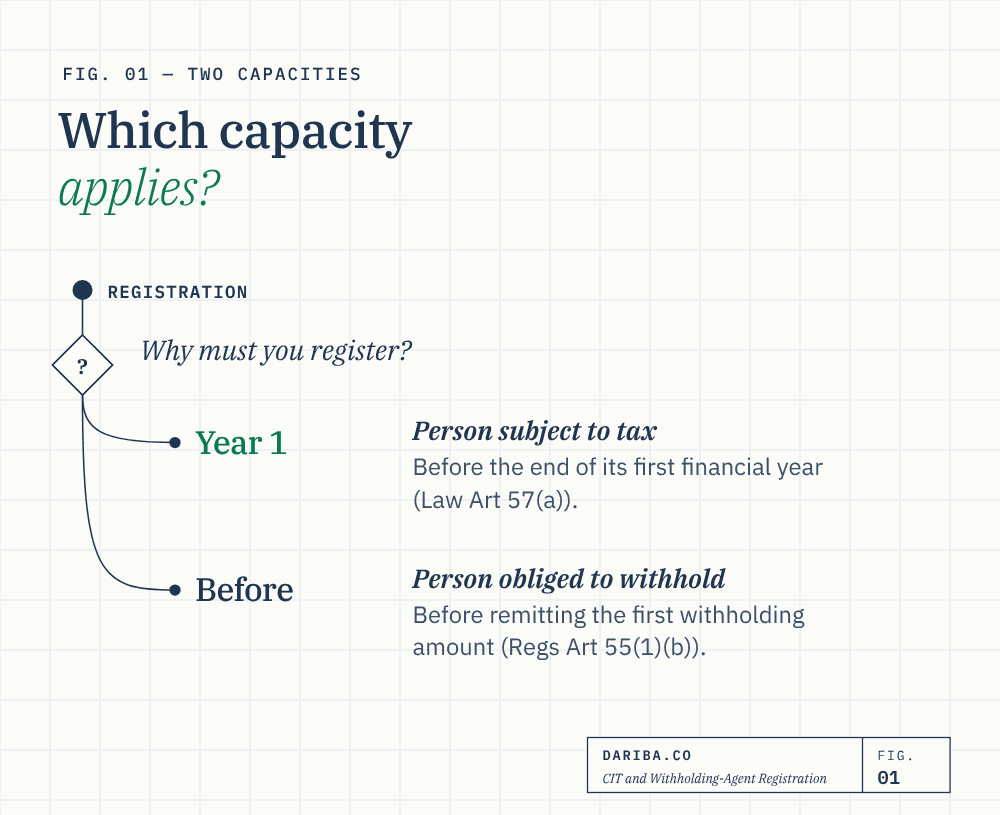
Income Tax Law Article 57 governs taxpayer registration. Regulations Article 55 separately identifies registration by a person subject to tax and registration by a person or entity obliged to withhold under Law Article 68. Those capacities can belong to the same business, but they answer different questions.
Dariba recommendation: identify the legal person, residence, actual activities, income-tax position and payments made to non-residents. A Zakat position, nil current CIT liability or government ownership does not, by itself, answer whether the person has withholding-agent obligations. Law Article 68(a) expressly addresses relevant resident payers whether themselves taxable or not, and Saudi permanent establishments of non-residents.
Use the CIT scope guide and WHT overview to establish those underlying positions. Registration records the relevant tax capacity; it does not create treaty eligibility, determine a payment’s source or replace its classification.
Apply the taxpayer’s first-financial-year deadline
Law Article 57(a) requires a person subject to tax under the Law to register its activity with ZATCA before the end of its first financial year. Regulations Article 55(1)(a) repeats that timing. Establish the actual applicable first financial year rather than substitute a calendar-year assumption or the first annual return’s later filing date.
The first-year registration requirement and the ordinary return deadline are separate. A taxpayer should not assume it can wait until 120 days after year-end to complete registration simply because that is the ordinary annual filing period. A short or long first period requires the actual financial-year and filing rules to be considered.
Sources: Law Article 57, p. 23 and Regulations Article 55, p. 27. The accounting-period guide explains the relevant year and transition rules.
Register the withholding capacity before the first remittance
Regulations Article 55(1)(b) requires the person or entity obliged to withhold under Law Article 68, including partnerships, to register before remitting the first withholding amount. This is a separate trigger from the taxpayer’s first-year-end rule.
Dariba analysis: a business with an early non-resident payment should not use its later first-year-end registration date as permission to miss the withholding process. Establish whether settlement creates an in-scope payment, calculate the tax, and ensure the relevant account and service are ready to report and remit it. The regulation’s registration wording concerns the first tax remittance; it should not be confused with a new standalone statutory deadline for every supplier invoice.
Regulations Article 63(9)(a) separately sets the monthly statement and remittance period by reference to payment to the beneficiary. The WHT compliance guide explains actual settlement, the monthly rule, annual reporting and certificates. Registration does not extend those obligations.
Keep the final-withholding exception attached to the right person
Law Article 57(b) excludes taxpayers subject only to final withholding under Article 68 from that article’s registration provisions. Regulations Article 55 preserves the stated final-withholding exception. Identify whose tax position qualifies before applying it.
The non-resident recipient’s final-withholding treatment is not a general exemption for the resident customer from withholding-agent registration, reporting or remittance. The customer’s own tax position and its payer duties remain separate. Nor does a person automatically fall within the exception merely because one receipt has suffered withholding while it has other Saudi tax activities requiring analysis.
Article 55(2) also states that ZATCA registers government bodies and public institutions. That provision should not be replaced with an assumption that every public body follows exactly the same initial portal sequence as a newly incorporated private business. Their actual payment and withholding obligations still require review.
Complete the portal process and retain the confirmation
ZATCA’s current Corporate Income Tax Registration service describes the commercial-registration and TIN sequence for the establishments covered by that service. After a TIN is generated, the taxpayer completes the requirements through the ZATCA portal and receives confirmation of completion by SMS and email. A generated identifier and completion of the relevant registration are therefore distinct steps in that described process.
Dariba recommendation: retain the entity documents, financial-year details, relevant tax capacities, completed request, submission acknowledgement and completion notification. Where the taxpayer already has a TIN or another tax account, verify the actual CIT or withholding service position rather than treating possession of one number as proof of every registration.
The service page provides operational instructions; the Law and Regulations establish the legal scope and timing. Its summary of taxpayers is not a substitute for the detailed ownership, activity, residence and sector provisions. No registration-processing duration is treated here as an extension of a statutory obligation.
Use the actual registration-penalty category
Law Article 57(c) sets a statutory non-registration penalty range of SAR 1,000–10,000 and leaves the category rules to the Regulations. Article 55(3) specifies:
| Category stated in Article 55(3) | Non-registration penalty |
|---|---|
| Natural person | SAR 1,000 |
| Joint-stock capital company | SAR 10,000 |
| Other entities | SAR 5,000 |
Do not assign the joint-stock amount to every company or present the table as a monthly percentage of unpaid tax. Filing, payment and fraud penalties have different statutory triggers. The CIT penalties guide explains those distinctions.
Correcting registration does not, by itself, establish that all earlier returns, withholding statements or payments are complete. Any temporary relief must be checked against its actual current conditions; this table does not promise an automatic waiver.
Registration does not settle filing, records or cessation
A registered taxpayer must still determine which returns apply. Law Article 60 identifies ordinary annual-return categories and separate cessation and partnership provisions. The return guide distinguishes annual, partnership-information and liquidation requirements.
Likewise, the final-withholding registration exception is not a reason for the payer to discard beneficiary, payment or withholding records. Law Article 58 and Regulations Article 56 address their own bookkeeping scope and exceptions, while Article 63(9) has specific withholding records. The records guide explains those separate duties.
An initial registration, a change in activity and cessation also describe different events. Keep the actual dates and resulting notifications, returns and payments together. Do not assume that editing a portal field has itself discharged every obligation arising from the underlying event.
Assign the registration and payment controls to named owners
Maintain a short control record with the legal entity, first financial-year end, CIT registration position, withholding-agent position, first relevant settlement and remittance, portal request and completion evidence. Reconcile it between legal, finance, procurement and treasury when the business starts or changes.
Dariba recommendation: review the tax classification before the first foreign payment reaches treasury, and review the registration status early enough to complete reporting and remittance. That is a practical control recommendation. The actual statutory triggers remain those in Articles 57, 55 and 68, with the applicable filing and payment provisions considered separately.
Key takeaways
- Identify the actual taxpayer and withholding-agent capacities separately.
- Taxpayer registration is due before the end of the first financial year under Article57.
- Article55(1)(b) requires withholding-agent registration before the first withholding-tax remittance.
- A qualifying final-withholding recipient’s exception does not discharge the payer’s duties.
- A generated TIN and completed registration are distinct steps in the service’s stated process.
- Registration fines depend on the actual category; filing and payment have separate consequences.
Sources
- Saudi Income Tax Law, current Arabic textArticle 57,p.23:registration,final-withholdingexceptionandpenaltyrange;58records;60returns;68payerobligations.
- Saudi Income Tax Implementing Regulations, current Arabic textArticle 55,p.27:taxpayerandwithholdingregistration,government/publicbodiesandthreepenaltycategories;56,p.28:recordsexceptions;63(9),pp.35–36:separatereporting/payment/records.
- ZATCA Simplified Guideline for Income Tax, second version May2026Sections 5–7:registration/annualobligationsandpenaltyoverview,readwithcontrollingArabicprovisions.
- ZATCA Corporate Income Tax Registration serviceChecked31October2026:commercialregistration,TINgeneration,portalrequirementsandSMS/emailcompletionconfirmation. Operationaldescriptionnotlegislativecommencementoruniversaltaxpayerscopetest.
General information only. Actual supplies, facts, applicable periods and controlling Arabic legislation determine the result. Official examples are distinguished from Dariba analysis and original illustrations. Seek advice or clarification where the arrangement or source material leaves a specific issue unresolved.