In brief
ZATCA’s current policy collection explains residence-State royalty taxation with an effective-connection exception. Article 8 classification, Article 18 A(2), MLI anti-abuse and the approved claim process still require separate analysis.
ZATCA’s Policy W-24-38, adopted on 19 September 2024 and included in the fourth edition of its dispute-policy collection dated September 2026, explains the Saudi–France treaty’s royalty allocation. It states that the recipient’s residence State has the exclusive taxing right, subject to the specified connection between the right or property and the recipient’s industrial or commercial activity in the source State.
That explanation must be read with the actual royalty definition, treaty residence, special provisions, anti-abuse and claim process. It is not a universal instruction to apply zero withholding to every payment invoiced by a French supplier.
Identify the published policy and its legal role
Policy W-24-38 addresses treaty Article 8. In its stated Saudi-to-French-resident case, it confirms that the royalty is not taxed in Saudi Arabia unless the relevant right or property is effectively connected with industrial or commercial activity carried on there by that recipient.
The collection’s introduction states that its contents explain the applicable statutory treatments and do not amend legislation. It also explains the prospective application of updated indicative treatments to transactions after publication where the underlying legislative text is unchanged. Distinguish the policy’s adoption date, the collection’s edition/publication and the actual transaction period rather than assigning all three the same date.
Dariba analysis: use the policy as ZATCA’s published explanation of the selected provision. It does not itself establish the facts of a taxpayer’s licence, residence, activity connection, tax-base inclusion or approved claim.
Classify the rights before applying the royalty article
Article 8(3) defines royalties by reference to payments for the use or right to use the stated property and rights. The listed categories include the relevant literary, artistic and scientific copyright, cinema/broadcast works, trademarks, designs, models, plans, secret formulas or processes, and information concerning industrial, commercial or scientific experience.
Dariba recommendation: retain the actual licence, scope of use, ownership, exploitation rights, restrictions and consideration. A software purchase, access to a hosted service, transfer of full ownership, equipment lease and supply of know-how should not be given an identical treaty classification solely because each invoice mentions technology.
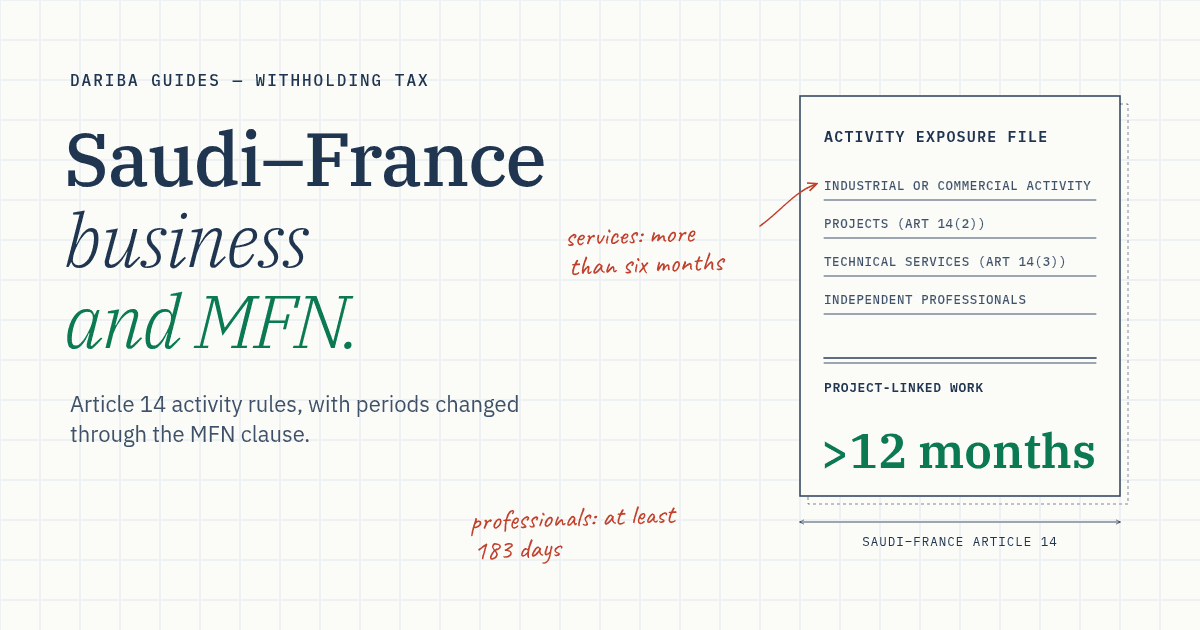
The treaty’s actual definition and the transaction must decide whether Article 8 applies. A domestic category and a treaty category can require separate analysis. If the payment is a service or another income type, use the appropriate provision rather than borrowing a royalty outcome. The France business-activities guide explains the separate Article 14 framework.
Source: ZATCA’s Arabic treaty publication, Article 8(3), p. 6, read with the authentic French publication, Article 8, p. 4, and ZATCA’s treaty-withholding circular, section 3.2.10, p. 12.
Read Article 8 with the specific ZATCA explanation
Article 8(1) allocates the stated royalty income to the recipient’s residence State; paragraph (2) sets out the effective-connection exception and directs the analysis to Article 14. The published French and Arabic texts should be read as a whole. ZATCA’s Policy W-24-38 expressly explains residence-State exclusivity and the source-State connection exception.
Dariba analysis: this is an allocation rule, not a treaty table imposing an ordinary 5%, 10% or 15% royalty ceiling. The domestic Saudi royalty rate and the treaty’s restriction of Saudi taxing rights are different steps. Do not import a percentage or definition from another country’s treaty.
Source: Arabic treaty Article 8(1)–(2), p. 6, French treaty Article 8, p. 4, and Policy W-24-38, p. 51.
Test the actual right’s connection with the recipient’s activity
Article 8(2) concerns the right or property for which the royalty is paid being effectively connected with industrial or commercial activity exercised in the source State by the recipient. It then applies Article 14.
The Saudi customer’s use of the licensed right in its own business does not, by itself, prove that the French licensor carries on the same activity. Equally, a French residence certificate does not independently establish that the licensor has no relevant Saudi activity or that the right is unconnected with it.
Dariba recommendation: identify the recipient’s activity, personnel and contractual functions, the right’s ownership and use, and the factual connection alleged. If the exception applies, perform the applicable Article 14 analysis, including attribution. Do not automatically replace that work with the gross domestic royalty rate or a generic presence threshold from another treaty.
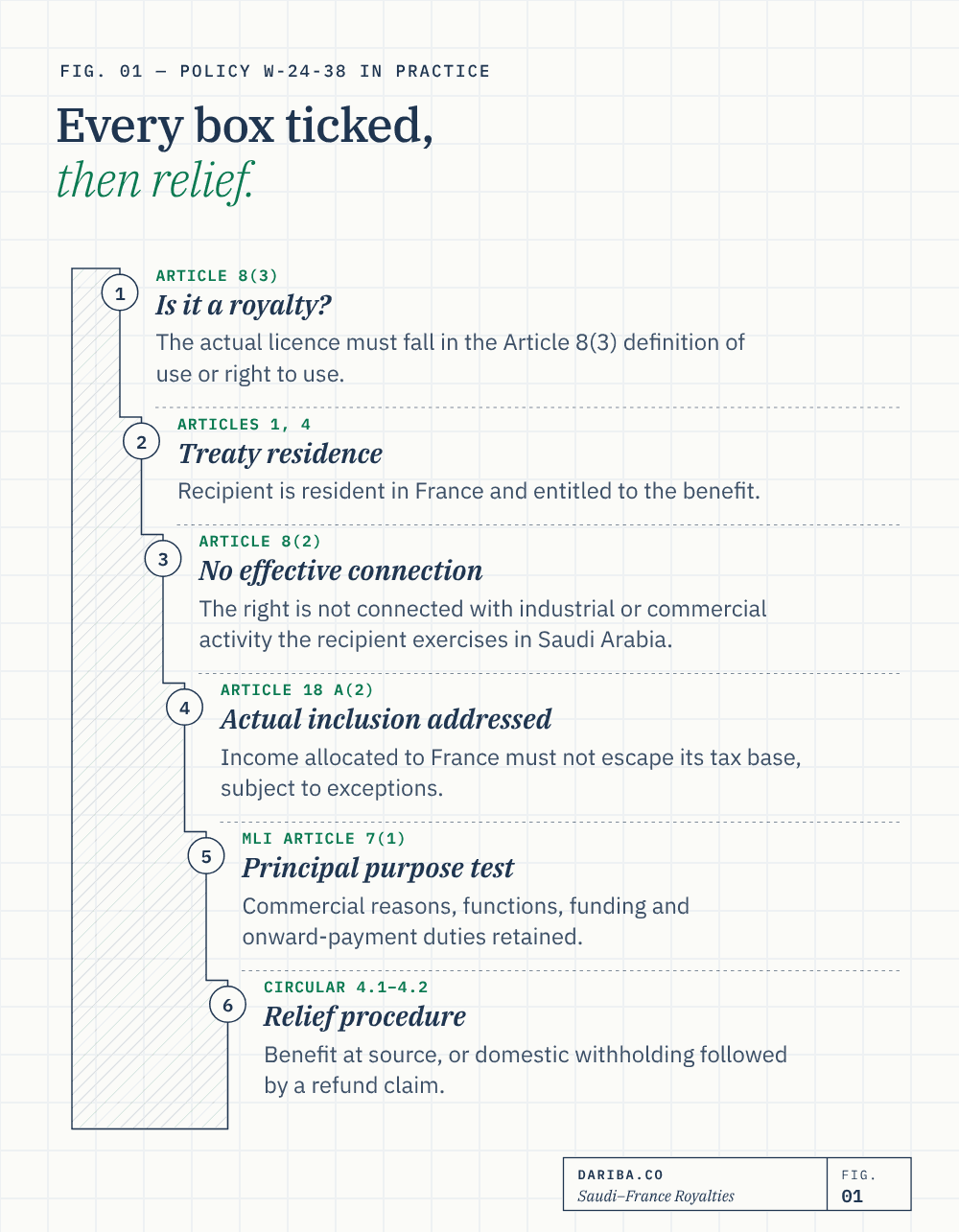
Source: treaty Article 8(2), Arabic p. 6, and Policy W-24-38, p. 51, read with Article 14 and the identified MFN framework.
Preserve the actual-inclusion safeguard
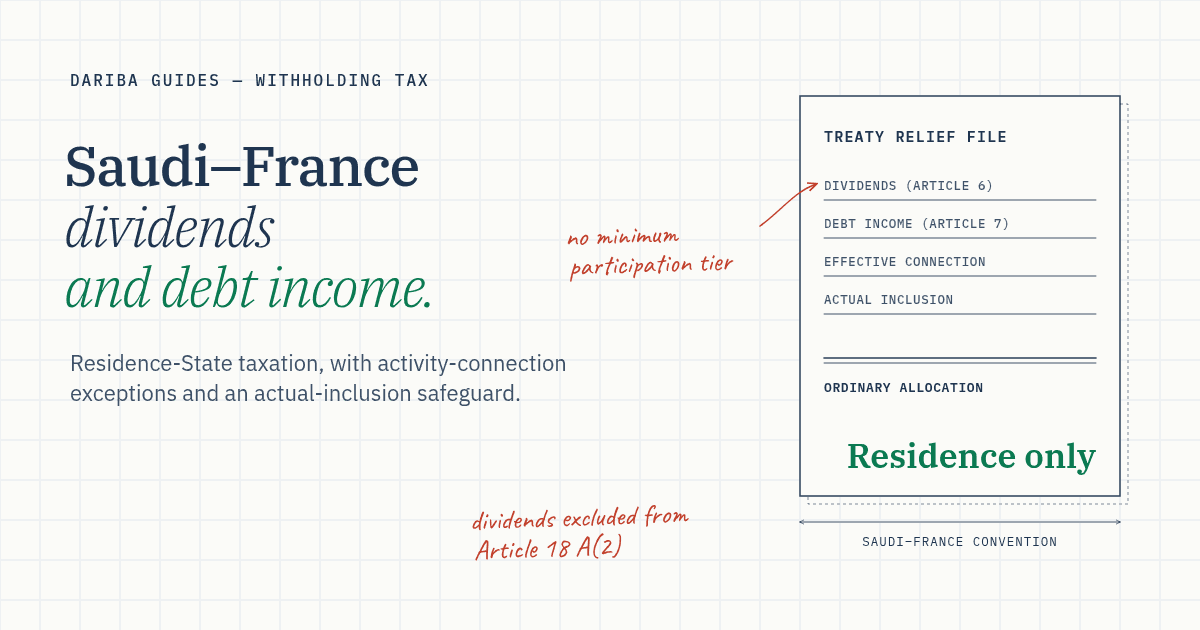
Article 18 A(2) addresses income allocated to the other State but not actually included in that State’s tax base, subject to its express exceptions. The paragraph excludes dividends from its scope; it does not express that same dividend exclusion for royalties.
Dariba analysis: the royalty policy’s explanation of Article 8 should not be treated as deleting Article 18 A(2). Establish the treatment of the actual income in France and any claimed express exception. Residence evidence and actual inclusion of a particular receipt are different facts. The selected wording should not silently be replaced by a universal requirement for positive cash tax on each receipt.
The dividend and debt-income guide explains the stated Saudi-citizen, more-than-50%-Saudi-owned-company and temporary investment-exemption exceptions. Those conditions retain their own scope; they should not be assumed from a group label or extended to every licence.
Source: treaty Article 18 A(2), consolidated p. 16.
Apply the anti-abuse rule to the actual arrangement
The MLI Article 7(1) principal-purpose test remains part of the applicable benefit analysis. Considering all relevant facts and circumstances, it can deny a benefit obtained through an arrangement or transaction where that benefit was one of the principal purposes, subject to its object-and-purpose exception.
Dariba recommendation: retain the commercial reason for the licensing structure, recipient’s rights and functions, funding and payment trail, and any contractual obligation to pass amounts onward. A signed declaration is not a substitute for an arrangement’s actual facts. ZATCA’s general treaty-withholding guidance must also be distinguished from the precise wording of the France provisions.
Source: MLI Article 7(1), pp. 9–10, displayed in the French consolidated benefit provision, p. 5.
Compare domestic withholding with a supported treaty claim
Current Saudi Implementing Regulations Article 63 specifies a 15% domestic royalty rate within its stated scope. Dariba illustration: assume a Saudi-source payment correctly classified as a royalty, a gross amount of SAR 500,000 and no applicable domestic exception. The domestic baseline is SAR 75,000.
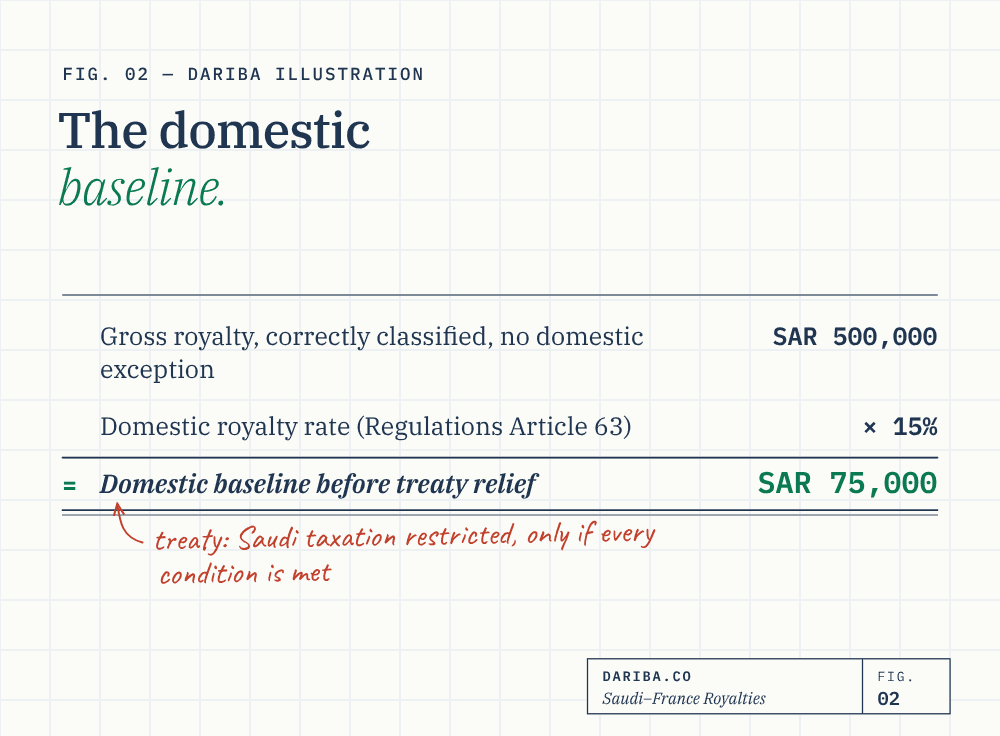
Where the France treaty’s residence, classification and other benefit conditions are met, no relevant Article 8(2) connection exists, Article 18 A(2) is addressed and the relief procedure is satisfied, Article 8 as explained in Policy W-24-38 restricts Saudi source taxation. This is a conditional legal analysis, not certification of an actual zero-withholding claim.
The illustration does not determine French tax, gross-up clauses, VAT, ownership of the intellectual property or the treatment of a separate equipment/service component. A failed condition requires the actual liability and procedure to be reconsidered.
Source: current Arabic Implementing Regulations, Article 63, pp. 34–35, read with the treaty and policy provisions identified above.
Complete the claim process and retain the decision
ZATCA’s January 2025 treaty-withholding circular, sections 4.1–4.2, distinguishes benefit at source from domestic withholding followed by a refund claim. Each route has its own documents and approval process. The relief and refund guide explains the residence certificate, approved forms, authentication/Apostille, undertakings and refund evidence with their qualifications.
Maintain the contract and classification memorandum, recipient/residence evidence, activity analysis, tax-base treatment where relevant, anti-abuse file, claim, actual approval and remittance/refund record. An acknowledgement is not itself a final approval or completed refund, and the royalty policy does not extend every filing or objection deadline.
This focused guide adds the current ZATCA policy to the France treaty analysis. Other payment categories, complete country/tool coverage, historical changes and actual claims remain subject to their own review.
Source: ZATCA treaty-withholding circular, sections 4.1–4.2, pp. 15–17.
Key takeaways
- Policy W-24-38 is included in ZATCA’s fourth edition dated September 2026.
- Its adoption date is 19 September 2024.
- Classify the actual licensed rights and payment components first.
- The effective connection concerns the recipient’s activity and relevant right or property.
- Actual-inclusion and anti-abuse provisions remain separate.
- Domestic withholding and the conditional treaty result are different steps.
Sources
- ZATCA: Saudi–France treaty, Arabic publicationArticle 8 at p. 6, read with residence, Article 14 and Article 18 A; the publication retains older MFN/MAP wording elsewhere and is not the complete MLI reading.
- ZATCA: Policies and Procedures on Major Dispute Items, fourth edition September 2026Introduction p. 2 and Policy W-24-38, adopted 19 September 2024, p. 51: specific France royalty allocation and effective-connection exception; explanatory policy does not amend legislation.
- French tax administration: authentic treaty compilation before MLI/MFN consolidationArticle 8, p. 4: royalty allocation, definition and activity-connection exception, read with the other authentic text and specific published Saudi policy.
- French tax administration: treaty consolidated for MLI and MFNReading aid, not authentic replacement. Article 8, Article 18 A(2), benefit/PPT and activity source notes remain separate.
- Saudi Income Tax Law, current Arabic textArticles 5 and 68: domestic source and withholding framework.
- Saudi Income Tax Implementing Regulations, current Arabic textArticle 63, pp. 34–35: domestic royalty classification/rate and stated scope, separate from treaty allocation.
- ZATCA: treaty withholding implementation circular, January 2025Section 3.2.10 on classification and sections 4.1–4.2 on benefit-at-source/refund procedures; general guidance is not a replacement for the France text.
- OECD: authentic English Multilateral InstrumentArticle 7(1) principal-purpose test, read with the matched treaty framework and consolidated source notes.
- OECD depositary: France deposited MLI positionRelevant covered-agreement/benefit framework checked alongside Saudi position; not complete later-position certification.
- OECD depositary: Saudi Arabia deposited MLI positionRelevant covered-agreement/benefit framework read with France; unilateral choices alone do not establish the modification.
- OECD depositary: current MLI signatories and partiesCurrent France/Saudi entry-into-force listing rechecked; entry into effect remains a separate question.
General information from selected official Arabic/French treaty texts, ZATCA policy, MLI and Saudi sources reviewed on 5 November 2026. Authentic instruments and actual facts, person, period, rights, activity, tax-base treatment and benefit/procedural conditions govern. Dariba illustrations are original. No complete France-country/tool schedule or individual relief claim is certified.