In brief
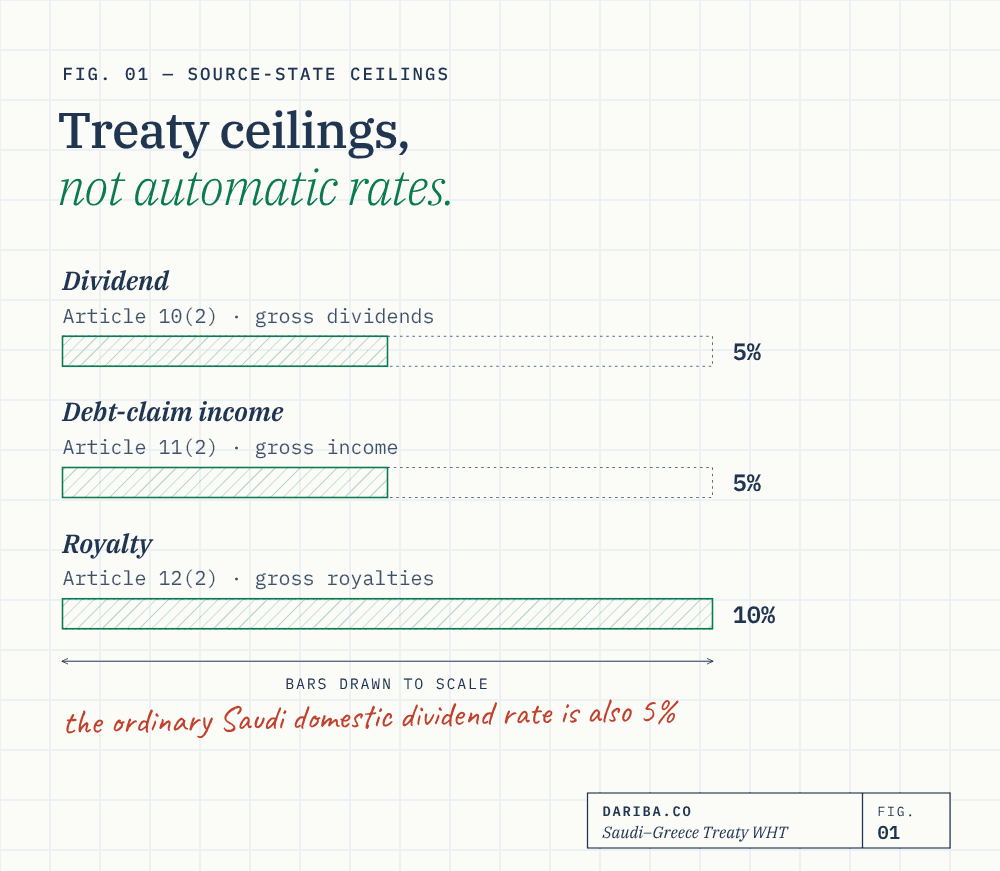
The Saudi–Greece Convention caps qualifying dividends and debt income at 5% and royalties at 10%. Income classification, effective connection and the principal purpose test can change the result.
A Saudi payer making a payment to a Greek resident should classify the payment under Saudi domestic law and the Saudi–Greece Double Taxation Convention. The domestic amount, treaty ceiling and evidence required for relief are separate parts of the calculation.
| Payment to a qualifying Greek beneficial owner | Treaty provision | Source-tax ceiling |
|---|---|---|
| Dividend | Article 10(2) | 5% of gross dividends |
| Debt-claim income | Article 11(2) | 5% of gross income |
| Royalty | Article 12(2) | 10% of gross royalties |
Identify the beneficial owner and any local connection
The 5% dividend ceiling uses residence and beneficial ownership. Article 10(2) sets no minimum capital percentage for that ceiling. The ordinary Saudi domestic dividend rate is also 5%. For debt income, Article 11(3) covers debt-claims and income treated as such under the source state’s tax law. Review guarantee fees and arrangement fees on their actual terms before applying that definition.
Article 27 exempts covered dividend, debt and royalty income derived by the Greek Government, including the Central Bank of Greece, or a wholly owned Greek State entity. It also covers gains from disposal of the holdings, claims or rights that generate that income. Verify the recipient and its status before applying the exemption.
The effective-connection clauses in Articles 10–12 can redirect the income to the relevant business-profit or independent-services rule where the holding, debt or right is effectively connected with a local permanent establishment or fixed base. Keep the contract and evidence showing where the asset is used or the debt is borne. The debt and royalty provisions also limit treaty treatment of amounts in excess of what independent parties would have agreed.
Classify mixed service and licence payments
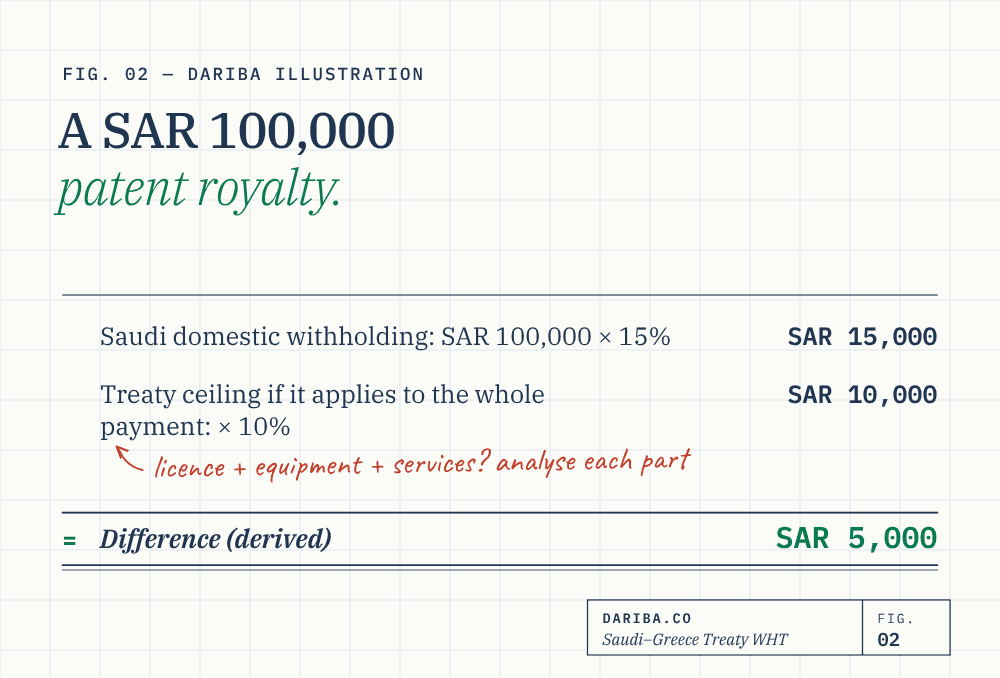
Article 12(3) defines the rights that can produce royalties. A contract that combines a licence, access to equipment and work performed by the supplier may require a separate analysis of each component. Dariba illustration. If a SAR 100,000 patent royalty is subject to 15% Saudi domestic withholding, the domestic amount is SAR 15,000. If the 10% treaty ceiling applies to the whole payment, the ceiling is SAR 10,000.
The OECD’s Sixth Peer Review Report on Treaty Shopping records the principal purpose test for this treaty through the Multilateral Instrument. Document the recipient’s role and the commercial purpose, and check the applicable period. Follow section 4 of ZATCA’s Tax Circular on Implementation of Withholding Tax Under the Double Taxation Agreement for relief at source or a refund.
Sources
- Saudi–Greece Convention for the Avoidance of Double Taxation and the Prevention of Tax Evasion with Respect to Taxes on Income and on Capital, with ProtocolArticles 10–12 and 27 and Protocol paragraph 2.
- ZATCA, Greece ConventionThe Convention entered into force on 1 May 2010.
- OECD Sixth Peer Review Report on Treaty Shopping, Saudi ArabiaThe Greece row records the principal purpose test through the MLI.
- ZATCA Tax Circular on Implementation of Withholding Tax Under the Double Taxation AgreementSection 4 on relief at source and refunds.