In brief
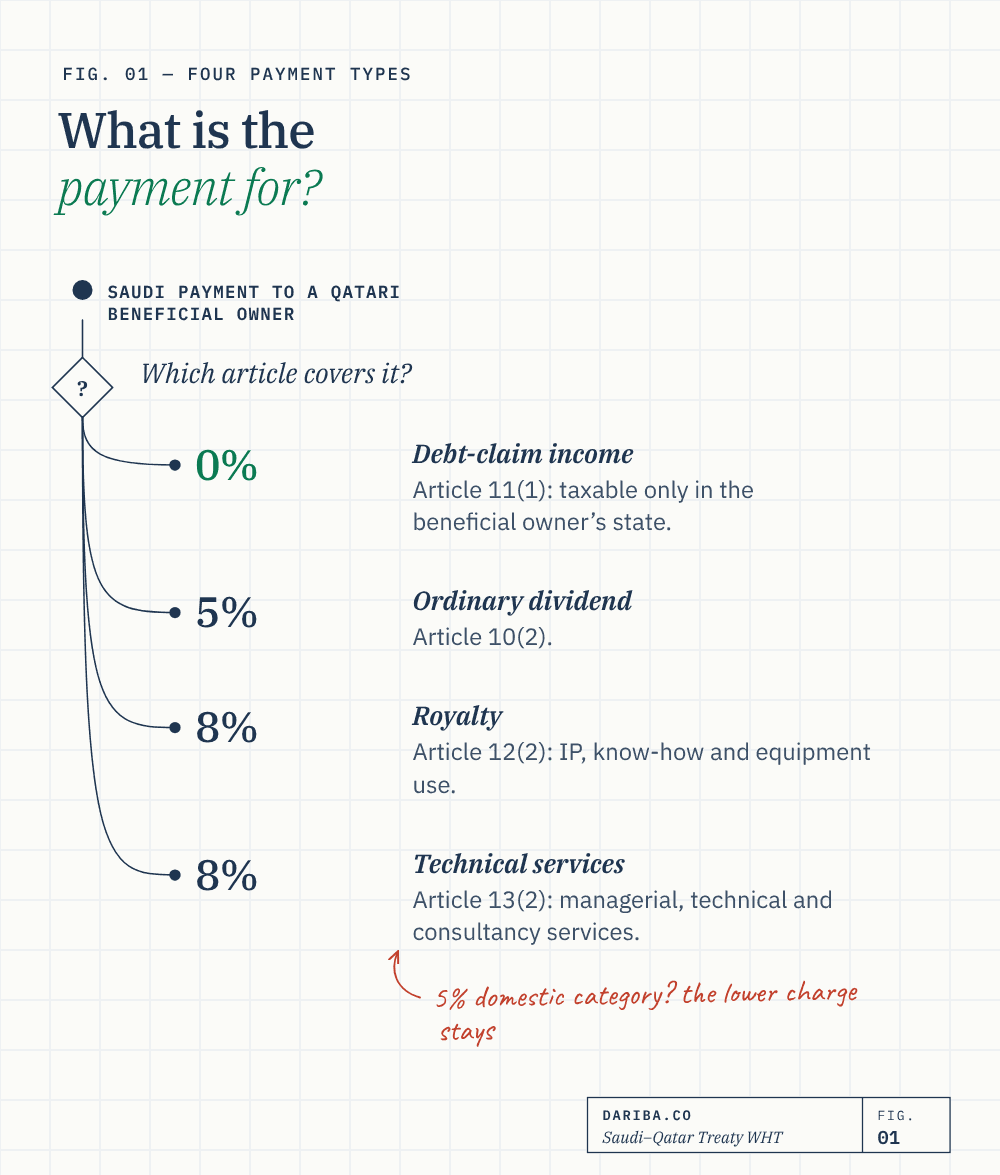
The Saudi–Qatar agreement has a 5% ordinary dividend ceiling, allocates qualifying debt income to the beneficial owner’s state, and sets separate 8% ceilings for royalties and technical services.
The Saudi–Qatar Double Taxation Agreement applies from 1 January 2026. A Saudi payer should classify each amount paid to a Qatari resident. A technology contract can include consideration for a licence, technical work and financing, and the Agreement treats those payments under different articles.
| Payment to a qualifying Qatari beneficial owner | Treaty provision | Saudi source-tax ceiling or allocation |
|---|---|---|
| Ordinary dividend | Article 10(2) | 5% of gross dividends |
| Qualifying debt-claim income | Article 11(1) | Taxable only in the beneficial owner’s state |
| Qualifying royalty | Article 12(2) | 8% of gross royalties |
| Qualifying technical-service income | Article 13(2) | 8% of gross technical-service income |
The applicable Saudi domestic rate still matters. For example, where the domestic category is subject to 5% withholding, an 8% treaty ceiling leaves that lower charge in place. Article 10(6) separately permits an additional tax on the specified permanent-establishment profits under domestic law, subject to a 5% ceiling on those profits.
Check debt income and licence rights
Article 11 allocates qualifying debt-claim income to the beneficial owner’s state. It excludes late-payment penalties from its definition and addresses effective connection and special-relationship excess separately. Review the agreement, payment flows and any Saudi permanent establishment or fixed base before claiming relief.
Article 12 includes qualifying intellectual property, know-how and equipment-use rights. Establish what the payer actually receives and how the contract allocates the price among rights and work. Review the effective-connection, source and special-relationship provisions before applying the ceiling.
Apply the technical-services article to the work and the payer
Article 13(3) covers managerial, technical and consultancy services. It excludes payments to the payer’s employee, specified teaching by or in an educational institution, and services paid for by an individual for personal use. Review the work, recipient and contract before using the 8% ceiling.
Article 13(4) addresses income effectively connected to a permanent establishment or fixed base. Paragraphs 5 and 6 address the payer’s residence and the establishment or fixed base that bears the obligation. Check both paragraphs where a Saudi resident contracts through a Qatari establishment. Paragraph 7 limits treaty treatment of related-party excess. A conclusion on whether the provider has a Saudi establishment leaves a separate question under Article 13 for a qualifying payment.
Article 29 contains the Agreement’s principal purpose test. Retain the residence and beneficial ownership evidence, the contract, any allocation and the commercial purpose of the arrangement. Use section 4 of ZATCA’s Tax Circular on Implementation of Withholding Tax Under the Double Taxation Agreement for the applicable relief route.
Sources
- Saudi–Qatar Agreement for the Avoidance of Double Taxation with Respect to Taxes on Income and the Prevention of Tax Evasion and Avoidance, official Arabic textArticles 1, 10–13, 15 and 29–30.
- ZATCA, Qatar ConventionEntry into force on 1 January 2025 and application from 1 January 2026.
- ZATCA Tax Circular on Implementation of Withholding Tax Under the Double Taxation AgreementSection 4 on the Saudi relief-at-source and refund routes.