In brief
VAT Law Article 12 and Regulations Article 9(2) turnover aggregation differ from group registration and related-party valuation. The Authority notice, group approval and supply-specific recovery condition lead to distinct results.
Related businesses can face three different Saudi VAT questions: whether turnover must be combined for registration, whether eligible persons can be treated as one VAT group, and whether a discounted supply must use fair market value. A conclusion under one route does not settle the others. The legal test, Authority action, relevant period and transaction evidence must be identified separately.
The VAT Law and its Implementing Regulations also use separate article numbering. Law Article 12 delegates related-person turnover aggregation and registration conditions. Regulations Article 12 concerns changes to, and dissolution of, an actual VAT group. Recording only “Article 12” can therefore point a finance team to the wrong decision.
Start with the decision and the correct instrument
| Question | Primary provisions | Result to establish |
|---|---|---|
| Must related businesses combine turnover for registration? | VAT Law Article 12; Regulations Article 9(2) | The actual notice, specified aggregation period and registration calculation for each person |
| Can eligible persons become one VAT group? | VAT Law Article 4; Regulations Articles 10–12 | Eligibility, Authority process, approved members and effective date |
| Must a discounted related-party supply use market value? | VAT Law Article 15(2); Regulations Articles 37–38 | Relationship, below-market value and incomplete recovery on the particular supply |
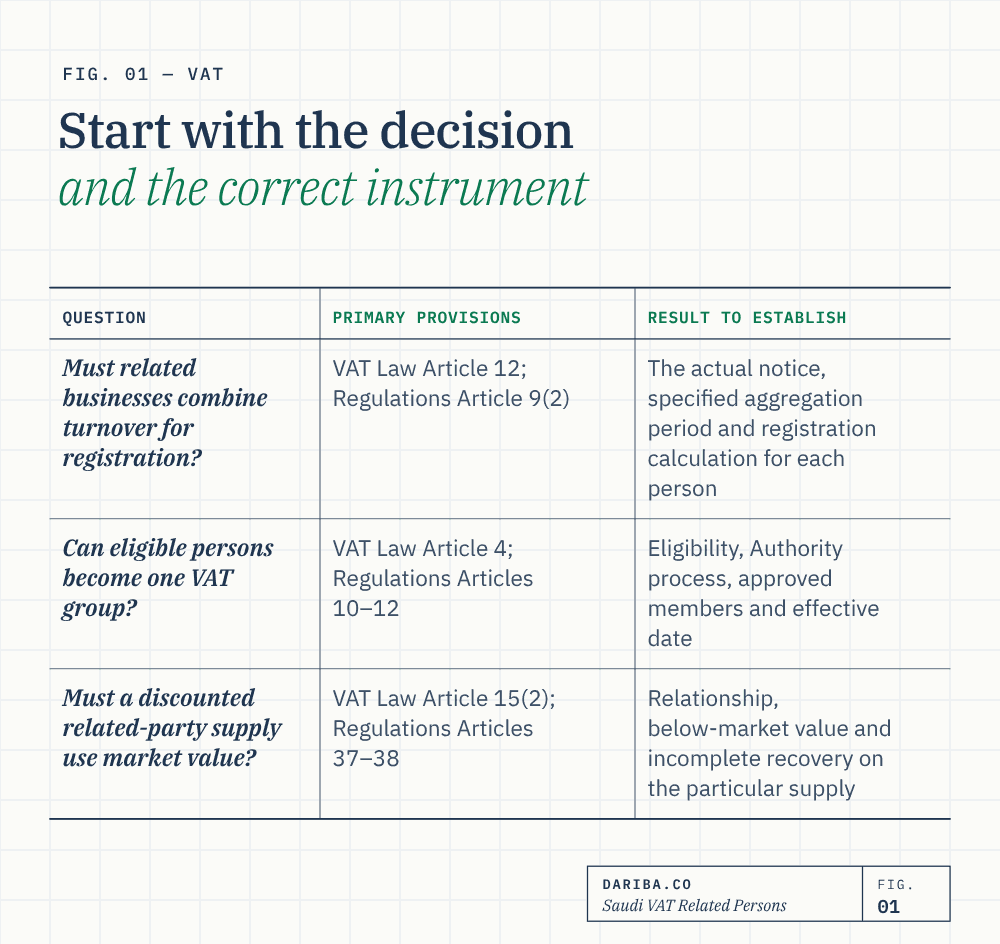
These routes have different consequences. Aggregating a turnover calculation does not itself issue a group certificate. A relationship does not itself disregard supplies, and a VAT number does not prove that a customer can fully recover VAT on every purchase.
Apply the notice-based turnover aggregation rule
VAT Law Article 12 provides for conditions governing aggregation of related persons’ turnover where they conduct similar or connected activities, and mandatory registration of each by reference to total turnover. Regulations Article 9(2) supplies the specific mechanism: ZATCA may issue a notice requiring two or more such related persons to aggregate their annual supplies during a specified period and use that total as the annual supplies value for each.
The Authority notice and its specified period are material. The paragraph does not say that every commonly owned business becomes a VAT group as soon as their combined sales cross a threshold. Equally, separately incorporated businesses should not assume that each can disregard a notice because its standalone turnover is lower.
Dariba illustration: assume two related Saudi businesses conduct connected activities and have qualifying annual supplies of SAR 240,000 and SAR 210,000. ZATCA issues an Article 9(2) notice covering the relevant calculation period and requiring aggregation. The combined amount is SAR 450,000. Subject to the actual supply-calculation and registration rules, that amount is used for each person’s test under the notice. It is not divided back between them merely to recreate their lower standalone figures.
The ordinary resident mandatory threshold is SAR 375,000, but the actual historical or expected-supply test, eligible supply population, application deadline and effective date still need to be established. This illustration does not supply the missing dates or determine that every accounting receipt is qualifying turnover. The registration guide explains those separate rules.
Establish an actual VAT group before changing invoices
Law Article 4 permits qualifying group registration and treats the registered group as one person. Regulations Article 10 requires eligible Saudi-resident legal persons and its actual ownership/control conditions, together with continuing eligibility and the specified exclusions. A natural person is not itself an eligible group member merely because that person owns the businesses.
The ownership wording matters. Article 10(1)(b) includes at least 50% of the stated capital, voting rights or market-value interests held directly or indirectly by the specified legal person or persons, as well as its control alternative. This should not be replaced by the “more than 50%” wording used in particular related-person limbs of Article 37. Nor should the percentage alternative be treated as removing the need to examine other eligibility conditions.
Regulations Article 11 requires the representative, application and supporting arrangements. Under paragraphs (5)–(6), formation ordinarily takes effect from the first day of the month after approval, or another later date determined by ZATCA; the Authority issues the group certificate and number and suspends previously registered members’ individual numbers. An internal board resolution or an aggregation notice does not substitute for that process.
Only supplies within the effective membership perimeter receive the applicable internal group treatment. External supplies and the group’s input entitlement remain relevant, including exempt activities and blocked costs. The VAT-group guide explains the application, current exclusions, change dates and source wording boundaries in more detail.
Use the relationship test for the actual valuation question
Regulations Article 37 addresses relationships for VAT purposes. Its categories include specified family, employment, partnership, management, ownership/control and common-control relationships, as well as the stated bankruptcy and endowment relationships. An accounting disclosure list is useful evidence but does not replace the actual statutory limb.
The specified ownership/common-control limbs use more than 50%. Exactly 50% does not satisfy such a limb by rounding. That does not establish that the persons are unrelated in every case: another statutory relationship or control basis may apply. The separate group test also retains its own wording and conditions.
Once relationship is established, Article 38(1) requires two further conditions for its market-value substitution: the agreed supply value is below fair market value, and the customer cannot deduct or recover all input VAT relating to that particular supply. A related customer’s mixed business does not automatically prevent full recovery on every directly attributable taxable-use purchase.
Dariba illustration: assume related persons agree SAR 10,000 exclusive of VAT for a standard-rated service; supported fair market value is SAR 15,000, and the recipient cannot fully recover VAT on that service. With all Article 38 conditions met, output VAT at 15% is SAR 2,250, compared with SAR 1,500 on the agreed net price: a SAR 750 difference. If the recipient can fully recover the VAT on that same service, the incomplete-recovery condition fails on those assumed facts. Relationship and a discount alone do not establish this uplift.
This illustration assumes the appropriate value has already been supported. Article 38(2)–(4) governs comparable supplies and the alternative valuation route; a supplier cannot simply select an attractive round number. The statutory VAT value also does not itself rewrite the parties’ commercial payment agreement. See the related-party valuation guide for evidence and official examples.
Keep intervention powers and membership liability separate
Regulations Article 12(8) permits ZATCA to require eligible persons that are not group members to be treated as a group from its specified date where their independent treatment produces, or will produce, tax advantages contrary to the Law’s purpose. That is a different power from Article 9(2)‘s notice-based aggregation of annual supplies.
Paragraph (7) separately permits the specified withdrawal of group treatment, cancellation or member exclusion. A routine commercial benefit from disregarding genuine internal supplies should not be labelled abusive without the applicable conditions and facts. Conversely, meeting an ownership percentage does not make an artificial recovery arrangement immune from review.
Law Article 4(3) and the implementing group provisions preserve joint obligations arising during membership. The representative’s filing role does not make the other members’ exposure disappear when a member later leaves. Keep the actual membership dates and liabilities connected rather than treating a corporate disposal as proof that all earlier group obligations have ended.
Maintain three connected evidence files
For aggregation, retain the related-person and connected-activity analysis, notice, specified period, qualifying annual supply reconciliation and each person’s registration position. For grouping, retain eligibility and control evidence, application, representative agreement, Authority decision, group number, effective dates and change notices. For valuation, retain the actual relationship limb, price comparison, received supply’s use and customer recovery evidence.
Dariba recommends reviewing the three files together when acquiring a business, splitting activities, changing ownership or introducing discounted management charges. That operating recommendation is not a new prescribed statutory form. The useful conclusion states which route applies, to whom, for which period, and on what evidence; “the companies are related” alone leaves those decisions unanswered.
Key takeaways
- Regulations Article 9(2) uses an Authority notice and specified period for related persons conducting similar or connected activities.
- Combined turnover for registration does not itself create an approved VAT group or disregard internal supplies.
- The group ownership test includes at least 50%; particular relationship limbs use more than 50%, and other control or relationship bases can matter.
- Article 38 market-value substitution also requires below-market pricing and incomplete recovery on the particular received supply.
- Regulations Article 12(8) compulsory group treatment is a separate intervention power from Article 9(2) aggregation.
- Record the correct instrument: VAT Law Article 12 and Regulations Article 12 address different questions.
Sources
- Saudi VAT Law, current official Arabic textArticles 4,12 and 15(2), pp.4–6: one taxable group person, membership-period joint obligations, related-person registration aggregation delegation and fair-market valuation delegation. Law12 and Regulations12 have separate subject matter.
- Saudi VAT Implementing Regulations, controlling Arabic textTenth edition April2025. Articles 9(2),10–12, pp.10–14, and 37–38, pp.35–36: specified-period notice, group eligibility/approval/intervention, relationship limbs and cumulative market-value conditions. Selected tests, not full legal certification.
General information only. Actual supplies, facts, applicable periods and controlling Arabic legislation determine the result. Official examples are distinguished from Dariba analysis and original illustrations. Seek advice or clarification where the arrangement or source material leaves a specific issue unresolved.