In brief
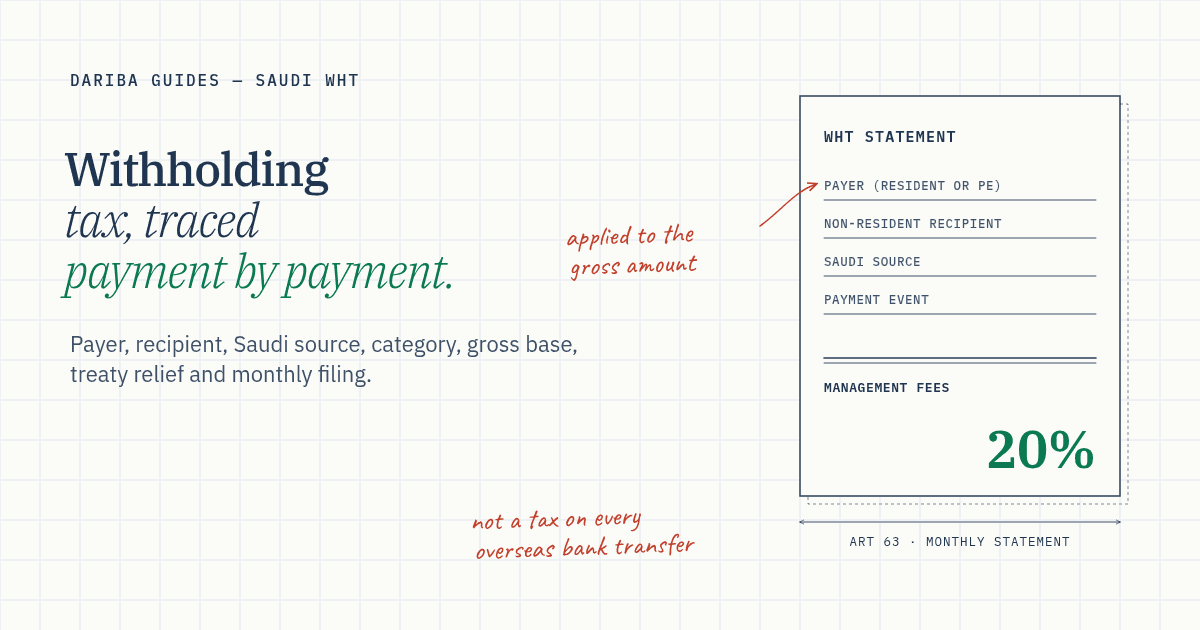
Qualifying air-ticket and air/sea freight payments carry a 5% domestic WHT rate. The definition distinguishes international departures, inbound freight and independent later delivery; recipient, treaty and permanent-establishment conditions remain separate.
Establish the payer, recipient and actual transport payment
Saudi withholding tax starts with the payment and the parties. Income Tax Law Article 68(a) addresses a resident payer, whether itself taxable or not, and a Saudi permanent establishment of a non-resident paying a non-resident Saudi-source income. A supplier’s transport label does not establish every part of that test.
Identify the contracting carrier, recipient, residence, any Saudi permanent establishment, journey and contractual obligation. Payment through a local agent needs the actual agency and recipient analysed; a local collection address does not by itself turn the foreign carrier into a Saudi resident. Equally, a payment to a resident supplier is not automatically a payment to a non-resident merely because that supplier uses foreign subcontractors.
Source: Income Tax Law Article 68(a), p. 29. The WHT overview explains the wider scope and the permanent-establishment guide addresses that separate enquiry.
Apply the defined air-ticket and freight category
The current Regulations Article 63(4), p. 35, covers payments to purchase international travel tickets departing from the Kingdom, or air/sea freight charges paid to air/sea carriers or their agents or representatives in the Kingdom. It expressly excludes amounts paid to ship goods from abroad to ports in the Kingdom.
Law Article 68(a)(4) and Regulations Article 63(1) specify 5% for the qualifying category. The rate applies after establishing the payment’s scope and source; it is not a universal tax on every logistics invoice.
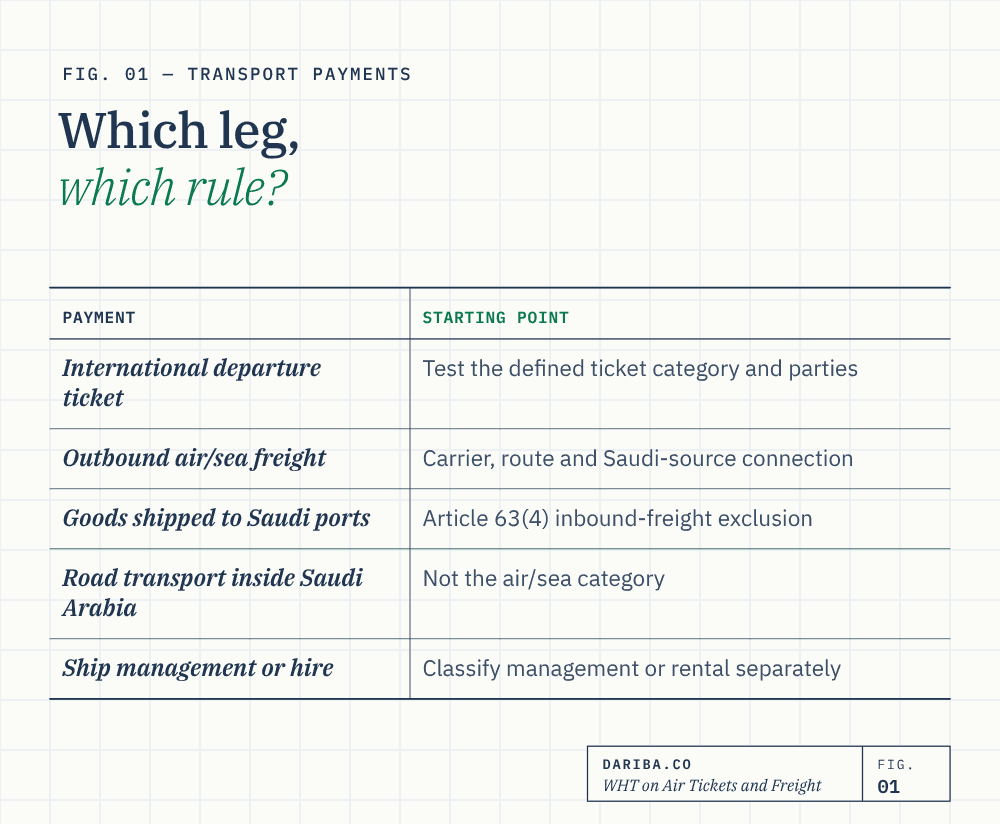
| Actual payment | Starting point for the review |
|---|---|
| International departure ticket from Saudi Arabia | Test the defined ticket category, non-resident recipient and payer conditions. |
| Outbound air/sea freight | Review the carrier, contractual route and Saudi-source connection. |
| Goods shipped from abroad to Saudi ports | Preserve Article 63(4)‘s express inbound-freight exclusion. |
| Separate transport within Saudi Arabia by road | Do not extend the air/sea category solely because the invoice forms part of a logistics package. |
| Ship management or vessel hire | Classify the actual management or rental payment separately from carriage. |
Sources: Regulations Article 63(1), p. 34, and 63(4), p. 35; ZATCA’s General Guideline for Withholding Tax, second version May 2026, definitions p. 5 and rates p. 28. Decision 25’s original annex, p. 15, expressly adds the international-departure wording to Article 63(4); the current definition is not inferred from the older table.
Separate inbound freight from work performed inside the Kingdom
The inbound-freight exclusion does not decide the treatment of every service connected with imported goods. Regulations Article 5(7), p. 6, separately addresses goods-supply contracts, including shipment and insurance, and the associated works actually performed inside the Kingdom. Internal transport, installation, maintenance and training require their own analysis under that provision.
Dariba recommendation: reconcile the freight contract, goods invoice and separately contracted Saudi services. Preserve the inbound leg’s exclusion while identifying the recipient, work, location and consideration for any additional service. A single invoice heading does not settle all components, and a separately priced service should not be reclassified as excluded inbound freight merely because the goods came from overseas.
The guideline’s section 3, p. 28, identifies land transport within the Kingdom at 15% where the WHT conditions apply. That does not impose withholding on every payment to a Saudi resident road carrier. The payer and non-resident-recipient tests remain essential.
Read the delivery obligation before splitting an outbound journey
ZATCA’s May 2026 guideline, section 2.2.2.2, Example 9, p. 27, considers parcels shipped from Saudi Arabia to foreign collection points, followed by delivery elsewhere abroad. The example does not make the foreign collection point an automatic end to the Saudi-source shipment.
Where the shipping company has undertaken delivery to the final destination abroad, the example treats the later legs as part of one continuing shipment, even when carried out in stages by more than one carrier. If its obligation ends at the foreign port and the later delivery is an independent operation, the example distinguishes that later operation from the Saudi activity.
Dariba analysis: the relevant evidence includes the promised destination, through bill, subcontracting arrangements and which party bears the final-delivery obligation. A change of aircraft, ship or subcontractor does not, by itself, reproduce the example’s independent later-delivery facts. Conversely, the example is not authority to treat every separately arranged foreign-to-foreign shipment as Saudi-source income.
Source: ZATCA guideline, Example 9, p. 27, read with the Law’s Article 5(a)(8) service-source rule and the actual contract.
Do not use the vessel’s flag as a withholding exemption
The same guideline’s Example 10, p. 27, asks about commercial vessels and oil/gas tankers flying Saudi or GCC flags. Its analysis turns on the person carrying on the shipping activity, rather than the flag alone. It distinguishes a resident Saudi company’s own income and annual return from payments to non-resident operators for shipping from Saudi ports.
The example also identifies withholding on a resident company’s payment for vessel hire where the lessor is non-resident. That is a distinct payment from the customer’s freight charge. The current table separately addresses rent, while management fees have their own definition and 20% rate. Applying a freight label to vessel hire or ship management does not establish the appropriate category.
Dariba recommendation: identify the owner, operator, charterer and contracting carrier, and distinguish the payment flows. A Saudi/GCC flag, a local agent and a Saudi customer are different facts; none alone resolves residence, source, treaty entitlement or the actual payment category.
Keep gross-payment withholding separate from an estimated income-tax base
Regulations Article 63(8) applies the relevant withholding percentage to the full payment within the provision, without deducting the recipient’s costs. Regulations Article 16(1), p. 15, separately contains a 5% estimated tax-base measure for the specified foreign airline and land/sea transport branches. That base is then subject to the applicable income-tax rate; it is not the Article 63 withholding percentage.
Dariba illustration: assume an otherwise in-scope gross freight payment of SAR 200,000, a 5% domestic withholding rate, no treaty reduction and no contractual gross-up. Withholding is SAR 10,000, leaving SAR 190,000 to the recipient. Applying 5% to the payment and then 20% to that result would produce SAR 2,000, but would mix two different tax mechanisms and is not this WHT calculation.
These figures are Dariba assumptions, not amounts in ZATCA’s Examples 9–10. They do not establish the result for a transport branch, a treaty-protected carrier, a package containing different services or an agreed net-of-tax price.
Sources: Regulations Articles 16(1), p. 15, and 63(8), p. 35. See the estimated-assessment guide for that separate base calculation.
Review treaty protection and permanent-establishment attribution separately
International-transport provisions in an applicable tax treaty may affect the domestic result. Establish the actual treaty, eligible resident enterprise, type of operation, relevant payment and procedural evidence. A generic reference to an international-traffic article does not prove that a particular airline, freight intermediary, charter arrangement or road service meets its conditions.
Law Article 68(f) also addresses a payment directly connected with the business of a non-resident’s Saudi permanent establishment, and Article 68(g) addresses credit for withholding on an amount included in a taxpayer’s base. A local representative is not, by itself, a determination that those conditions are met.
Use the treaty-relief and refund guide with the actual treaty and recipient documents. This guide does not certify a carrier’s treaty residence, international-traffic exemption or permanent-establishment attribution.
Build the evidence and filing record from the actual payment chain
Keep the contract, itinerary or bill of lading, origin and final destination, carrier/agent identities, payment records, residence evidence and any treaty-relief file together. Document why a later foreign delivery is independent, or why it remains part of the original obligation. Separate goods, inbound freight and additional services where the actual arrangements support that separation.
Law Article 68(b) and Regulations Article 63(9) govern payment, statements, certificates and records. The WHT compliance guide explains the monthly and annual obligations. Classification work needs to reach the payment team before settlement so that the actual gross amount, rate, contractual burden and filing period agree.
The VAT treatment of a ticket or freight service is a separate enquiry. A VAT zero rate does not establish exemption from income-tax withholding, and a WHT conclusion does not establish VAT recovery or international-transport zero-rating conditions.
Key takeaways
- Start with the actual payer, non-resident recipient and source.
- Article63(4) specifies international departures from Saudi Arabia and excludes inbound freight to Saudi ports.
- A foreign collection point does not automatically end a continuous delivery obligation.
- Saudi or GCC vessel flags do not alone establish a WHT exemption.
- The 5% WHT rate and the separate 5% estimated transport tax-base measure are different mechanisms.
- Treaty eligibility, permanent-establishment attribution and VAT treatment require separate analysis.
Sources
- Saudi Income Tax Law, current Arabic textArticle 5(a)(8),p.6; Article 68(a)–(b),p.29 and 68(f)–(g),p.30:source,payer,5%transportcategory,complianceandPE/creditconditions.
- Saudi Income Tax Implementing Regulations, current Arabic textArticle 5(7),p.6;16(1),p.15;63(1),p.34;63(4),(8),(9),pp.35–36:category,exclusion,grossbase,complianceanddistinctestimatedbase.
- ZATCA General Guideline for Withholding Tax, second version May2026Definitions,p.5;section2.2.2.2,Examples 9–10,p.27:continuousshippingversusindependentdeliveryandoperatorversusflag;section3,p.28:rates. OfficialexampleskeptseparatefromDaribaarithmetic.
- Umm Al-Qura issue4998, Ministerial Decision 25 annexArticle 63(4)amendment,p.15:internationaldeparturesfromKingdomexpresslyspecified;inboundfreightexclusionretained. Electronicpublication27/2/1445 distinguishedfromprintedissue15September2023.
General information only. Actual supplies, facts, applicable periods and controlling Arabic legislation determine the result. Official examples are distinguished from Dariba analysis and original illustrations. Seek advice or clarification where the arrangement or source material leaves a specific issue unresolved.