In brief
Analyse actual dividends, liquidation surplus, branch transfers, hydrocarbon exceptions, estimated profits and treaty conditions under current Saudi rules.
A distribution to a non-resident shareholder can carry Saudi withholding even where the distributing company has already paid income tax. Establish the actual distribution, recipient and payment event before calculating the current 5% domestic dividend category. A proposed dividend, a financing return and repayment of capital are not interchangeable transactions.
Identify the statutory distribution category
Current Arabic Income Tax Implementing Regulations Article 63(6), p. 35, includes distributions by a resident company to a non-resident shareholder and profits transferred by a permanent establishment to related parties. Article 63(1), p. 34, specifies the 5% domestic dividend rate for payments within scope.
ZATCA’s General Withholding Tax Guideline, second version May 2026, explains the rate table in section 3, p. 28. The payer, recipient and relevant withholding scope still require assessment; the rate is not imposed indiscriminately on every shareholder account movement.
Distinguish company income tax from distribution withholding
Article 63(6)(c) expressly preserves withholding on the distribution notwithstanding the distributing company’s income-tax liability. These concern different taxable events and should be modelled separately.
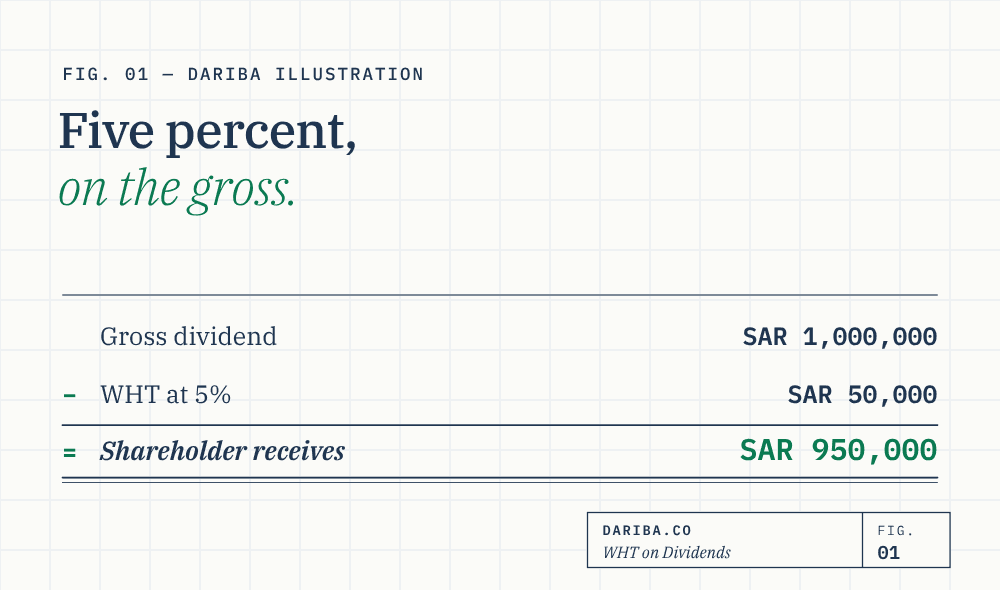
Dariba original illustration: assume SAR 1 million is an actual gross dividend within the 5% domestic category, with no treaty or specific relief. WHT is SAR 50,000 and the shareholder receives SAR 950,000. This assumes an amount available for distribution; it does not calculate the company’s income tax or certify that every investor’s profit is subject to the same corporate-tax treatment.
The company’s Zakat or income-tax position, distributable reserves and shareholder entitlements require their own analysis. Withholding payment does not establish that the distribution was legally authorised.
Read the hydrocarbon exception within its actual scope
Article 63(6)(a) excludes the stated distributions in companies operating in natural-gas investment, oil or hydrocarbon activities. Guideline section 4, p. 29, repeats the exception.
Confirm the actual entity and qualifying activity. An ordinary supplier to an oil company, an investor using an energy-related name or an unrelated service fee does not obtain this dividend exception merely by association with the sector.
Dariba recommends retaining the legal and operational basis for relying on the exception. Do not extend it to all payments by the group or invent a commercial-policy explanation as a statutory eligibility test.
Liquidation requires capital and surplus reconciled
Article 63(6)(b) treats partial or complete liquidation as a distribution to the extent it exceeds paid-in capital. An amount called liquidation proceeds therefore requires its components identified.
Dariba original assumptions: SAR 1.2 million liquidation proceeds include SAR 1 million substantiated paid-in capital and SAR 200,000 relevant surplus distributed to a non-resident shareholder. At 5%, without relief, withholding on the assumed surplus is SAR 10,000. This is not a rule that every capital repayment or sale of shares is a dividend.
Keep the paid-capital history, ownership, liquidation accounts and actual entitlement. A shareholder loan or capital-gain transaction needs its own classification rather than being included or excluded solely by its accounting label.
Branch profit transfers and estimated profits need separate facts
The Article 63(6) definition includes actual permanent-establishment profit transfers to related parties. It does not make all payments to headquarters dividends: actual technical services, management fees and allocated premiums have their own analysis.
Guideline section 4, p. 29, also addresses estimated profits. Its stated exceptions include actual payment/offset, the taxpayer’s own estimated return, undeclared revenue/contracts, missing books, failure to file, absence of Saudi bank accounts, evasion/avoidance audit cases and written agreement to taxation. Do not shorten this into either all estimated profits are exempt or every assessment automatically proves a cash distribution.
Reconcile the assessment basis, actual settlement and relevant stated exception before calculating. A statutory estimated basis is not a substitute for identifying an unrelated service invoice’s category.
Establish the actual payment event
Guideline p. 17 discusses cash, in-kind payments and liability-discharging adjustments, offsets or settlements. A transfer through treasury or a netting account does not automatically postpone withholding until an international wire occurs.
Conversely, a proposal, declaration, unpaid accrual and completed settlement are not automatically the same event. Determine the legal and economic effect of the actual entry and shareholder entitlement; this article does not certify one universal trigger for all corporate procedures.
The compliance guide explains monthly reporting, the actual official deadline and annual information. Preserve the settlement evidence supporting the reported month.
Treaties require the actual shareholder and applicable article
Guideline section 4, p. 29, recognises possible treaty exemptions or reductions. Check the current agreement, payment period, actual recipient, residence, ownership/entitlement conditions, relevant permanent-establishment connection and required relief procedure.
A residence certificate alone does not prove every condition. Nor should a treaty outcome for an incorporated subsidiary be assumed identical for a branch profit transfer without reading the agreement.
No country-specific rate or automatic refund is certified here. A change in shareholder, ownership percentage or legal recipient can require a fresh analysis before the next distribution.
Preserve a distribution-to-return file
Keep the corporate authorisation, accounts, actual shareholder, paid-capital/surplus reconciliation, qualifying-exception basis, treaty analysis, settlement, return, remittance and certificate. The main WHT guide connects these facts to payer and recipient scope.
Dariba recommends reviewing the proposed distribution before settling it. Clear documentation of what is distributed and why an exception or treaty applies provides more support than carrying forward the previous year’s rate code.
Key takeaways
- Actual distributions to non-resident shareholders use the current 5% domestic category unless relief applies.
- Company income tax and distribution withholding concern separate events.
- Liquidation surplus above paid-in capital requires a supported reconciliation.
- Branch transfers and estimated profits require their specific conditions assessed.
- Actual settlement and treaty entitlement require evidence.
Sources
- Official Arabic Income Tax Implementing RegulationsArticle 63(1),(6),(8)-(9), pp. 34–36: current dividend rate, definition, exceptions, gross base and reporting.
- ZATCA General Withholding Tax GuidelineSecond version May 2026, p. 17, 28-31: settlement, rates, distribution exception, eight estimated-profit cases and conditional treaties.
General information only. Actual supplies, facts, applicable periods and controlling Arabic legislation determine the result. Official examples are distinguished from Dariba analysis and original illustrations. Seek advice or clarification where the arrangement or source material leaves a specific issue unresolved.