In brief
Hotels and serviced visitor accommodation are excluded from residential exemption. A four-month stay can still be taxable; genuine homes and student residences differ. Taxable accommodation does not guarantee deduction of every cost.
Hotels and serviced visitor accommodation do not qualify as residential real estate under Article 30(3). A long stay does not automatically turn that accommodation into an exempt residential lease. Equally, the rule does not mean every furnished dwelling, every platform booking or every payment associated with a hotel has identical VAT treatment. Classify the actual supply, liable person and costs separately.
Apply the Article 30 category to the actual supply
Article 30(2) defines residential accommodation used or intended as a home, including the specified primary-residence and student cases. Paragraph (3) excludes hotels, inns, guest houses, motels, serviced accommodation and buildings designed to provide temporary accommodation to visitors/travellers.
ZATCA’s Real Estate Sector guideline, issue 3.0 May 2026, section 6.1, pp. 14–15, explains these categories. Ordinary qualifying taxable Saudi accommodation is standard-rated at 15% when supplied by a person liable to account for it. A property’s ownership transfer, an exempt home lease and a guest accommodation service are distinct transactions.
Assess registration thresholds and each element of hotel-related revenue separately. Registration, the actual activity and supply, exemptions/outside-scope transactions and any deemed-supplier rules still need consideration.
Official example: the four-month traveller
The guideline section 6.1, Example 7, p. 15, describes a traveller occupying serviced apartments for four months. ZATCA treats the supply as taxable accommodation, because it is not a residential unit leased for regular residence. Four months does not itself satisfy the residential exemption.
Contrast Example 5, page 14: Abdullah regularly lives in his Al Khobar apartment during the working week while his family lives in Lebanon. Its residential lease is exempt. Example 6, page 15, treats school accommodation used by students during terms as a primary residence despite holiday absences.
Dariba analysis: duration is evidence within the actual arrangement, rather than a universal exemption threshold or an irrelevant fact in every case. The decisive legal categories concern a genuine dwelling/home and the excluded visitor accommodation. Neither a four-month stay nor a twelve-month contract supplies a complete answer alone.
Examine the rights, operator and use
Dariba recommends reviewing who contracts with the occupant, what rights are granted, intended and actual use, availability to visitors, services, pricing and operating arrangements. These are practical review questions grounded in the category distinction, not a published ZATCA scoring formula.
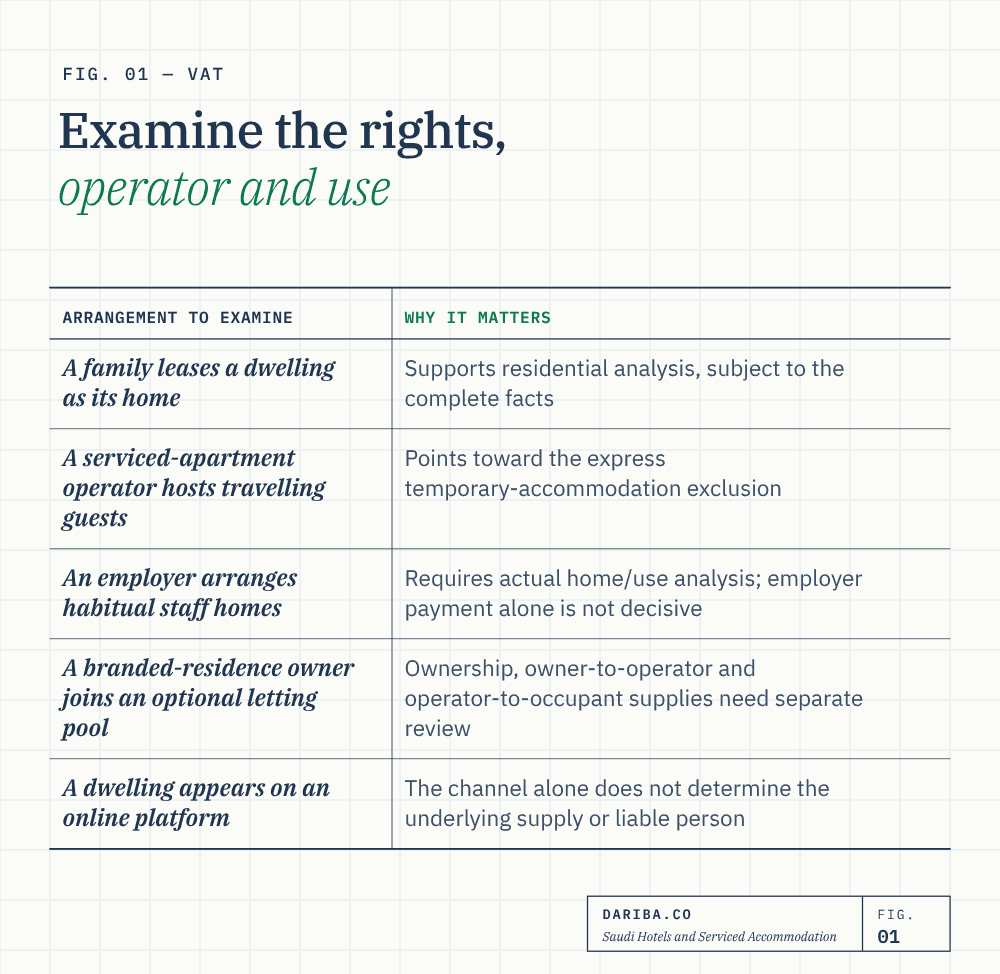
| Arrangement to examine | Why it matters |
|---|---|
| A family leases a dwelling as its home | Supports residential analysis, subject to the complete facts |
| A serviced-apartment operator hosts travelling guests | Points toward the express temporary-accommodation exclusion |
| An employer arranges habitual staff homes | Requires actual home/use analysis; employer payment alone is not decisive |
| A branded-residence owner joins an optional letting pool | Ownership, owner-to-operator and operator-to-occupant supplies need separate review |
| A dwelling appears on an online platform | The channel alone does not determine the underlying supply or liable person |
Reception, housekeeping or marketing can be relevant evidence, but the presence or absence of one feature is not an invented statutory safe harbour. Where the actual model falls between categories, resolve that uncertainty before promising an exempt price.
A building sale is different from operating accommodation
Article 30(1)(a)‘s ownership/disposal exemption extends across the specified property types, not only homes. The Real Estate Sector guideline sections 2–3, pp. 7–9, lists hotels and temporary accommodation as non-residential while distinguishing sale and rental treatment.
A qualifying transfer of a hotel building can therefore be VAT-exempt even though accommodation supplied there is taxable. That does not make construction, refurbishment, management or a sale of movable operating assets automatically exempt. Identify the property rights, business assets and actual transaction before selecting treatment; a qualifying transfer of economic activity under Article 17 has separate conditions.
RETT is a separate analysis. Do not treat it as input VAT in the operator’s VAT return or infer its outcome solely from the VAT classification.
Official hotel-operator examples identify the supplier
The Guideline for Agents under VAT Provisions, second version May 2026, section 9.4, requires examination of guest terms, contractual responsibility and supplier identity on invoices. In particular, responsibility for alternative accommodation or compensation when the hotel is overbooked helps identify who actually undertakes the guest supply. These are factual indicators, not a mechanical three-point scoring rule.
In section 9.4.1, Example 17, Abdullah leases his Riyadh hotel to Global Hotels for SAR 200,000 monthly plus VAT. Global contracts with guests in its own name and for its own account, and incurs its own supplier expenses. Global therefore charges VAT on guest accommodation and its other guest revenues. Ownership of the building does not make Abdullah the direct supplier to every guest.
Dariba calculation using the official lease facts: at 15%, the SAR 200,000 taxable lease carries SAR 30,000 VAT and a SAR 230,000 total. That owner-to-operator supply is distinct from Global’s guest supplies. It is not a second charge to the same guest for the same supply, and Global’s input recovery still requires the actual entitlement conditions.
Own-name operation can require reporting the full guest charge
Section 9.4.2, Example 18, describes Tariq’s hotel operated by Royal Hotels under his instructions. Royal remits 80% of revenues after approved expenses, retains its 20% entitlement and records only its entitlement in its accounts. A sign names Tariq as owner and Royal as operator, but guest and supplier contracts are in Royal’s name and the agency is not apparent to those parties.
The guideline treats Royal as supplying the accommodation to guests and charging VAT on the full amount. Its diagram also shows an owner-to-Royal accommodation supply on the owner’s 80% share. Preserve these two legs: reporting only the retained 20% would not reflect the stated own-name arrangement. VAT Law Article 9 supports the own-name treatment.
Dariba analysis: the settlement and financial-accounting presentation do not replace the VAT supply analysis. Do not treat the mere existence of an owner sign as disclosing the principal in the guest contract. Equally, the example does not establish a universal calculation for approved expenses, every revenue share or an assumed gross-versus-net formula. Reconcile the actual contracts and consideration before computing each leg; deduction remains conditional.
Disclosed ownership changes the supply chain on different facts
Section 9.4.3 instead describes the guest booking with the owner shown as supplier or agreeing to the owner’s terms. The owner supplies accommodation and issues guest invoices in its own name. The operator manages the hotel on the owner’s behalf without supplying accommodation to the guest in its own name; it accounts for its separate operation/management service to the owner.
This is different from Royal’s own-name facts. It is also different from a platform merely collecting a booking payment. Review the accepted guest terms, the owner/operator agreement, invoices and responsibility for performance together. The principal and agency guide explains the wider distinction; no choice of bookkeeping label can replace those facts.
Input recovery is conditional, including for a taxable hotel
Articles 49–51 still apply. Qualifying VAT on costs used for taxable accommodation may be deductible, but private/non-economic use, Article 50 restrictions, incorrect tax, insufficient evidence and exempt activities can change the result. A taxable hotel does not recover every invoice merely because its rooms bear VAT.
Dariba illustration — original assumptions: a registered operator has SAR 100,000 otherwise qualifying input VAT directly attributable to its taxable accommodation and SAR 8,000 of input VAT on expenditure that is actually blocked under Article 50. Eligible deduction is SAR 100,000, not SAR 108,000. The example assumes the classifications; it is not a blanket ruling on a named hospitality expense or every employee benefit.
The owner’s and operator’s costs may also belong to different taxpayers and supplies. Where a property owner makes an exempt supply to an operator, the operator’s taxable guest business does not automatically give the owner full input recovery. Analyse each person’s actual activity and contract.
Mixed activities and changes require separate calculations
First directly attribute inputs. Costs wholly for taxable supplies differ from wholly exempt residential units; shared inputs use the applicable Article 51 method. A room-revenue percentage is not automatically an approved substitute for the required method.
Qualifying buildings and improvements can also fall within Article 52’s capital adjustment framework. Moving from taxable accommodation to exempt residential use, or the reverse, needs the original deduction, asset classification, period and actual later event reviewed. It does not always mean simply repaying all original VAT or deducting all previously blocked costs immediately.
See the apportionment guide and real-estate capital analysis for the connected rules. Maintain the evidence of use changes and avoid applying two inconsistent adjustments to the same event.
Establish whether the owner or platform accounts for VAT
The registration rules consider the actual person, taxable supplies and relevant received supplies; different resident and non-resident rules apply. A single listed unit is not an automatic exemption, and a booking platform does not automatically replace the owner’s obligations in every arrangement.
Article 47’s actual/deemed-supplier rules may affect specified marketplace arrangements. Establish whether the platform is principal, agent or deemed reseller and who actually makes the accommodation supply. Do not decide solely from who collects the cash, or charge the same Saudi liability twice. The non-resident guide explains why platform labels alone are insufficient.
Price, invoice and document the classified supply
Dariba illustration: assume an ordinary standard-rated accommodation fee of SAR 1,000 exclusive of VAT, with no other charges in the example. VAT is SAR 150 and the total SAR 1,150. An inclusive price or separate additional services requires its own calculation; describing every receipt as room rent is not a classification method.
Use the invoicing and return rules applicable to the actual customer and transaction and retain the contracts, invoices, classification, use and deduction records under Article 66. Any other statutory fees need their own treatment considered. The objective is a coherent explanation of the supplies and costs, rather than a blanket conclusion that a hospitality label answers every VAT question.
Key takeaways
- Article 30(3) excludes hotels and serviced visitor accommodation from residential real estate.
- Duration is not a universal threshold; the actual home/accommodation arrangement matters.
- A hotel building sale and an operator's guest accommodation are different supplies.
- Taxable operations do not remove blocked, private-use, evidence or exempt-use input restrictions.
- Owner, operator and platform responsibilities must follow the actual supplies and applicable rules.
- Mixed activities, later use changes and capital adjustments need their own calculations.
Sources
- Controlling Arabic VAT Implementing RegulationsTenth edition April 2025. Articles 29-36, pp. 27-35; Articles 49-52, pages 48-54; relevant registration/correction/records distinctions. Arabic controls.
- ZATCA Real Estate Sector guidelineIssue 3.0 May 2026. Sections 2-3, pages 7-10; section 6 Examples 5-9, pages 14-17; sections 8-9, pages 19-24. Home, school, four-month traveller, optional parking and incidental disposal examples retain facts.
- ZATCA Input Tax Deduction guidelineThird version May 2026. Entitlement, restricted costs, direct attribution and shared-cost methods remain conditional; a taxable output or invoice alone is not full deduction.
- ZATCA Capital Assets guidelineSecond version May 2026. Article 52 analysis, original use, review cycles and changes remain separate. The earlier reviewed real-estate capital article is linked and unchanged in this batch.
- ZATCA Guideline for Agents under VAT Provisions, second version May 2026Section 9.1: travel agent capacity and separate commission; section 9.2, Example 15: 2019 platform facts at historical 5%; sections 9.4.1–9.4.3, Examples 17–18: hotel suppliers. Current-rate figures are separately labelled Dariba assumptions.
- Saudi VAT Law, official amended Arabic textArticle 9: supplies made or received in the intermediary’s own name on another’s behalf are treated as its own; current standard rate is distinguished from the historical example.
General information only. Actual supplies, facts, applicable periods and controlling Arabic legislation determine the result. Official examples are distinguished from Dariba analysis and original illustrations. Seek advice or clarification where the arrangement or source material leaves a specific issue unresolved.